
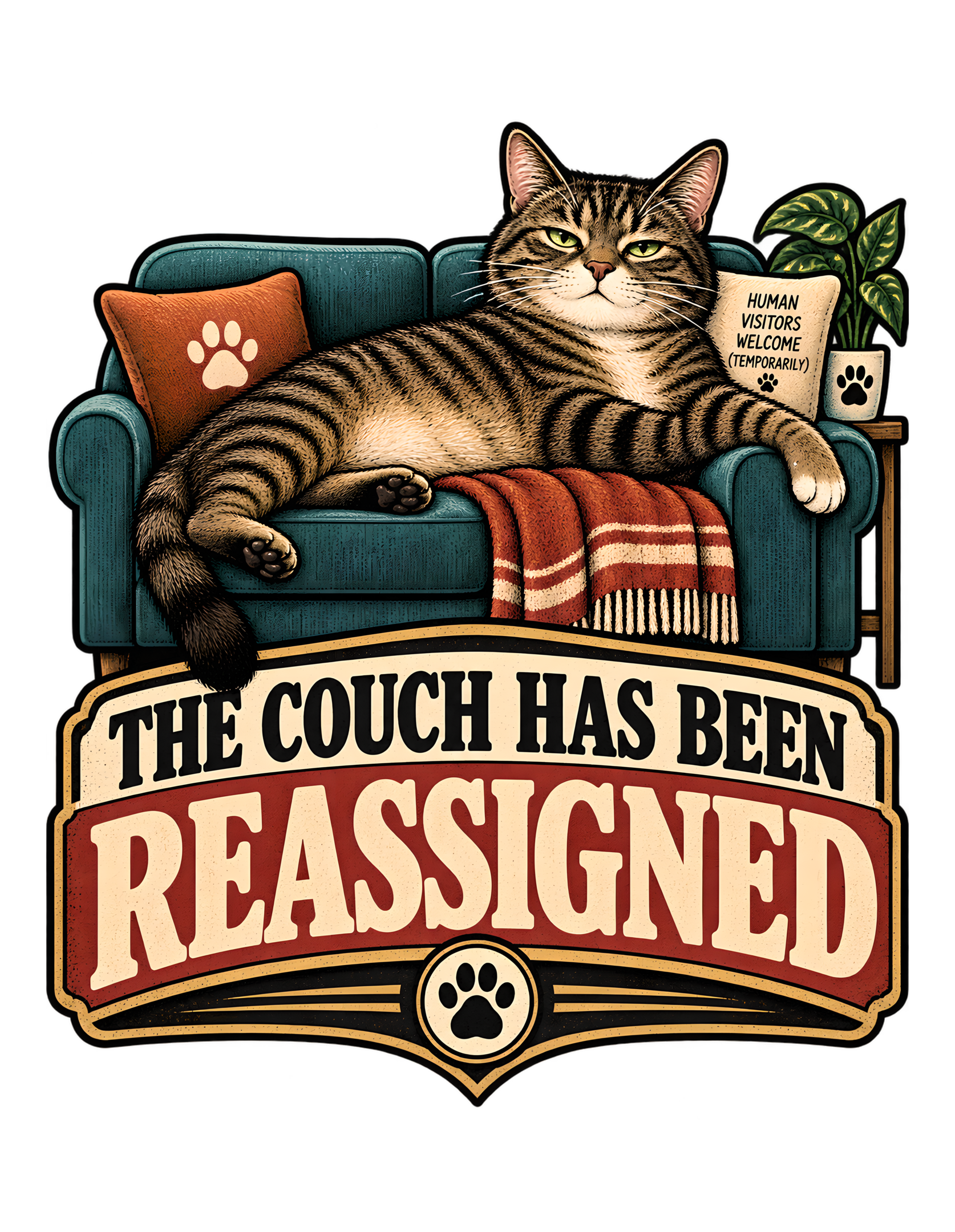
“THE COUCH HAS BEEN REASSIGNED” turns one of the most ordinary cat-and-human household negotiations into a formal transfer of property. The canonical concept is simple: a cat takes ownership of the couch and treats the human as a temporary visitor. The approved artwork makes that idea instantly readable by placing a relaxed tabby across a deep teal couch, occupying the cushions with the confidence of someone who has already completed the paperwork.
The visual joke depends on composure. The cat is not scrambling, fighting, or defending anything. It is stretched out comfortably, with a mildly unimpressed expression and one front leg draped over the armrest. The posture says the reassignment is settled. The humans, if they exist in this room at all, are now working from a revised seating plan.
The supporting details strengthen that reading without changing the basic joke. A rust-colored pillow with a paw motif, a striped rust-and-cream throw, a leafy plant, and a small side-table object create a recognizable home setting. A placard behind the cat reads “HUMAN VISITORS WELCOME (TEMPORARILY),” which pushes the ownership joke further: the couch is not merely occupied; the entire hospitality policy appears to have been rewritten from the feline point of view.
Below the scene, the large vintage-style phrase “THE COUCH HAS BEEN REASSIGNED” converts the cat’s relaxed pose into an official ruling. The comedy comes from the gap between what humans believe furniture is for and what the cat appears to believe ownership means.
This page treats the approved artwork as the factual visual authority and the canonical source as the factual concept authority. Everything beyond those elements is transparent Cats Judging Humans interpretation. The result is evergreen household satire about territory, seating, entitlement, and the remarkable ease with which a cat can turn shared furniture into a privately administered estate.
The Joke Begins With an Official Transfer of Something Humans Thought They Owned
The central joke is contained in the phrase “THE COUCH HAS BEEN REASSIGNED.” That wording does more than say a cat is sitting on a couch. It frames ordinary feline occupation as an administrative decision.
“Reassigned” is the crucial word. It implies that the couch already belonged to one department and has now been moved to another. The human may believe the couch is shared household furniture. The design presents a different conclusion: ownership has been reviewed, the asset has been reallocated, and the previous users were not consulted.
That bureaucratic framing gives the joke more structure than a simple “cat on couch” image. The phrase behaves like a notice issued after a policy change. It does not ask permission and it does not invite discussion. The ruling has already taken effect.
The approved artwork reinforces that interpretation because the tabby is not shown in a temporary or uncertain position. The cat is stretched across the couch with full-body confidence. It occupies the seat, the cushions, and the armrest like someone who understands that possession has become procedure.
Cats Judging Humans works especially well when familiar pet behavior is translated into human systems of authority. Here, a common household moment becomes a property transfer.
The human experience is instantly recognizable: the couch was purchased, placed, decorated, and perhaps even cleaned by people. The cat contributes nothing to those logistics and still appears to have final control of the asset.
That imbalance is the joke.
The couch has not been stolen.
According to management, it has been reassigned.
The source concept strengthens that interpretation by describing the couch takeover as a formal change of ownership rather than casual occupation. That gives the page a useful editorial boundary: the design is not making a factual claim about territorial behavior in cats generally. It is taking one visibly relaxed tabby and turning the ordinary act of occupying furniture into a mock administrative event. The humor therefore belongs to the language of procedure. The human does not lose the couch through conflict; the human discovers that the status of the couch has apparently changed while nobody was looking. That dry procedural gap is the core of the design.
The Relaxed Tabby Makes Ownership Look Effortless
The approved artwork centers a relaxed tabby cat stretched across the couch in a way that makes the ownership joke feel completely natural. The posture is broad, loose, and comfortable. The cat is not perched nervously on one edge or squeezed into a small space. It has settled across the furniture as though the entire seating area was designed around its dimensions.
That visual confidence matters because the concept is not about conflict. There is no visible struggle for the couch. The cat does not need to defend its claim. The pose suggests the dispute ended before the viewer arrived.
One front leg hangs casually over the armrest while the rest of the body occupies the main cushions. The head is upright, the eyes are narrowed slightly, and the expression reads as calm self-possession rather than aggression.
That is exactly the kind of posture that suits Cats Judging Humans. The cat does not need to perform dominance theatrically. It simply behaves as though the hierarchy is obvious.
The tabby markings also keep the image grounded in an ordinary house-cat reality. The scene does not require a fantasy breed, royal costume, or exaggerated character design. The humor comes from giving a familiar domestic cat an absurd level of administrative certainty.
That grounding makes the joke more relatable. Many viewers have seen a cat stretch across a chair, bed, sofa, or favorite human seat with no visible concern about prior claims.
The design turns that small daily experience into policy.
The cat is comfortable.
The human ownership model is not.
The cat’s body language also makes the takeover feel self-sustaining. Nothing in the pose suggests that the animal needs to perform for an audience or defend the couch through effort. The body is loose, the weight is settled, and the face remains composed. That lets the viewer project a very human idea—confidence in ownership—onto unmistakably feline posture. The approved artwork keeps the animal cat-first, which matters to the brand. The joke is not a person acting through a cat costume. It is an ordinary tabby behaving exactly like a cat while humans interpret the result as an organizational decision.
The Teal Couch Becomes the Main Piece of Evidence
The couch itself is essential to the design because the joke depends on a clearly recognizable piece of shared household furniture. In the approved artwork, the couch is large, upholstered, and deep teal, with rounded arms and broad cushions.
That gives the cat a substantial piece of territory to occupy.
If the cat were sitting on a small stool or a narrow chair, the phrase would feel less consequential. A couch implies shared space. It is built for more than one person. That makes the idea of a unilateral reassignment much funnier.
The cat’s body is arranged across the couch in a way that visually blocks ordinary human use. The animal does not need to cover every inch. It only needs to occupy the seat with enough confidence that the viewer understands the practical outcome.
The couch also gives the composition a stable visual center. Its teal color creates strong contrast with the cat’s brown-and-black tabby coat, the cream text elements, and the rust accents.
Cats Judging Humans uses furniture well when the furniture itself becomes part of the hierarchy. The couch is not just background scenery. It is the contested resource.
The approved art makes the resource look comfortable, desirable, and unmistakably claimed.
Editorially, the couch becomes a perfect symbol for the brand’s human-cat relationship. Humans buy furniture for themselves. Cats evaluate the purchase and determine the final user.
The design does not show a negotiation because the cat appears to believe there was never anything to negotiate.
Asset control has been clarified.
The couch also allows the concept to remain broad and evergreen. It is not a specialty object or a niche reference. It is familiar shared furniture, which makes the reassignment joke legible without explanation. The visual idea therefore scales from one household to another: people furnish a space for collective use, and the cat develops a different allocation model. The approved artwork does not need to show every cushion or define a precise boundary. The tabby’s relaxed sprawl is enough. Once the cat is visually established as the principal occupant, the phrase below can do the rest of the bureaucratic work.
The Draped Paw Over the Armrest Turns Comfort Into Authority
One of the most effective visual details is the cat’s front paw draped over the couch armrest. It is a small gesture, but it changes the entire attitude of the scene.
A cat curled tightly on a cushion might read as resting. A cat with one foreleg extended over the armrest reads as settled, expansive, and entitled to space.
The gesture has a human analogue without becoming humanized. People often use armrests to claim comfort and position. The tabby is doing something recognizably feline, but the composition allows the viewer to read it as executive ease.
That is a strong Cats Judging Humans technique: the cat remains fully catlike while the human viewer projects an organizational meaning onto the pose.
The paw also helps visually connect the cat to the couch as one integrated shape. The body does not merely sit on top of the furniture. It appears to belong there.
That matters because the phrase “reassigned” needs the image to support more than temporary occupation. The draped paw makes the cat look like a permanent administrator of the seat.
There is no tension in the limb. No urgency. No sign that the cat plans to move.
The casualness makes the joke stronger.
Cats do not need to file property records.
Sometimes one paw over the armrest is sufficient documentation.
That single paw also creates a strong bridge between domestic behavior and mock executive confidence. It remains anatomically and behaviorally feline, yet the viewer can read it as the equivalent of someone leaning back in a chair they have no intention of surrendering. This is exactly the kind of interpretation Cats Judging Humans relies on: the human brain supplies institutional meaning to a familiar cat pose. The artwork does not need to anthropomorphize the paw into a hand, point a finger, or stage a complicated gesture. The cat simply settles in. The human provides the paperwork mentally. That restraint keeps the joke cleaner and more believable.
The Mildly Unimpressed Expression Turns the Viewer Into the Visitor
The tabby’s face is central to the emotional tone. The eyes are narrowed and the expression is calm, composed, and slightly unimpressed.
That look matters because the design is not simply about furniture occupation. It is about judgment.
The cat appears aware of the viewer and entirely comfortable with the revised ownership arrangement. There is no embarrassment, apology, or uncertainty.
This shifts the viewer’s role.
Instead of looking at a pet that has taken over the couch, the viewer begins to feel like the person who has arrived at the cat’s couch and is waiting to learn whether access will be granted.
That is a subtle but important perspective reversal.
Cats Judging Humans often works by moving the human from owner to staff, guest, or applicant. Here, the couch joke becomes stronger because the cat’s gaze seems to evaluate the human rather than seek approval.
The expression is also what keeps the humor dry. A smiling cartoon face would make the design more overtly playful. The mildly unimpressed stare makes the humor feel official.
The cat behaves as though the reassignment was reasonable.
The human is the one who apparently failed to read the notice.
The facial expression gives the viewer just enough disapproval to feel evaluated without making the cat hostile. That balance keeps the joke playful and recognizably feline.
The expression also helps explain why the design avoids cruelty. The tabby is not sneering at a visible person or reacting with anger. It simply looks settled enough to assume that anyone questioning the arrangement is late to the decision. That mild superiority is central to the brand voice. The human viewer can recognize the joke without feeling that the image is attacking anyone. The cat’s stare is more like an administrative confirmation than a confrontation. In practical terms, the viewer has arrived at the couch, discovered that the seating chart has changed, and is now receiving a look that suggests the update should have been obvious.
The Visitor Placard Expands the Joke From Furniture to Household Policy
Behind the cat, the approved artwork includes a small placard reading “HUMAN VISITORS WELCOME (TEMPORARILY).”
That supporting detail pushes the concept beyond couch ownership.
The couch has been reassigned, but apparently the cat has also assumed authority over visitor status.
The word “temporarily” is especially useful because it adds conditions to human presence. The humans are not banned. They are simply no longer treated as permanent stakeholders.
This is classic Cats Judging Humans framing: the cat does not need to be cruel or hostile. It only needs to describe the household in terms that make human control sound less secure.
The placard also gives the main phrase a second layer. The large headline announces the transfer of the couch. The smaller sign suggests the transfer may be part of a wider governance model.
That creates a richer visual world without making the design dependent on long explanation.
The couch is feline territory.
Humans may visit.
Duration of access remains subject to review.
The temporary-visitor wording also broadens the joke beyond seating. Once the viewer accepts the sign, the cat appears to be administering the entire room rather than only one cushion.
The small placard is also effective because it gives the viewer a second level of information after the main joke lands. At a glance, the cat and couch communicate ownership. On closer inspection, the visitor language extends that ownership into hospitality policy. The artwork therefore rewards attention without making the secondary text carry the concept. The parenthetical “temporarily” is especially dry because it implies that human access is conditional even when it is allowed. That turns the household into a lightly regulated feline institution. The cat never has to move, speak, or gesture. The sign quietly does the additional administrative work.
The Paw-Motif Pillow Quietly Marks the Territory
A rust-colored pillow with a cream paw motif sits on the couch behind the cat.
It is a small decorative element, but it strengthens the sense that the space has been visually claimed.
The pillow does not need to say the cat’s name or display a logo. The paw symbol is enough to suggest that the couch’s identity has been adjusted to match its current administrator.
That matters because the overall design works best when the environment supports the joke without becoming crowded.
The pillow adds color, texture, and thematic reinforcement while remaining secondary to the cat and main phrase.
It also helps create a believable domestic setting. This is still a home. The joke does not require a fantasy throne room or corporate office.
The human household remains visible in the details.
The cat simply appears to have completed a quiet rebranding exercise.
Cats Judging Humans thrives on that kind of reinterpretation. A normal decorative object becomes evidence that the cat’s authority has reached the furnishing stage.
The humans may still recognize the room.
Management has updated the visual identity.
The pillow works as a subtle territorial marker because it feels plausible inside the room. It supports the feline theme without becoming a separate advertising element.
The paw motif on the pillow also supports the idea of reassignment without requiring literal ownership labels. It makes the couch look as though it has already been decorated according to feline preferences. That is more elegant than adding another large joke or sign. The design gains from these smaller visual confirmations because the viewer can discover them in sequence. First the tabby occupies the couch. Then the headline declares the reassignment. Then the pillow, placard, and other details suggest that the change has spread into the room’s identity. Management has not merely taken a seat. Management appears to have updated the décor.
The Rust-and-Cream Throw Makes the Couch Feel Lived In, Not Staged
The striped throw draped across the couch introduces a warm rust-and-cream rhythm into the composition.
Its function is partly visual, but it also makes the couch feel used, comfortable, and genuinely domestic.
That matters because the humor depends on a familiar household setting rather than an abstract stage.
The throw looks like something a person might place carefully for comfort or decoration. The cat then occupies the entire arrangement and turns it into part of the feline estate.
This is another small reversal of effort.
Humans arrange the space.
Cats inherit the benefits.
The blanket also creates a useful bridge between the teal couch and the warm red field of the typography below. That helps the approved artwork feel cohesive instead of divided into separate image and text zones.
Editorially, the throw supports the idea that the couch was already prepared for comfort before the cat took over.
From the feline point of view, this may count as competent staff work.
No additional thanks appear to be required.
The throw also helps emphasize how thoroughly the cat has claimed the comfortable part of the couch. Human effort has created the ideal setting for the reassignment.
The throw contributes a similar kind of evidence. It visually softens the couch and makes the environment feel comfortable enough to justify the cat’s commitment to the space. The warmer stripes also stop the teal couch from becoming a single flat block of color, helping the composition feel lived in. Editorially, the blanket supports the broader joke that human effort has produced excellent conditions for the feline takeover. Someone selected the furniture, added the textile, and arranged the room. The cat arrives at the final stage and assumes the most desirable location. That imbalance is recognizable, harmless, and perfectly suited to the brand’s view of human labor.
The Plant and Side Table Keep the Scene Firmly in Ordinary Domestic Life
The leafy plant and small side-table elements are not the focus of the artwork, but they are important to the setting.
They tell the viewer this is an ordinary home rather than a symbolic stage.
The cat’s authority becomes funnier because the environment is familiar. The room contains the kinds of objects people place around a couch to make a living space comfortable and finished.
Nothing about the surroundings suggests an official institution.
The institution exists only in the cat’s interpretation.
That contrast is the foundation of the humor.
Cats Judging Humans often works by allowing a normal household object to acquire a much larger meaning once the cat enters the scene. The couch becomes property. The side table becomes part of the estate. The visitor sign becomes policy.
The more ordinary the room feels, the more absurdly believable the cat’s authority becomes.
The human built a living room.
The cat established jurisdiction.
The domestic props make the cat’s takeover feel more believable precisely because nothing else in the room is theatrical. The absurdity comes from the hierarchy, not the setting.
The plant and side-table area also provide scale and context. They tell the viewer that the cat is not occupying an abstract sofa isolated for the purpose of the joke. This is a normal corner of a home, with the visual rhythm of ordinary domestic life. That matters because Cats Judging Humans works best when feline authority emerges from recognizable human environments rather than fantasy worlds. The more normal the room looks, the more confidently absurd the cat’s jurisdiction becomes. Humans created a tasteful living space. The cat has reviewed the result and chosen the most important asset. The rest of the room can remain under provisional human management.
The Vintage Badge Typography Makes the Reassignment Feel Final
The phrase “THE COUCH HAS BEEN REASSIGNED” fills the lower portion of the approved artwork in a large vintage badge treatment.
The upper line appears in dark lettering on a cream field, while “REASSIGNED” dominates the center in large cream letters against a rust-red background.
This hierarchy gives the word “REASSIGNED” the visual weight of the actual decision.
The wording is not presented like a casual caption. It looks formal, official, and resolved.
That typography matters because the humor relies on treating a ridiculous premise with procedural seriousness.
The cat is lounging.
The typography is issuing policy.
Together, they create a complete argument.
The lower badge also contains a paw emblem, tying the formal structure back to feline authority without needing the official brand logo.
Cats Judging Humans is strongest when the joke feels like a ruling rather than a punchline shouted at the viewer.
This design does exactly that.
The type does not ask whether the couch has been reassigned.
It announces that the paperwork is already complete.
The typography also creates a clear reading order. The viewer receives the setup first and the decisive word second, which mirrors the concept’s movement from ordinary couch to official transfer.
The type treatment also creates the right emotional register for the phrase. The wording is dry enough to sound administrative, while the vintage badge shape gives it enough visual drama to feel official without becoming severe. The large scale of “REASSIGNED” is especially useful because it tells the viewer where the joke’s real transformation happens. The couch is not merely occupied; its status has changed. That distinction is what separates the design from a generic cat-on-sofa image. The typography does not describe the cat’s behavior. It reclassifies the furniture. By the time the viewer reads the final word, the entire domestic scene has been reframed.
The Cream, Rust, Teal, and Black Palette Keeps the Joke Warm and Readable
The approved artwork uses a restrained palette centered on deep teal, warm rust, cream, black, tan, and natural green.
That combination keeps the design visually rich without becoming noisy.
The teal couch provides a large cool field. The rust pillow, throw, and typography introduce warmth. The cream text and light details create readability. Black outlines give the whole composition structure.
The cat’s brown-and-black tabby coat fits naturally into that palette without disappearing into the background.
Color therefore supports both readability and tone.
Nothing feels harsh enough to make the joke hostile.
The palette is warm, domestic, and slightly vintage.
That is ideal for a design about household territory because the visual environment still feels inviting even as the cat quietly removes humans from the ownership structure.
Cats Judging Humans does not need menace to establish hierarchy.
A comfortable couch, warm colors, and one very certain cat are enough.
The palette keeps the design cohesive enough that the smaller props remain secondary. The viewer never loses the cat or the phrase inside the supporting details.
The palette also supports the artwork’s vintage character without making the living room feel old-fashioned in a literal historical sense. The teal, rust, cream, tan, and black combination is cohesive enough to feel designed while remaining natural to a domestic scene. That balance helps the humor stay accessible. Nothing in the color system competes with the cat’s expression or the large wording. Instead, the colors guide the eye from the tabby to the couch and down into the badge. The result is a visual hierarchy that feels calm, organized, and oddly appropriate for a joke about a cat making unauthorized organizational changes.
The Composition Reads as One Complete Household Takeover
The approved artwork is arranged as one centered apparel graphic rather than a loose scene with separate text.
The cat occupies the upper half. The couch creates a broad horizontal platform. The visitor placard, pillow, plant, and side-table details support the setting. The large typography locks the entire composition together below.
This structure matters because the design contains several supporting jokes.
Without hierarchy, the smaller details could compete with the main message.
Instead, the viewer reads the scene in stages.
First: tabby on couch.
Second: large phrase.
Third: smaller evidence that the cat has expanded the reassignment into household policy.
That two-speed reading makes the design stronger both visually and editorially.
From a distance, the concept is immediately understandable.
Up close, the details reward inspection.
Cats Judging Humans benefits from this layered structure because the brand voice often works the same way: a simple feline judgment on the surface, followed by a surprisingly complete administrative theory underneath.
The couch has been reassigned.
Apparently the entire department followed.
The compact layout also makes the artwork feel complete rather than episodic. There is one scene, one ruling, and one clear feline authority at the center.
The compact structure is particularly important because the design contains both a full domestic scene and large typography. The couch acts as a horizontal bridge between character and wording, while the surrounding details remain tucked close enough to preserve one silhouette. That makes the artwork feel like a single emblem rather than a screenshot of a room. It also supports the concept conceptually: all of the evidence belongs to one ruling. The cat, couch, placard, pillow, and headline do not tell separate jokes. They all confirm the same reassignment. The viewer receives one clear idea with several supporting documents.
The Human Is Absent, Which Makes the Ownership Claim Stronger
No human appears in the approved artwork.
That absence is important.
The design could have shown someone standing beside the couch looking confused, annoyed, or displaced. Instead, the human is represented only indirectly through the visitor sign and the concept of reassignment.
This makes the cat’s control feel more complete.
There is no visible argument because the human side of the argument is apparently no longer relevant.
The viewer becomes the displaced party.
That is a strong Cats Judging Humans technique because it places the audience inside the joke instead of merely showing them someone else being judged.
The couch looks occupied.
The cat looks settled.
The visitor policy has been posted.
The human is left to infer their new status.
Editorially, the absence also keeps the design from becoming mean-spirited. There is no humiliation scene and no confrontation.
The joke is entirely about feline certainty.
Management did not remove the human from the composition.
Management simply found no operational reason to include them.
The absent human also lets the viewer project their own experience into the design. Anyone who has lost a favorite seat to a cat can become the temporary visitor without needing a specific character.
The absent human also makes the design more reusable as an editorial concept because no single person owns the reaction. The displaced human can be anyone looking at the image. That broadens the joke beyond one owner or one household. It also keeps the cat’s authority from depending on visible human frustration. The tabby does not win because someone else loses dramatically. The tabby wins because the room has quietly reorganized itself around feline comfort. That is gentler, drier, and more consistent with the brand. Humans are not humiliated. They are simply informed that their previous assumptions about seating are no longer current.
The Humor Works Because the Cat Never Looks Like It Is Joking
The tabby’s expression and posture remain straight-faced throughout the approved artwork.
That seriousness is what allows the viewer to laugh.
If the cat looked mischievous or self-aware, the design would feel like a character performing a joke. Instead, the cat behaves as though the reassignment is simply the correct description of reality.
This dry delivery is central to Cats Judging Humans.
The brand voice is sarcastic and judgmental, but it works best when the cat’s confidence remains calm rather than exaggerated.
The couch takeover is absurd from the human perspective.
From the cat’s perspective, it appears administrative.
That difference creates the comedy.
The visual style supports the same tone. The vintage treatment, formal badge shape, visitor placard, and symmetrical typography all take the premise seriously.
The viewer supplies the laughter.
The cat supplies policy.
The straight-faced tone protects the brand from becoming overly cute. The cat is appealing, but the joke comes from certainty and judgment rather than sweetness.
The seriousness also lets the supporting details carry humor without overwhelming the main idea. Because the cat does not react theatrically, the visitor sign, paw pillow, and formal typography can supply the absurdity. The result is layered rather than loud. The viewer recognizes a normal cat expression and then notices that the entire design interprets that expression as legal certainty. This is one of the brand’s most dependable comic mechanisms: take ordinary feline confidence, enlarge the human interpretation, and leave the cat emotionally unchanged. The cat does not know it is in a joke. From its perspective, it is simply sitting correctly.
The Design Is Evergreen Because Furniture Ownership Is a Permanent Feline Dispute
The source marks the concept as evergreen, and the approved artwork supports that status.
There is no holiday, date, event, trend, or platform-specific reference.
The joke depends on a simple household relationship: humans buy and arrange furniture, and cats occupy it as though ownership was always negotiable.
That situation does not require updating.
The couch could exist in almost any ordinary home. The cat’s behavior is recognizable without specialized context.
The vintage illustration style also helps the design avoid feeling tied to one moment.
Cats Judging Humans turns this familiar dynamic into a reusable category of humor about territory, ownership, comfort, and human misunderstanding.
The phrase remains effective because “reassigned” is broad enough to feel bureaucratic without depending on a specific workplace or legal reference.
The joke will continue working as long as humans keep purchasing soft furniture and cats keep discovering it.
Management sees no reason to revise the policy.
The evergreen strength also comes from the fact that the humor is behavioral rather than topical. Furniture occupation is a household pattern, not a momentary trend.
The evergreen quality also benefits from the absence of technology or topical references. There is no app, platform, trend, current event, or temporary cultural hook carrying the humor. The design relies on furniture, domestic space, a cat, and an ownership dispute that exists entirely in the human imagination. That simplicity gives the concept a long shelf life. Even the vintage treatment supports that durability because it avoids the visual language of one narrow moment. The couch may change style over time, but the underlying situation remains recognizable: humans establish a seating arrangement, and the cat issues an amendment.
The Design Fits Cats Judging Humans by Turning Shared Space Into Feline Jurisdiction
“THE COUCH HAS BEEN REASSIGNED” fits Cats Judging Humans because it reframes a familiar domestic moment through feline authority.
The cat is not simply taking a nap.
The cat is administering territory.
The couch is not merely occupied.
The couch has changed departments.
The visitor sign is not decoration.
It is policy.
Every element supports the same perspective: the cat interprets the human household as a system that exists primarily to be evaluated, reorganized, and used.
The humor remains playful because the stakes are deliberately small. This is a couch, not a kingdom. The grand language is funny because the underlying behavior is so ordinary.
That balance is exactly where the brand works best.
The human recognizes the situation.
The cat recognizes ownership.
No further meeting appears necessary.
The final brand fit comes from perspective. Humans see a pet using the couch. The cat sees a property-management decision that has already been implemented.
The design’s place in Cats Judging Humans is therefore less about cats behaving badly and more about cats behaving with impossible confidence. The tabby does not destroy the couch, attack anyone, or create chaos. It simply occupies the space so completely that the human interpretation shifts from “the cat is sitting there” to “the couch now belongs to the cat.” That escalation from behavior to authority is the brand’s signature move. Human assumptions are treated as provisional. Feline decisions are treated as final. The joke stays affectionate because the stakes are intentionally domestic. The result is judgment without hostility and superiority without cruelty.
The approved “THE COUCH HAS BEEN REASSIGNED” artwork works because every element agrees on the same absurdly formal conclusion. A relaxed tabby stretches across a teal couch with the confidence of a permanent occupant. A paw drapes over the armrest. A rust pillow and striped throw make the space feel comfortably claimed. A placard welcomes human visitors only temporarily. The large vintage phrase beneath the scene turns ordinary feline furniture occupation into an official transfer of property.
Nothing in the image requires conflict. That is one of its strengths. The cat is not defending the couch. The cat behaves as though the couch was always going to end up here.
That composure keeps the Cats Judging Humans tone dry rather than hostile. The humans are not enemies. They are simply former stakeholders with reduced access.
The source concept describes a cat formally taking ownership of the couch and treating the human as a temporary visitor. The approved artwork delivers that premise directly, then expands it through household details that make the policy feel oddly complete.
The human may still own the home on paper.
Management has reviewed the seating arrangements and reached a different conclusion.