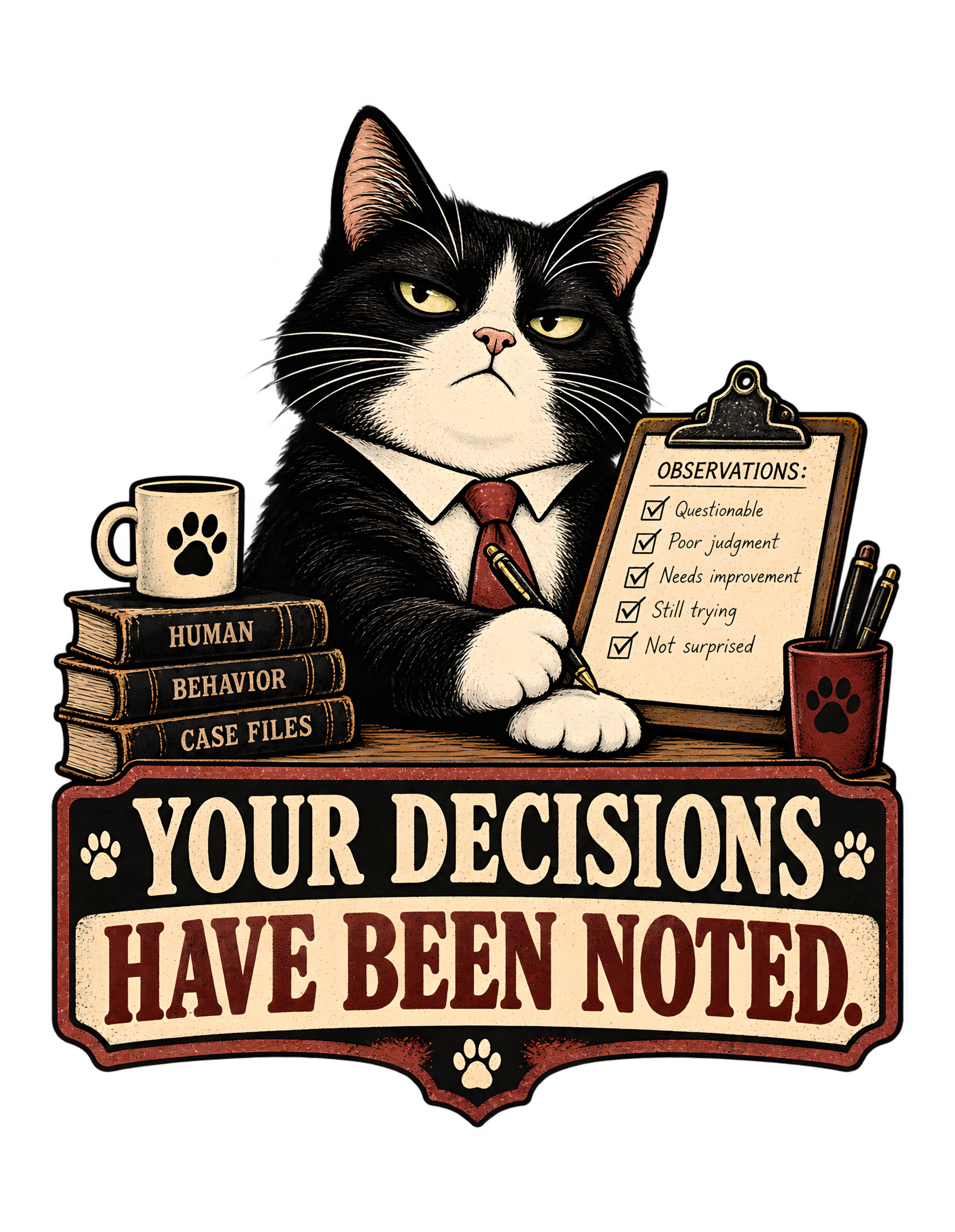
“Your Decisions Have Been Noted” turns one of the most familiar cat-owner experiences into an administrative event: the feeling that a cat has seen exactly what you did, understood enough of it to be unimpressed, and quietly filed the incident for later review. The canonical concept describes a cat recording human behavior as though maintaining an official case file, and the approved artwork builds that joke with a stern tuxedo cat seated behind a compact work surface. The cat wears a crisp white collar and red tie, holds a pen beside a clipboard, and looks directly outward with narrowed yellow eyes and the expression of someone who has stopped expecting improvement but continues documenting the evidence.
The surrounding props make the premise feel institutional rather than merely observational. A stack of books is visibly labeled “HUMAN BEHAVIOR CASE FILES.” The clipboard is headed “OBSERVATIONS:” and lists a series of judgments: “Questionable,” “Poor judgment,” “Needs improvement,” “Still trying,” and “Not surprised.” A paw-print mug and pen cup turn the scene into a compact office of feline oversight. The human is absent, which is useful: the viewer becomes the subject of the file.
The main phrase below the illustration—“YOUR DECISIONS HAVE BEEN NOTED.”—does not threaten punishment or demand an apology. It is funnier because it sounds procedural. Nothing dramatic needs to happen immediately. The cat has seen enough, recorded enough, and apparently has excellent records retention. That is pure Cats Judging Humans: dry authority, mild disappointment, and the uncomfortable possibility that every questionable human choice has already been entered into the permanent archive.
The Joke Begins With Observation Becoming Official Record
The core premise is not simply that a cat watches humans. Cats Judging Humans has plenty of room for ordinary observation, but this design goes one step further by making observation administrative. The cat does not merely notice a questionable choice. The cat records it. That transformation is what gives the phrase its distinctive tone.
The canonical concept says the cat quietly records human behavior for later judgment, as though maintaining an official case file. The approved artwork follows that idea precisely. The clipboard, pen, case-file books, office accessories, and formal tie all tell the viewer that the cat believes there is a process. Human decisions enter that process whether the human consented or not.
The phrase “YOUR DECISIONS HAVE BEEN NOTED.” is therefore less like an insult and more like a status update. The cat is not yelling. It is informing you that the event has been captured and retained. That procedural language makes the joke sharper because it creates uncertainty about what comes next. Will there be a review? A hearing? A trend analysis? The design never says, which is exactly why the quiet documentation feels so funny.
The human side of the relationship becomes strangely vulnerable. A person may think a choice was minor, private, or quickly forgotten. The cat appears to operate under a different records policy.
This makes the design broader than a workplace joke. It can apply to household decisions, daily habits, strange purchases, missed routines, or any moment a cat happens to witness. CJH supplies the fictional bureaucracy; the viewer supplies the questionable decision.
The distinction between noticing and documenting also explains why the design feels more institutional than a simple reaction image. A reaction disappears when the moment passes; a record remains. That permanence gives the cat more fictional power without requiring aggression. The decision may be over, but the paperwork survives. CJH’s bureaucracy therefore extends the joke beyond the incident and into the viewer’s imagination about what else might already be on file.
The section also shows why the wording stays useful beyond one incident: recording is a process, not a reaction. The cat’s authority therefore survives the moment that triggered the note. The human decision may be finished, but the file remains available for later comparison. That is what makes the bureaucracy feel larger than the joke’s immediate setup.
The Tuxedo Cat Looks Qualified to Judge Before the Paperwork Appears
The tuxedo cat is an especially effective central character because its natural black-and-white pattern already suggests a kind of accidental formality. The approved artwork pushes that visual association further without hiding the fact that the subject is still unmistakably a cat.
The face carries most of the authority. The yellow eyes are narrowed, the mouth is neutral, and the head is held upright. Nothing in the expression reads as frantic or cruel. The cat looks composed, observant, and deeply unsurprised by the latest human decision.
That emotional register matters. A visibly angry cat would make the scene about conflict. A cheerful cat would weaken the judgment. This cat occupies the ideal CJH middle ground: mildly disappointed, entirely certain, and prepared to continue the review.
The broad black face and white muzzle also create a strong focal contrast. The viewer sees the cat before reading the clipboard or examining the desk props. That sequencing helps the joke land quickly. First comes the authority figure. Then comes the evidence of what that authority figure has been doing.
The tuxedo coloring therefore works both aesthetically and narratively. It gives the cat a formal visual presence before the collar and tie are even considered.
Cats Judging Humans often works best when feline authority feels effortless. This cat does not need to prove it has jurisdiction. It simply looks like the person who has been keeping records longer than the human realized.
The tuxedo pattern also helps the cat remain visually readable among the warm paper, wood, red, and cream elements. The black fur creates the strongest dark mass, while the white chest and muzzle keep the face and body from disappearing into the surrounding office props. The design’s hierarchy begins with that contrast. Management is literally the clearest thing in the room, which feels exactly as self-important as the concept requires.
The cat’s black-and-white face also makes the surrounding cream and red details easier to organize. The viewer can absorb the expression first, then the office cues. That order matters because the character must feel judgmental before the paperwork can feel funny. Visual authority precedes procedural authority, and the design handles that transition cleanly.
The Clipboard Turns Quiet Judgment Into Procedure
The clipboard is the most direct symbol of the design’s bureaucratic joke. Without it, the cat would still look stern and supervisory. With it, the scene becomes an official review.
The approved artwork makes the clipboard large enough to read as a major visual element beside the cat. The heading “OBSERVATIONS:” is visible at the top, followed by a checklist of short judgments. The cat holds a pen beside the board, making the record-keeping role active rather than decorative.
This matters because the phrase says the decisions have already been noted. The clipboard visually proves that claim inside the joke. There is a place where the notes go, a list of categories, and apparently a reviewer responsible for maintaining the file.
The humor comes from disproportion. Human behavior is messy, complicated, and often explained with context. The cat’s system reduces it to neat check marks and concise findings. That is an unfair review method, naturally, but efficiency appears to be valued more highly than human nuance.
The clipboard also keeps the joke evergreen. It does not depend on a specific app, platform, software interface, or workplace trend. Paperwork is immediately recognizable as documentation, and the cat’s grip on the process is visually clear.
In CJH terms, the clipboard is not merely a prop. It is jurisdiction made portable. Wherever the human makes a decision, management can apparently open a new line item.
The clipboard also turns the cat’s judgment into something repeatable. A facial expression can evaluate one moment; a form can evaluate many. That repeatability supports the case-file premise and makes the scene feel like routine work rather than a one-time gag. The human decision is just another entry. Management is not improvising a response. Management has apparently established a workflow, which is considerably more organization than the humans have been credited with.
The board’s physical angle also helps it read as something actively being used rather than a decorative sign. The cat is positioned beside the working document, pen ready, which reinforces the idea that the review is underway. The artwork therefore depicts documentation as an action, not merely a theme, while still keeping the scene compact and readable.
The Observation Checklist Escalates From Questionable to Predictable
The visible checklist on the clipboard adds a second layer of humor because its items create a small progression of human performance concerns. The approved artwork shows “Questionable,” “Poor judgment,” “Needs improvement,” “Still trying,” and “Not surprised.” Each line is short enough to read like a formal category while still sounding unmistakably judgmental.
The sequence is especially effective because it moves between assessment and resignation. “Questionable” and “Poor judgment” sound like findings. “Needs improvement” sounds like a performance-management category. “Still trying” almost resembles encouragement until it is placed beside the cat’s expression. “Not surprised” abandons professional neutrality entirely and reveals that management has developed expectations.
That last move gives the cat personality without requiring a speech bubble. The clipboard itself starts to sound like the cat.
The checklist also broadens the joke beyond one isolated mistake. A single decision might be questionable, but a document with multiple categories implies a longer review history. The viewer begins to suspect that the cat has been collecting patterns.
The canonical concept supports exactly that feeling: human behavior is being documented for later judgment. The artwork does not need to show previous incidents because the checklist suggests continuity on its own.
For Cats Judging Humans, this is ideal administrative satire. The human may remember one awkward decision. The cat appears to have a taxonomy.
The checklist’s humor also depends on brevity. None of the items explains the human mistake, which makes the categories feel even more absolute. Context has been removed from the process. The cat’s system records outcomes, not excuses. That compression is visually efficient and tonally sharp: humans may have paragraphs of explanation, while management needs only a check mark and two words. Administrative cruelty would be too harsh; administrative impatience is much funnier.
The checklist also makes the cat’s standards feel both specific and suspiciously broad. A human can apparently fail through poor judgment, questionable choices, or simply continuing to try in an unimpressive way. The categories are flexible enough to catch almost anything. Management has designed a system with excellent coverage and very limited opportunities for appeal.
Human Behavior Case Files Make the Review Feel Ongoing
The stack of books labeled “HUMAN BEHAVIOR CASE FILES” expands the premise from one clipboard session into an entire archive. This is one of the most useful visual details in the approved artwork because it implies history without needing another character, another scene, or another paragraph of explanation.
The three stacked volumes sit beside the cat like reference material accumulated over time. Their worn, substantial appearance makes the records feel established rather than temporary. The cat is not experimenting with judgment today. The institution appears mature.
That changes the emotional scale of the main phrase. “Your decisions have been noted” might initially sound like one recent observation. The case-file stack suggests that this decision may simply be the newest entry in a much larger collection.
The human is therefore not only being evaluated in the present. The human appears to have a file history.
Cats Judging Humans gains a lot from this kind of implied continuity. The brand premise becomes funnier when feline judgment feels older, more organized, and more systematic than the human expected.
The books also create a satisfying contrast with the cat’s stillness. Nothing dramatic is happening now, yet the archive suggests plenty has happened before.
Editorially, the detail is a compact way of saying that humans produce enough questionable material to justify dedicated storage. Management would call that a documentation need. Humans might call it excessive. The books have already been shelved.
The books also function as visual memory. The clipboard represents the present review, while the case files imply everything that came before. Together, they create a timeline without requiring separate panels. The current decision is being recorded into an existing system. That makes the central phrase feel less like a warning and more like confirmation that the archive remains active. Humans may forget. Management appears to have indexed the matter.
The archive also makes the phrase feel collective even though it addresses one viewer. If there are multiple case-file books, the current human may not be the first subject under review. That implication enlarges the fictional world without adding another character. The department appears to study humanity as a category, which is exactly the kind of feline confidence CJH enjoys.
The Red Tie Gives Feline Authority a Workplace Uniform
The red tie and white collar are small compared with the cat’s head and body, but they do important narrative work. They turn natural feline composure into recognizable workplace authority while leaving the character visibly feline.
The cat is not wearing a full suit or standing like a human executive. Paws remain paws. The body remains compact and catlike. The tie simply establishes that the role is formal enough to require a dress code.
The muted red also becomes one of the strongest color accents in the design. Against black fur and cream-colored paper, it draws the viewer toward the center of the composition without competing with the cat’s face.
That restraint is important. A more elaborate costume could turn the scene into generic office parody. The simple collar and tie keep the concept anchored in Cats Judging Humans: this is still a cat, but the cat has apparently promoted itself.
The visual format supports the same idea. The tie sits directly above the paws, pen, and clipboard, creating a small chain of authority from costume to action. The viewer reads professional role, then documentation.
The result is dry rather than theatrical. The cat does not need a title plaque. The tie already tells us enough.
Management has dressed for the review. The human, inconveniently, was not informed there would be one.
The tie’s red tone also links the character to the design’s lower typographic emphasis and surrounding warm accents. That repeated color helps the illustration and phrase feel like one system rather than two stacked ideas. More importantly, the costume remains minimal enough that the joke stays feline. The cat has borrowed the symbol of office authority without surrendering the visual certainty that it would rather be sitting exactly where it is.
The tie also creates a small visual joke about professionalism. The cat is impeccably prepared for the meeting while the human is not even pictured. That imbalance reinforces the idea that management has taken the review more seriously than the employee knew was necessary. Formality becomes another tool of judgment rather than just costume.
The Paw-Print Mug and Pen Cup Make Judgment Look Like Office Work
The small desk accessories keep the bureaucratic premise grounded. A cream-colored mug with a paw emblem sits on one side of the composition, while a red pen cup with another paw emblem sits on the other. These details do not carry the main joke, but they make the environment feel operational.
The mug is particularly useful because it makes the review look routine. This is not an emergency hearing. The cat appears to be working through normal office hours, beverage nearby, while human decisions arrive for documentation.
The pen cup performs a similar function. It suggests supplies, repeat use, and a workstation that exists beyond the current moment. The cat is not improvising the review with one borrowed pen. There is infrastructure.
The paw emblems also keep the office firmly inside a feline institution. The props are recognizable human office objects, but they have been absorbed into a cat-centered system.
That visual move supports the broader Cats Judging Humans premise. Human tools are not evidence of human authority. The cat has simply appropriated them for better governance.
The accessories also create balance around the central figure without overwhelming it. They reward a closer look while the face, clipboard, and main phrase continue to carry the fast read.
The joke becomes richer because management appears prepared for a long day. The humans, apparently, continue supplying material.
The paw-branded accessories make the fictional institution feel self-contained. Even the office supplies appear to belong to the feline department. That tiny layer of branding is funny because it implies procurement, standardization, and repeat operations inside a bureaucracy that exists only to review humans. The human may own the actual mug or pens in real life; inside the artwork, management has appropriated everything necessary for proper documentation.
The office accessories provide another layer of scale: they are ordinary, familiar objects, which keeps the absurdity grounded. The joke is not happening in a fantasy tribunal. It is happening at a desk with a mug and pens. That mundane setting makes the cat’s authority feel more plausible inside the fictional CJH world.
The Cat’s Expression Suggests the Verdict Predates the Meeting
The approved cat’s expression is not merely stern. It is weary in a way that suggests experience. The narrowed eyes, lowered lids, and neutral mouth communicate less shock than confirmation.
That is why the checklist item “Not surprised” fits the scene so well. The cat looks as though the latest human decision has not created a new opinion; it has reinforced an existing one.
This gives the design an important comic advantage. Surprise would make the human mistake seem exceptional. Disappointment makes it seem routine.
Cats Judging Humans thrives on that distinction. The human may think a questionable decision was unusual. The cat appears to classify it as statistically consistent with prior performance.
The expression also keeps the humor from becoming cruel because the cat is not enraged. There is no threat or visible punishment. The authority comes from certainty rather than aggression.
That quiet emotional register makes the design more relatable. People recognize the look of a cat that seems to be evaluating them even when nothing dramatic is happening.
The artwork simply formalizes that familiar feeling with paperwork and office props.
By the time the viewer reaches the main phrase, the face has already delivered the subtext: the decision has been seen, the pattern has been recognized, and management has updated the file.
The expression also works because it does not demand empathy. The cat is not asking the viewer to understand its feelings. It is evaluating theirs—or, more accurately, their decisions. That reversal keeps the emotional power on the feline side. Humans are accustomed to interpreting pets; here, the cat appears to have been interpreting humans for some time. The result is less a confrontation than an audit, and the face suggests the preliminary findings are not promising.
Because the expression is so controlled, the viewer has room to project their own mistake into it. The cat does not react to one visible offense; it reacts to a pattern the viewer can imagine. That openness is one reason the image can stay funny across different audiences. Everyone has a decision they suspect belongs in the file.
The Missing Human Makes Every Viewer the Subject of the File
No human appears in the approved artwork. That absence is one of the design’s strongest choices because it prevents the joke from being limited to a particular person or scenario.
The viewer sees the cat, the clipboard, the case files, the mug, the pens, and the large phrase. The only missing participant is the person whose decisions are being recorded.
That makes the wording direct. “Your decisions” does not refer to a character inside the picture. It points outward.
The design therefore recruits the viewer into the joke without needing a second figure. Anyone can imagine the decision that might have earned a check mark under “Questionable” or “Needs improvement.”
The absence also preserves the cat’s visual dominance. There is no human face competing with the feline expression and no need to explain what the person did.
This makes the humor broader and more evergreen. The artwork does not depend on a specific mistake. It depends on the universal human suspicion that we have all made at least one decision a cat would consider indefensible.
Cats Judging Humans benefits from that open-endedness. The brand can suggest human incompetence without accusing anyone of one fixed behavior.
The file is personalized by the viewer’s imagination. Management provides the form. Humanity supplies the incident.
The absent human also makes the artwork unusually portable across situations. Because no specific mistake is pictured, the design can attach itself to whatever questionable decision the viewer remembers most recently. That personal substitution is more effective than showing one fixed error. The joke renews itself. Every viewer becomes both audience and subject, while the cat remains the same calm administrator receiving a steady stream of new evidence.
The viewer-facing structure also helps the design behave like a direct address rather than a scene witnessed from the outside. The cat appears to be looking at the person under review, and the phrase confirms that relationship. The composition therefore turns the wearer or viewer into the missing employee without needing to show them.
The Typography Turns a Private Judgment Into a Formal Notice
The main phrase occupies a large lower panel and reads with the weight of an official notice. “YOUR DECISIONS” appears in large cream letters against a dark field, while “HAVE BEEN NOTED.” appears below in dark red on a lighter cream field. The two-part structure gives the sentence a deliberate rhythm.
The upper line identifies the subject of the review. The lower line confirms that documentation has already occurred.
That separation matters because the joke is not asking the human to change behavior in the moment. It is reporting that the record exists.
The typography also balances the detailed illustration above. The cat, books, clipboard, mug, and pen cup contain many small shapes. The broad letterforms below create a strong visual base and keep the design legible at apparel scale.
The vintage-inspired lettering fits the rest of the artwork without becoming ornate enough to compete with the cat. Cream, dark red, and black keep the hierarchy clear.
Most importantly, the phrase sounds procedural. It does not say “You made a bad decision.” It says the decisions have been noted. That difference gives the cat more power because the judgment process seems larger than the current conversation.
The human may still hope to appeal. The typography suggests the record has already been finalized.
The two-part typographic structure also mirrors the logic of the sentence. “Your decisions” identifies the material under review; “have been noted” announces the completed action. Visually separating those clauses lets the design perform the sentence in stages. First the viewer is implicated, then informed. The typography therefore does narrative work rather than merely displaying copy. Management appreciates language that can complete a procedure in two efficient steps.
The typography’s blocky scale also ensures that the joke survives reduction. The detailed upper scene rewards close viewing, but the sentence remains legible as the main message. That dual-speed design is useful for apparel and social sharing alike: the phrase lands first, then the case-file details deepen the joke.
Black, Cream, Red, and Warm Brown Organize the Visual Hierarchy
The approved artwork uses a restrained palette that supports both the vintage treatment and the workplace satire. Deep black dominates the tuxedo cat and the upper typographic field. Warm cream appears in the cat’s muzzle and chest, the clipboard paper, mug, book lettering, and large headline. Muted red appears in the tie, pen cup, border details, and lower typographic emphasis. Warm brown and tan tones structure the books, desk surface, clipboard frame, and aged-paper details.
That palette does more than create consistency. It directs the eye.
The black-and-white cat becomes the strongest natural contrast. The red tie pulls attention toward the center. The cream clipboard remains readable beside dark fur. The lower typography repeats the same cream, black, and red relationship, tying the illustration and phrase together.
The colors also support the emotional tone. Nothing feels neon, corporate-blue, or digitally slick. The warm, slightly aged palette makes the bureaucracy feel established and almost archival.
That is useful for a joke about case files and long-term records. The design does not look like a temporary notification. It looks like a department with history.
Cats Judging Humans gains extra personality from that visual seriousness. The palette behaves as though the institution matters. The subject matter is still human decision-making under feline review.
Management has chosen excellent stationery for the occasion.
The warm brown and aged cream tones also support the case-file concept by making the office feel archival rather than temporary. A bright modern palette might suggest a fresh notification or contemporary software dashboard. The approved treatment feels like records that have existed for years. That visual age is useful comedy: the human may have only just discovered the review system, but the color palette suggests the department has been operating quietly for generations.
The palette’s repeated cream and red tones also create visual continuity between the cat’s office and the lower statement. That repetition makes the entire piece feel designed as one system. Even the color hierarchy supports the premise that management has standardized the process. The humans may be improvising; the review department clearly is not.
The Composition Builds a Compact Office Around One Unimpressed Face
The approved composition contains several props, yet the design remains readable because everything is organized around the cat’s face. The tuxedo cat occupies the central upper area. The case-file books stack to one side, while the clipboard rises on the other. The mug and pen cup fill smaller supporting spaces near the edges.
This creates a compact office without requiring a full room. The viewer understands the setting through objects rather than architecture.
That is especially effective for apparel because a complete office background would weaken the silhouette and introduce unnecessary detail. The approved artwork instead compresses the essential evidence into one emblem-like cluster.
The cat remains the strongest visual mass. The clipboard is the most important narrative prop. The books, mug, and pen cup support the idea of an established review process.
The large typography below stabilizes the composition and prevents the top half from feeling like a loose collection of objects.
The result is dense enough to reward inspection but structured enough to read quickly. From a distance, the viewer sees a stern cat and a bold phrase. Up close, the office details reveal how seriously the cat has taken the job.
That hierarchy mirrors the joke itself. First comes judgment. Then comes documentation. Then comes the unsettling realization that there may be an entire department behind it.
The compact composition also strengthens the commercial read because every supporting object stays close to the central silhouette. The books, clipboard, mug, and pen cup widen the scene enough to tell the story without turning the artwork into a full environmental illustration. The cat remains unmistakably dominant. That balance lets the viewer understand both character and bureaucracy quickly, which is essential when the joke depends on immediate recognition followed by slower discovery.
The composition also avoids unnecessary background architecture, which keeps the institutional joke focused on the objects that matter. A full office would add information but dilute the silhouette. Here, every visible prop earns its place by supporting record-keeping, review, or feline authority. The result is compact bureaucracy rather than scenery.
The Humor Works Because Nothing Is Punished Yet
One of the smartest aspects of the phrase is that it stops before announcing consequences. “Your decisions have been noted” does not say what will happen next. That omission creates more comedy than an explicit punishment would.
The cat has authority, records, categories, and files, but the design never tells us whether the human will receive a warning, lose privileges, or simply remain under observation.
That uncertainty makes the bureaucracy feel larger than the current moment. The viewer is left imagining procedures that the artwork never has to define.
Cats Judging Humans benefits from this restraint because the brand tone is judgmental without being cruel. The cat can be slightly superior and deeply unimpressed without threatening harm.
The humor therefore lives in surveillance, documentation, and quiet evaluation rather than punishment. The human’s discomfort comes from knowing the record exists.
This also makes the design more evergreen. Any decision can be inserted into the joke because no fixed consequence limits the scenario.
The cat’s expression supports the same idea. Management is not furious enough to act immediately. Management is simply gathering evidence.
That may be worse, emotionally, but it is much funnier visually. The human is still free to continue making decisions. The case files suggest that this freedom has produced excellent material.
The lack of punishment also preserves room for the viewer to participate playfully rather than defensively. The cat has not declared the human hopeless; the checklist even includes “Still trying.” That tiny hint of reluctant acknowledgment keeps the review from becoming purely negative. The bureaucracy is judgmental, but not final. Humans may continue operating, apparently under observation. Management has chosen documentation over immediate corrective action, which is almost generous by CJH standards.
The absence of consequences also invites repeat readings. Each new human mistake can mentally become the next note without changing the design. The cat’s system remains open-ended. That is a stronger comic engine than a one-time punishment because the viewer can keep reusing the premise against themselves.
The Design Is Evergreen Because Humans Keep Generating Evidence
The canonical concept is marked evergreen, and the design earns that classification because it depends on no temporary trend, holiday, platform, celebrity, or current event. Its subject is human decision-making, which is unlikely to disappear as a source of material.
The office props are equally durable. A clipboard, pen, books, mug, and case files are familiar symbols of documentation that do not depend on a specific technology or software interface.
The phrase itself is flexible enough to apply to countless situations. A questionable household choice, missed routine, odd purchase, failed plan, unnecessary rearrangement, or simple moment of poor judgment can all fit inside the premise without changing the artwork.
That flexibility gives the design long-term usefulness. The viewer supplies the context each time.
Cats Judging Humans also benefits from the fact that cats already have a cultural reputation for watching people with expressions that humans interpret as judgmental. The design turns that familiar emotional reading into a record-keeping institution.
Because the joke is structural rather than topical, it does not need updating to remain understandable.
Humans will continue making decisions. Cats will continue appearing unimpressed. The clipboard can remain in service indefinitely.
Management considers the content pipeline secure.
Evergreen strength also comes from the sentence’s lack of specificity. It never names what decision was made, when it happened, or why it was questionable. That openness prevents the joke from aging around one scenario. The record-keeping concept can absorb whatever humanity produces next. The clipboard remains valid, the case files remain relevant, and the cat’s expression remains entirely plausible. The content supply is renewable because the humans are still making choices.
The evergreen quality is also strengthened by the lack of dates, deadlines, or current references. The record could have been opened yesterday or years ago. The joke remains valid because the only ongoing requirement is that humans continue making choices. The artwork has wisely selected a resource with no foreseeable shortage.
The Design Fits Cats Judging Humans by Making Judgment a Department
“Your Decisions Have Been Noted” fits the Cats Judging Humans world because it takes feline judgment and gives it infrastructure. The cat is not simply unimpressed. There are forms, categories, case files, writing supplies, and an established desk routine.
That expansion is important to the brand because it turns one familiar cat expression into a larger fictional system. Human incompetence is no longer an occasional annoyance. It is a workload.
The tuxedo cat is especially effective in that system because the black-and-white coat already carries visual formality. The collar and tie make the role explicit, while the clipboard and books provide procedural context.
The humor remains playful because the cat never becomes genuinely hostile. The viewer is judged, not attacked. The human may be under review, but the review is funny precisely because the stakes are left undefined.
The visual treatment also aligns with the broader CJH commercial language: bold central cat, vintage-inspired color palette, strong typography, paw motifs, and a compact apparel-friendly silhouette.
At the same time, the case-file concept gives this design its own identity within the catalog. It is not a feeding joke, throne joke, or simple workplace complaint. It is documentation humor.
CJH’s worldview becomes unusually complete here: cats judge humans, somebody keeps records, and the humans were never informed that records existed.
Within the CJH catalog, the design also demonstrates how feline superiority can be expressed without crowns, thrones, or explicit declarations of royalty. Authority here comes from process. The cat has forms, categories, archives, and office supplies. That makes the superiority feel bureaucratic instead of ceremonial. It is a useful variation on the same brand worldview: humans may run the household physically, but the cat appears to run compliance.
As a CJH design, the piece also demonstrates that feline authority can be procedural rather than loud. No crown, throne, or dramatic declaration is necessary. A clipboard, archive, and expression are enough. That variety expands the brand world while preserving its central belief: cats are evaluating humans, and humans are not performing as well as they think.
“Your Decisions Have Been Noted” works because it never overexplains what the cat intends to do with the information. The approved artwork gives the viewer everything needed to understand the premise: a stern tuxedo cat in a white collar and red tie, a pen and clipboard headed “OBSERVATIONS:”, a checklist of concise human-performance findings, books labeled “HUMAN BEHAVIOR CASE FILES,” and small office props that make the review feel routine rather than improvised.
The human remains outside the frame, which makes the judgment universal. The viewer becomes the person whose decisions have entered the archive.
The typography then delivers the final procedural statement with complete confidence. Nothing is threatened. Nothing is forgiven. The decisions have simply been noted.
That restraint is what makes the design durable. Any questionable human choice can become the unseen incident behind the artwork, while the cat’s role never changes. Management observes, records, categorizes, and files.
In the Cats Judging Humans universe, this is not paranoia. It is records management. The humans may continue making decisions, but the case-file shelf suggests they should abandon any hope that those decisions are going undocumented.