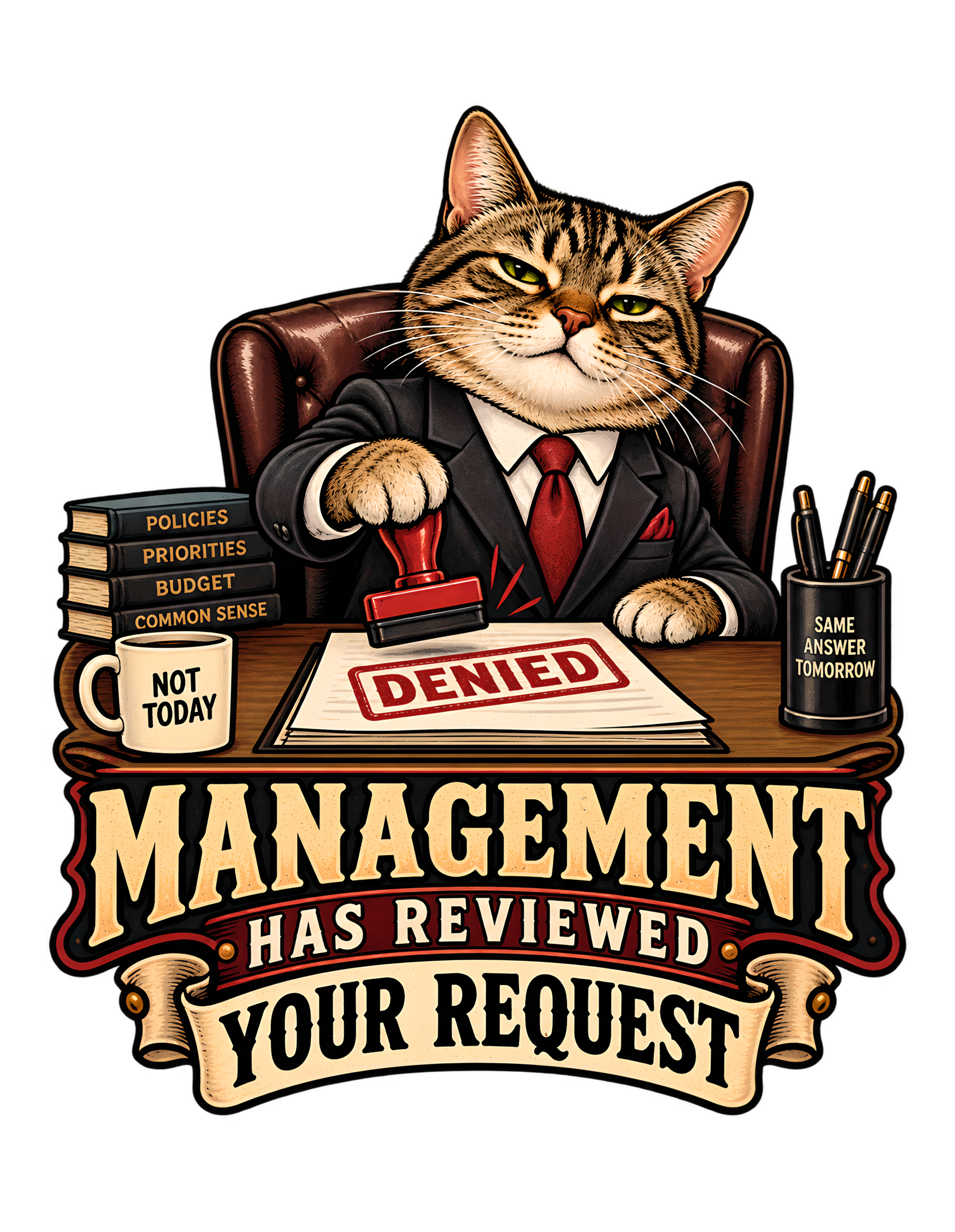
“Management Has Reviewed Your Request” turns one of the most familiar cat-owner experiences into an administrative event: a perfectly ordinary human request enters a process controlled entirely by a cat. The canonical concept is simple and strong: a cat manager formally denies a perfectly reasonable human request with calm executive authority. The approved artwork develops that premise into a compact office scene centered on a tabby cat seated behind a desk, dressed in a dark suit, white shirt, and red tie. One paw operates a large red stamp over a document already marked “DENIED,” while the cat’s half-lidded expression suggests the decision was never in serious doubt.
The surrounding details make the refusal feel institutional rather than impulsive. A stack of books beside the cat is labeled “POLICIES,” “PRIORITIES,” “BUDGET,” and “COMMON SENSE.” A cream mug says “NOT TODAY.” A black pen cup says “SAME ANSWER TOMORROW.” Those visible details create a complete fictional management culture in a very small space: there are rules, priorities, paperwork, office supplies, and apparently no meaningful appeals process.
The main phrase—“MANAGEMENT HAS REVIEWED YOUR REQUEST”—then reframes the entire scene as a formal notification. The joke does not depend on anger, chaos, or a visibly unreasonable cat. It depends on procedure. The request has been reviewed. The answer has been stamped. The human has not been invited to participate in the review.
That is an especially good fit for Cats Judging Humans. The cat remains dry, composed, clever, and slightly superior without becoming cruel. The human is not attacked; the human is administratively dismissed. The result is workplace satire filtered through feline authority, with the additional inconvenience that management appears extremely comfortable with its own process.
The Joke Starts With a Perfectly Reasonable Request Meeting Feline Management
The canonical concept establishes the central imbalance immediately: a human makes a perfectly reasonable request, and a cat manager formally denies it. The humor does not require the request itself to be visible because the important part is the process that follows. Whatever the human asked for, management has already transformed it into paperwork.
That ambiguity is useful. The viewer can imagine a workplace request, a household request, a favor, a schedule change, a door being opened, a seat being vacated, or any other small negotiation that might reasonably occur between human beings. The design does not specify the subject because the denial is the universal part of the joke.
The approved artwork makes the cat’s authority feel complete. The tabby sits behind a desk in a dark suit and red tie, with one paw over the rejection stamp and the other resting near the document. The expression is not excited. There is no visible argument. The cat looks as though this decision falls comfortably within normal operating procedure.
That calmness is what allows the phrase “MANAGEMENT HAS REVIEWED YOUR REQUEST” to function as both setup and punchline. The wording sounds fair, careful, and procedural. The image reveals that the review process may have been mostly ceremonial.
The human side of the relationship becomes strangely vulnerable. A person may think a choice was minor, private, or quickly forgotten. The cat appears to operate under a different records policy.
This makes the design broader than a workplace joke. It can apply to household decisions, daily habits, strange purchases, missed routines, or any moment a cat happens to witness. CJH supplies the fictional bureaucracy; the viewer supplies the questionable decision.
The lack of a visible request is therefore not missing information; it is a deliberate source of flexibility. The design only needs the concept that the request was reasonable and the result was denial. That gap invites the viewer to personalize the joke while preserving the cat’s fixed role. Management handles the procedure. Humanity supplies the paperwork.
Because the request is never pictured, the page also avoids locking the design to one kind of human problem. That choice makes the artwork more useful as editorial catalog content: the reader can understand the core gag immediately while still projecting a different reasonable request into the scene each time.
The Tabby Manager Looks Like the Decision Was Made Before the Meeting
The central tabby cat is the most important piece of the design because the expression carries the entire tone. The cat’s eyes are narrowed and slightly lowered, the mouth is neutral, and the head tilts just enough to suggest confidence without becoming theatrical. The result is not anger. It is certainty.
That distinction matters. If the cat looked furious, the image would become a joke about temper. If the cat looked gleeful, the refusal might feel mischievous. Instead, the approved artwork presents a manager who appears to have reached the same conclusion it always reaches.
The dark suit, crisp white shirt, and red tie formalize that attitude. They make the cat read as management before the viewer has even processed the stamp or the books. The leather chair behind the cat reinforces the same visual hierarchy: this is the person—or rather, the cat—occupying the decision-making seat.
The canonical concept describes calm executive authority, and the image supports it exactly. Nothing about the cat suggests uncertainty. The request is not being debated. It is being processed.
Cats Judging Humans benefits from that emotional restraint because the brand’s judgment works best when it feels effortless. The cat does not need to raise a paw dramatically or bare teeth or announce superiority. The office has already arranged itself around feline authority.
By the time the viewer notices the document, the face has already delivered the outcome. Management may have reviewed the request, but the expression strongly suggests the review began with a preferred answer.
The cat’s expression also works because it is not caricatured into a grin or sneer. The restraint keeps the design closer to dry workplace satire than cartoon villainy. The face suggests a manager who has seen this type of request before and does not expect the human to understand why the answer is no.
The tabby markings also keep the character visually distinct from a generic corporate mascot. The cat remains a cat first and a manager second. That ordering matters because the humor depends on feline authority occupying human bureaucracy, not on an animal being transformed into an ordinary human executive.
The Red DENIED Stamp Converts Opinion Into Policy
The large red stamp is the clearest action in the approved artwork. One paw holds the stamp directly over a document marked “DENIED,” turning the cat’s private preference into something that looks official.
That visual move is central to the joke because a denial made by a cat could otherwise feel like ordinary stubbornness. A stamped denial feels procedural. The cat is not merely refusing. The cat is creating a record.
The stamp also gives the composition a strong visual center beneath the face. The eye moves from the cat’s expression to the red tie, then to the red handle of the stamp, and finally to the large red “DENIED” on the paper. Those repeated red accents connect authority, action, and outcome.
The humor comes from the formality of the gesture. A perfectly reasonable human request has apparently required a document, a review, and an official rejection mark. The amount of process is wildly disproportionate to the likely importance of the request, which is exactly why the scene feels like workplace satire.
The image does not reveal what policy was cited or what standard was applied. It only shows that the decision has been formalized.
That missing explanation helps the joke. The human may want reasons, but the stamp implies that reasons are no longer necessary. The process has moved to final disposition.
Cats Judging Humans turns the familiar feline act of refusing cooperation into institutional bureaucracy. The cat has not simply said no. Management has documented the no, stamped the no, and placed the no into the permanent administrative universe.
The stamp becomes even more effective because it is physically oversized relative to an ordinary office stamp. That exaggeration makes the administrative act visible at a glance without changing the underlying joke. The tool is larger because the verdict matters more visually than the paperwork that supposedly justified it.
The red denial mark also gives the eye a clear visual destination below the face. Even before the wording is read, the viewer understands that a decisive action has occurred. The stamp supplies the outcome in the same instant the expression supplies the attitude.
The Missing Human Makes Every Viewer the Employee Under Review
No human appears in the approved artwork, and that absence makes the design more effective. The viewer sees the manager, the desk, the denial, the policies, the mug, the pen cup, and the main phrase. The person whose request has been rejected exists entirely outside the frame.
That allows the wording to point directly outward. “Your request” becomes the viewer’s request. There is no fictional employee absorbing the joke on the audience’s behalf.
The empty human role also keeps the visual hierarchy clean. A second face would compete with the cat’s expression and potentially shift the image into a conversation scene. Instead, the design behaves like a formal notice handed directly to the person reading it.
This makes the premise portable. The request can be anything because the viewer supplies the context. Someone may imagine a workplace request. Someone else may imagine asking a cat to move, share space, change routine, or acknowledge a human preference. The artwork does not need to choose.
Cats Judging Humans benefits from this kind of open-ended direct address because the brand premise is fundamentally relational. The cat is judging humans as a category, but the strongest jokes often make one human feel personally reviewed.
The approved composition does exactly that. The cat looks outward from behind the desk as if the viewer is standing on the other side waiting for an answer.
The answer is visible.
The human never appears because the human is already in the room.
The viewer-facing arrangement also creates the sensation of standing at the desk awaiting a decision. That perspective reinforces the direct address of “your request.” The cat does not look sideways toward another employee; it appears to occupy the position of authority directly across from the person reading the design.
The empty human position also makes the cat’s direct gaze more important. The viewer is not watching someone else receive bad news. The composition places the viewer at the receiving end of management’s attention. That directness turns a catalog image into a miniature performance review.
POLICIES, PRIORITIES, BUDGET, and COMMON SENSE Build the Bureaucracy
The stack of four books to the cat’s left is one of the richest details in the approved artwork. The visible spines read “POLICIES,” “PRIORITIES,” “BUDGET,” and “COMMON SENSE.” Together, they create a miniature management library that makes the denial feel backed by an entire administrative framework.
Each label contributes differently. “POLICIES” implies formal rules. “PRIORITIES” suggests that the request has been ranked and found wanting. “BUDGET” introduces the possibility that resources are being withheld. “COMMON SENSE” is the funniest addition because it quietly suggests the human may have failed a standard so basic that management has a reference volume for it.
The books also make the cat’s authority feel established rather than improvised. The manager appears to have reference materials, procedures, and institutional memory.
Visually, the stack balances the pen cup on the opposite side and fills the desk without turning the scene into a cluttered office. The labels reward a closer look after the viewer has already understood the central joke.
The detail also broadens the satire. The phrase alone could be read as generic management humor. The books make the management style specific: the cat has access to all the categories humans use when explaining why something cannot happen.
Cats Judging Humans then applies feline superiority to that vocabulary. The cat does not need to explain which book justified the denial because all four are apparently available.
The request has encountered policy, priorities, budget, and common sense. The odds were not good.
The stack also creates a compact hierarchy of excuses. Policy, priority, budget, and common sense cover different kinds of justification, which means management appears prepared for almost any challenge. The human can object from several angles. The shelf already contains a corresponding reason to decline.
The book titles also create a small internal joke about justification. A denial can be blamed on policy, priority, budget, or common sense depending on what management needs in the moment. The shelf therefore suggests the cat is prepared to defend the same answer through several administrative languages.
The NOT TODAY Mug Turns Refusal Into a Daily Operating Principle
The cream mug marked “NOT TODAY” adds a small but important layer to the design. Unlike the main phrase, it does not refer specifically to the current request. It reads more like a standing attitude.
That distinction expands the joke. The denied document may concern one human request, but the mug suggests that refusal is part of management culture.
The mug also humanizes the office scene without humanizing the cat too much. It is an ordinary desk object, familiar in countless workplaces, but its message fits the feline manager perfectly. Management has a beverage, a chair, a desk, and an established preference for declining additional obligations.
The visual placement matters too. The mug sits close to the policy books, creating a secondary cluster of institutional humor on one side of the cat. The viewer can understand the image at a distance without reading the mug, then discover the additional joke on a closer look.
That layered readability is useful for a detailed commercial illustration. The main phrase and denial stamp carry the immediate premise. Smaller details reward inspection.
Cats Judging Humans often gains humor from treating feline preferences as official doctrine. “NOT TODAY” does exactly that. It turns a mood into a workplace policy without needing any explanation.
The human request has been denied today. The mug suggests management would prefer not to revisit the subject until at least another administrative period.
Unfortunately for the human, the pen cup on the other side provides further guidance about that timeline.
The mug also makes management look comfortable. There is no sign that refusing the request has interrupted the cat’s day. That ease is part of the power dynamic. The human experiences a decision; the cat experiences routine office work. CJH turns that emotional imbalance into another quiet layer of superiority.
The mug’s wording also helps keep the scene from becoming too severe. “Not today” sounds dismissive rather than threatening. The cat is exercising authority, but the tone remains dry and playful. Management is not cruel. Management is simply unavailable for whatever the human was hoping to accomplish.
SAME ANSWER TOMORROW Quietly Eliminates the Appeal Process
The black pen cup on the right side of the approved artwork reads “SAME ANSWER TOMORROW.” That small line may be the most efficient piece of secondary comedy in the entire composition because it closes the door that the main phrase leaves slightly open.
A human receiving a denied request might reasonably assume the decision could be reconsidered later. The pen cup removes that hope.
The wording is especially effective because it is presented on an ordinary office container rather than a formal policy document. The message feels so established that it has become desk decoration.
Together with the “NOT TODAY” mug, the pen cup creates a complete timeline. Today is no. Tomorrow is also no.
The request has therefore not failed because of timing. The problem appears to be the existence of the request itself.
Visually, the pen cup balances the books and mug on the opposite side, helping the composition feel orderly. The red accent on the cup also echoes the tie and stamp, keeping the color structure cohesive.
Cats Judging Humans uses this detail to push the management satire beyond one decision. The cat is not merely reviewing requests. The cat appears to have developed a consistent service standard.
There is also something distinctly feline about the certainty of it. The viewer may still plan to ask again. Management has already anticipated this behavior.
The answer tomorrow has been pre-approved.
Efficiency, apparently, is one area where the department performs extremely well.
Because the line sits on a pen cup, it reads less like a formal ruling and more like a permanent desk philosophy. That makes the joke feel institutional rather than situational. Someone has chosen to keep this sentence visible every day, which suggests the appeal process was eliminated long ago.
The pen cup’s promise of the same answer tomorrow turns the whole desk into a visual FAQ. Humans may repeat themselves; management has already standardized the response. That efficiency is part of the joke because it treats stubbornness as process optimization.
The Suit, Red Tie, and Leather Chair Establish Executive Rank
The approved artwork uses a small number of workplace symbols to establish hierarchy quickly. The cat wears a dark suit jacket, crisp white shirt, and red tie while seated in a substantial leather chair. Those details are enough to make the scene read as executive without requiring a full office background.
The dark suit also works well against the tabby fur. It creates a broad visual mass around the body while leaving the face and paws easy to read.
The red tie becomes the brightest clothing accent and connects directly to the red denial stamp below. That relationship is important: the same color marks both the authority figure and the decision.
The leather chair adds another layer of status. The cat is not perched on a stool or standing behind a counter. It occupies a chair that visually belongs to the person with final approval rights.
The canonical concept calls for a cat manager with calm executive authority, and these details support that without turning the cat into a human caricature. The paws remain visible. The face remains unmistakably feline. The clothing simply assigns a role.
Cats Judging Humans works best when the cat appears to have inherited human systems and then improved them for feline purposes. The suit and chair make that transfer of power immediately legible.
The human may have invented management structures. The cat has apparently claimed the corner office.
There was no vote.
The clothing also avoids over-humanizing the subject because the cat’s head and paws remain visually dominant. The suit establishes office rank, but the cat never stops reading as a cat. That balance is important to the CJH tone: feline authority is funniest when human systems are borrowed without erasing feline identity.
The leather chair also adds vertical weight behind the cat’s shoulders and head, strengthening the sense that this seat belongs to the highest-ranking person in the scene. There is no visible boss above the cat. The organizational chart appears to stop here.
The Warm Vintage Palette Makes Bureaucracy Feel Established
The approved artwork uses a warm, restrained palette built around black, cream, red, brown, tan, and small golden accents. That color system gives the office satire a vintage, established quality rather than the look of a modern digital workplace.
Deep black grounds the suit, pen cup, and major typographic areas. Warm cream appears in the mug, paper, and large lettering. Red carries the strongest accent through the tie, stamp, document mark, and portions of the typography. Brown and tan define the desk, books, chair, and paper edges.
The result feels archival. The bureaucracy does not look newly created. It looks like a department that has been denying requests for years.
That visual age strengthens the joke because the human may only just be discovering the system. The cat, by contrast, appears completely at home inside it.
The palette also organizes the image clearly. The tabby face remains prominent against the dark suit and chair. The red accents lead the eye downward toward the denial. The cream typography below remains highly readable against dark and red fields.
Cats Judging Humans benefits from this seriousness. A bright novelty palette might make the scene feel like a one-off gag. The warm vintage treatment makes the institution feel permanent.
Management does not look trendy.
Management looks tenured.
The vintage treatment also supports the evergreen requirement. It does not chase a current visual trend or platform aesthetic. Instead, the warm palette, bold outlines, and aged-paper feeling give the piece a durable illustrative character. Management looks established enough to survive several reorganizations.
The warm palette also makes the design feel less like modern corporate branding and more like an established institution with history. That suits the CJH worldview, where feline authority is treated as older and more permanent than whatever administrative system humans think they invented.
The Typography Makes the Review Sound More Fair Than It Is
The main phrase “MANAGEMENT HAS REVIEWED YOUR REQUEST” occupies the lower portion of the approved artwork in large vintage-style lettering. The hierarchy gives “MANAGEMENT” the greatest visual weight, followed by “HAS REVIEWED,” then “YOUR REQUEST” on a curved cream banner.
That structure matters because the sentence begins with the authority rather than the outcome. Before the viewer thinks about the request, the design establishes who controls the process.
The phrase also sounds reassuringly procedural. A request was submitted. Management reviewed it. That language implies attention, consideration, and perhaps even fairness.
The image above complicates that implication. The cat’s expression, the rejection stamp, the policy books, the “NOT TODAY” mug, and the “SAME ANSWER TOMORROW” pen cup suggest that the review may not have been especially open-minded.
That tension is the heart of the joke.
The typography does not say “NO.” It says something more bureaucratic and therefore more powerful: management has reviewed the matter.
Cats Judging Humans uses that formal language to make feline refusal feel institutional. The phrase could plausibly appear in a workplace memo, but the cat transforms it into a declaration of household hierarchy.
The human may object to the fairness of the process.
The sentence never promised fairness.
It only confirmed review.
The wording’s passivity is also useful. “Has reviewed” sounds completed and neutral, as though the process happened properly somewhere out of sight. The image shows the actual process: one cat, one stamp, one answer. The difference between bureaucratic language and visible reality is where much of the satire lives.
The phrase’s formal tone also leaves the actual emotional message unstated. Management does not say it disliked the request. It simply reports review. The image supplies the missing emotional context through the face, stamp, mug, and pen cup. Text and illustration therefore divide the joke efficiently.
The Composition Leads the Eye From Manager to Stamp to Verdict
The approved composition is tightly organized around a simple visual sequence. The viewer first encounters the tabby manager’s face near the top center. The red tie leads downward to the cat’s paw and the red stamp. The document marked “DENIED” sits directly beneath. The large phrase then forms a broad typographic base.
That sequence lets the story read quickly even though the illustration contains several secondary details.
The books, mug, and pen cup occupy the left and right edges of the desk, but they do not interrupt the central chain from authority to action to message.
The leather chair creates a dark frame behind the cat, while the desk provides a horizontal platform that separates the character scene from the typography below.
This is important for apparel-style art because the image needs to function both as a silhouette and as a detailed illustration. From a distance, the viewer can read a powerful central cat and bold phrase. Up close, the office props reveal additional jokes.
The composition therefore has two speeds. The first is immediate: cat manager, denied request. The second is investigative: policies, priorities, budget, common sense, not today, same answer tomorrow.
Cats Judging Humans rewards that closer look because the supporting details all reinforce the same premise rather than introducing unrelated decoration.
Management has not merely denied the request.
Management has built an entire visual process around denying it efficiently.
The lower phrase also gives the image a strong structural base, allowing the upper scene to contain several details without losing overall clarity. The composition behaves almost like a badge: character and props above, declaration below. That compactness helps every supporting element remain connected to the same management premise.
The strong lower banner structure also helps the design read at thumbnail size. The upper office scene can reward detail, while the large phrase remains the primary verbal signal. That makes the composition suitable for repeated editorial discussion because the main joke and the secondary jokes live at different scales.
Calm Executive Authority Is Funnier Than an Angry Refusal
The approved cat never looks furious. That choice is essential to the design’s tone.
An angry manager would make the scene about confrontation. A shouting or visibly aggressive cat would push the joke toward hostility. The canonical concept instead specifies calm executive authority, and the artwork delivers exactly that.
The tabby’s half-lidded eyes and relaxed posture make the denial feel routine.
The cat is not emotionally invested enough to fight about the request. It simply has the power to reject it.
That imbalance creates a more durable kind of humor. The human may care deeply about the answer. Management appears to regard the entire matter as one more item on the desk.
The stamp reinforces that emotional distance. The rejection is not delivered with dramatic flair. It is applied like standard procedure.
Cats Judging Humans depends on this kind of controlled superiority. The cat can be judgmental and slightly smug without becoming cruel.
The viewer is invited to laugh at the absurd hierarchy rather than feel attacked by it.
The calmness also makes every surrounding prop feel more credible. The books, mug, pen cup, and desk are not part of a chaotic scene. They belong to an orderly office where the same decisions are made every day.
The cat’s power is therefore not emotional.
It is administrative.
Humans generally find that worse.
The calmness also lets the viewer imagine repeated use. A furious cat might only work for one dramatic incident. This cat could deny requests all afternoon. That repeatability strengthens both the office joke and the feline character: management has a system, and emotional energy is not required to keep it running.
The restrained expression also protects the brand personality. CJH is judgmental but not hostile. A bored, confident manager is funnier than an enraged one because the denial feels routine rather than personal. The human has not offended management. The human has merely encountered policy.
The Reasonable Request Makes the Power Imbalance the Real Punchline
The canonical concept specifically describes the human request as perfectly reasonable. That detail is important even though the request itself never appears in the artwork.
If the request were obviously foolish, the denial would simply confirm good judgment. The comedy comes from the fact that management is denying something reasonable anyway.
That makes the real subject of the design power rather than logic.
The human can make a sound case. The human can cite need, fairness, efficiency, or common sense. The cat has the stamp.
The “COMMON SENSE” volume on the desk makes this imbalance especially funny. Management has access to a book with that exact label and still appears to have reached the predetermined answer.
Cats Judging Humans often works by reversing assumptions about ownership and authority. Humans may believe they set household rules or make final decisions. The design calmly presents a different organizational chart.
The request is reviewed by the cat because the cat is management. The outcome is denied because management says so.
No additional justification is required.
That simplicity keeps the joke broadly relatable without inventing one scenario. The reasonable request can be whatever the viewer wants it to be.
The important thing is that reason has entered a system where reason is not necessarily the controlling variable.
Management appreciates the submission.
Management declines the proposal.
The concept therefore does not ask whether the request deserved approval. It asks who has the power to decide. By specifying that the request was reasonable, the source makes the answer clear: fairness is not the controlling mechanism. Authority is. CJH naturally assigns that authority to the cat.
The concept’s reference to a reasonable request keeps the satire pointed toward power rather than incompetence. The human does not need to be wrong for the cat to deny them. That is what turns the scene from simple judgment into bureaucracy: procedure outranks persuasion.
The Workplace Satire Works Even Before the Viewer Thinks About Cats
The design functions as workplace humor because the visual language of management is immediately recognizable. A desk, suit, tie, stamp, policy books, mug, pen cup, and formal phrase create the atmosphere of an office review before the feline reversal is fully processed.
That allows the joke to operate on two levels.
At one level, it is familiar bureaucracy: a request enters a system and emerges denied. The human wonders whether anyone genuinely considered it.
At another level, the person controlling the system is a tabby cat who appears completely qualified by its own standards.
That combination gives the artwork wider recognition without requiring outside references. The viewer does not need a specific employer, industry, or office experience. The generic structure of management review is enough.
The cat then improves the satire by removing any illusion of negotiation.
Human managers often explain decisions. This cat has a red stamp.
Cats Judging Humans uses that compression to make bureaucracy feel cleaner and more absurd at the same time.
The books labeled “POLICIES,” “PRIORITIES,” “BUDGET,” and “COMMON SENSE” function like a miniature vocabulary of institutional refusal. The mug and pen cup supply the attitude that official language leaves unstated.
The artwork therefore does not merely put a cat in an office.
It turns feline certainty into the purest imaginable version of office management.
The office satire also remains accessible to viewers who do not picture a literal workplace scenario. Policies, budgets, priorities, and review processes have escaped the office into everyday life. The cat simply collects those familiar forms of institutional language and applies them to the human relationship.
The office setting also gives the viewer a vocabulary for the joke before any feline interpretation is needed. Review, denial, policy, budget, and management are familiar ideas. The cat then takes control of them, converting ordinary workplace frustration into a feline power fantasy that remains recognizable outside any one job.
The Design Is Evergreen Because Humans Will Keep Making Requests
The canonical source marks the concept as evergreen, and the artwork supports that classification because nothing in the central joke depends on a date, trend, holiday, celebrity, platform, or temporary reference.
Humans make requests. Authority reviews requests. Requests are denied.
That structure is unlikely to become unfamiliar.
The office props are similarly durable. Books, paper, a stamp, a mug, pens, a desk, a suit, and a chair all communicate management without relying on one software interface or current technology.
The phrase itself is also deliberately broad. It does not name what was requested, when it was requested, or why the request failed.
That gives the viewer room to reuse the joke mentally across many contexts.
Cats Judging Humans adds a second evergreen layer: the brand’s fictional hierarchy can absorb any future human proposal. The request may change. The cat manager does not.
The secondary details support the same long-term structure. “NOT TODAY” and “SAME ANSWER TOMORROW” are not tied to one calendar date. They describe policy.
The result is a design that can remain understandable even as the viewer’s own examples change.
Management will continue reviewing requests.
Humanity will continue submitting them.
The answer appears operationally stable.
The visual joke can therefore renew itself indefinitely. Each new request becomes a fresh unseen document, but the manager, stamp, and policy shelf remain ready. The content is evergreen because the system is procedural, not topical. Management has achieved admirable scalability.
The evergreen quality is strengthened by the design’s analog tools. Paper, books, a stamp, mug, and pens do not tie the joke to a software platform that could disappear. The bureaucracy feels timeless enough to keep operating even after several human systems have been replaced.
The Design Fits Cats Judging Humans by Turning Refusal Into Governance
“Management Has Reviewed Your Request” fits Cats Judging Humans because it does more than show a cat being stubborn. It turns feline refusal into governance.
The cat has a role, an office, a desk, policy references, a stamp, writing supplies, and a formal review process. Human preference has become an input into a system controlled entirely by feline authority.
That is a strong expression of the brand’s central reversal. The human may provide the house, furniture, paperwork, and office vocabulary, but the cat is the one using those tools to make final decisions.
The humor stays playful because the rejection is procedural rather than malicious. The cat is not threatening anyone. It is simply running the organization according to standards that were never submitted for human approval.
The approved artwork also fits the brand visually through its bold cat focal point, vintage-inspired palette, strong typography, and compact silhouette.
Within the wider CJH catalog, the management angle gives this design its own identity. It is not a throne, temple, feeding complaint, or generic judgment scene. It is the administrative refusal department.
That distinction matters because the brand world becomes richer when feline superiority can appear in different institutions.
Here, the institution is management.
The humans may appeal.
The pen cup has already reviewed that possibility.
The design also demonstrates how CJH can express feline superiority without using royal imagery or overt household entitlement. Here, the cat rules through administration. That variation preserves the brand worldview while giving the catalog a different flavor: not monarchy, but management—and somehow the answer is still no.
Within CJH, that administrative style offers a useful counterpoint to more ceremonial or domestic concepts. The same feline superiority appears here through process, not posture alone. The cat wins because it controls the review system. Humans may own the desk. Management owns the answer.
“Management Has Reviewed Your Request” succeeds because every visible element supports the same imbalance of power. The human submits a reasonable request. The tabby manager sits behind the desk in a dark suit and red tie. A red stamp turns the answer into a formal “DENIED.” Books labeled “POLICIES,” “PRIORITIES,” “BUDGET,” and “COMMON SENSE” imply a complete administrative framework. The “NOT TODAY” mug and “SAME ANSWER TOMORROW” pen cup make clear that timing is unlikely to improve the outcome.
The main phrase then delivers the official version of events: management has reviewed the request. It sounds neutral, fair, and procedural. The artwork quietly suggests that the conclusion was much simpler.
That tension is what makes the design durable. The request never needs to be shown because the viewer can supply one. The cat never needs to become angry because authority is already established. The office never needs to become elaborate because a few carefully chosen props make the bureaucracy feel complete.
In the Cats Judging Humans universe, this is feline superiority expressed through administration rather than royalty. Humans may make reasonable proposals. Management may review them. Review does not imply approval.
The file is complete. The stamp is dry. Tomorrow’s answer has already been prepared.