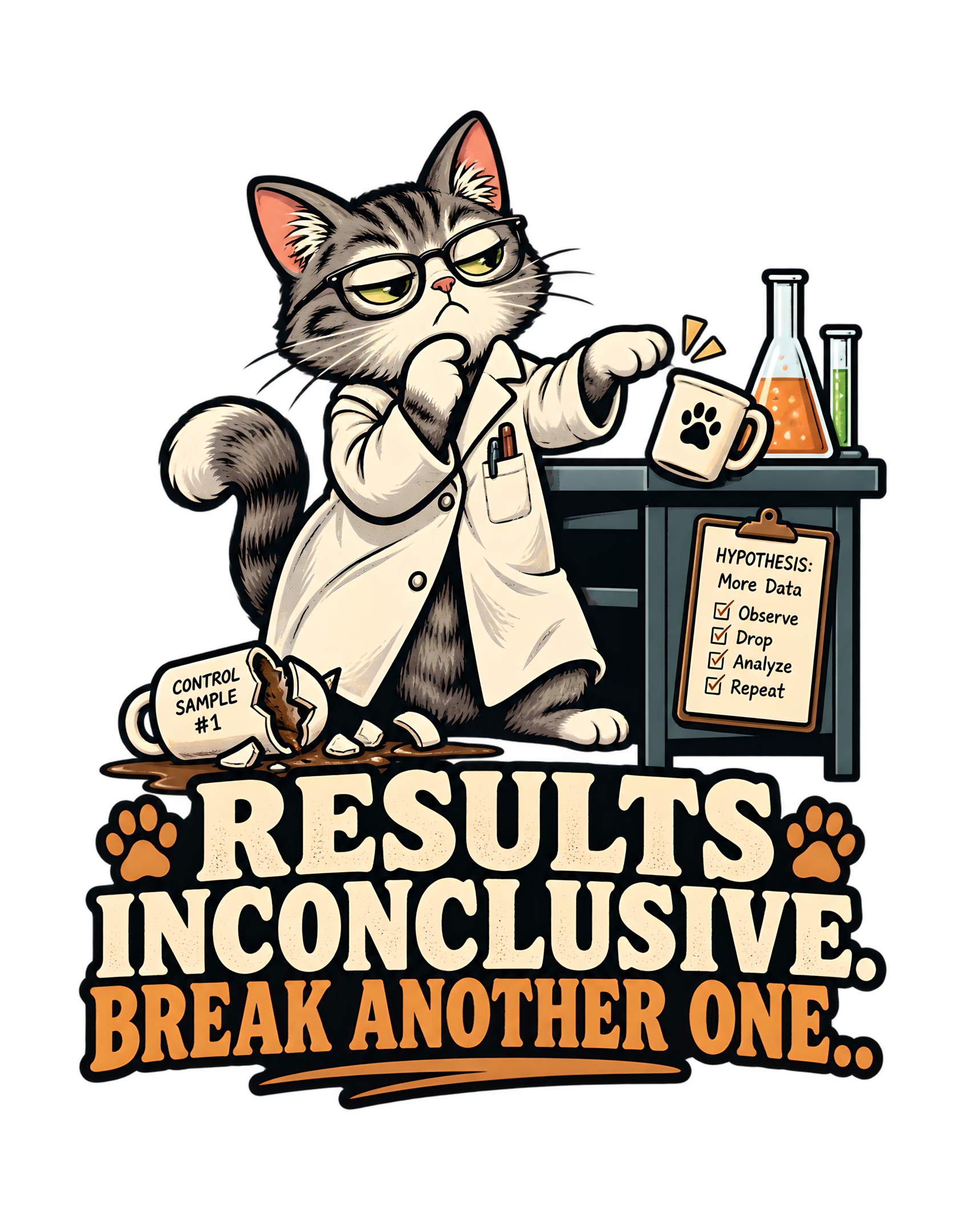
“Results Inconclusive. Break Another One.” takes a familiar piece of cat-owner folklore—the mysterious urge to push objects toward gravity—and gives it the formal language of experimental science. The approved artwork presents a gray tabby cat as a deeply unimpressed researcher in round glasses and a white lab coat, stationed beside a compact laboratory bench with colorful glassware, a mug, a clipboard, and one visibly broken cup labeled as a control sample. The central joke is not simply that a cat broke something. It is that the cat has developed a complete intellectual framework for doing it again.
That distinction gives the design its personality. The phrase suggests that destruction is not impulsive, accidental, or mischievous. It is methodology. The first result failed to answer the research question, so the only responsible course—according to the feline scientist—is replication. The humor becomes stronger because the visual language takes this logic seriously. The cat looks analytical rather than guilty. The lab coat establishes authority. The scientific props imply procedure. The broken mug is treated as evidence. A clipboard converts the chaos into documentation. Everything around the cat behaves as though another falling object is a perfectly reasonable next step.
That is the Cats Judging Humans inversion at work. Humans usually describe a knocked-over object as a problem to prevent. The cat-scientist reframes it as a data point. The human sees property damage; the cat sees an underpowered sample size. The result is a dry, compact joke about feline curiosity, scientific language, and the extraordinary confidence with which cats can turn questionable behavior into an official process.
The Joke Turns Feline Chaos Into Experimental Method
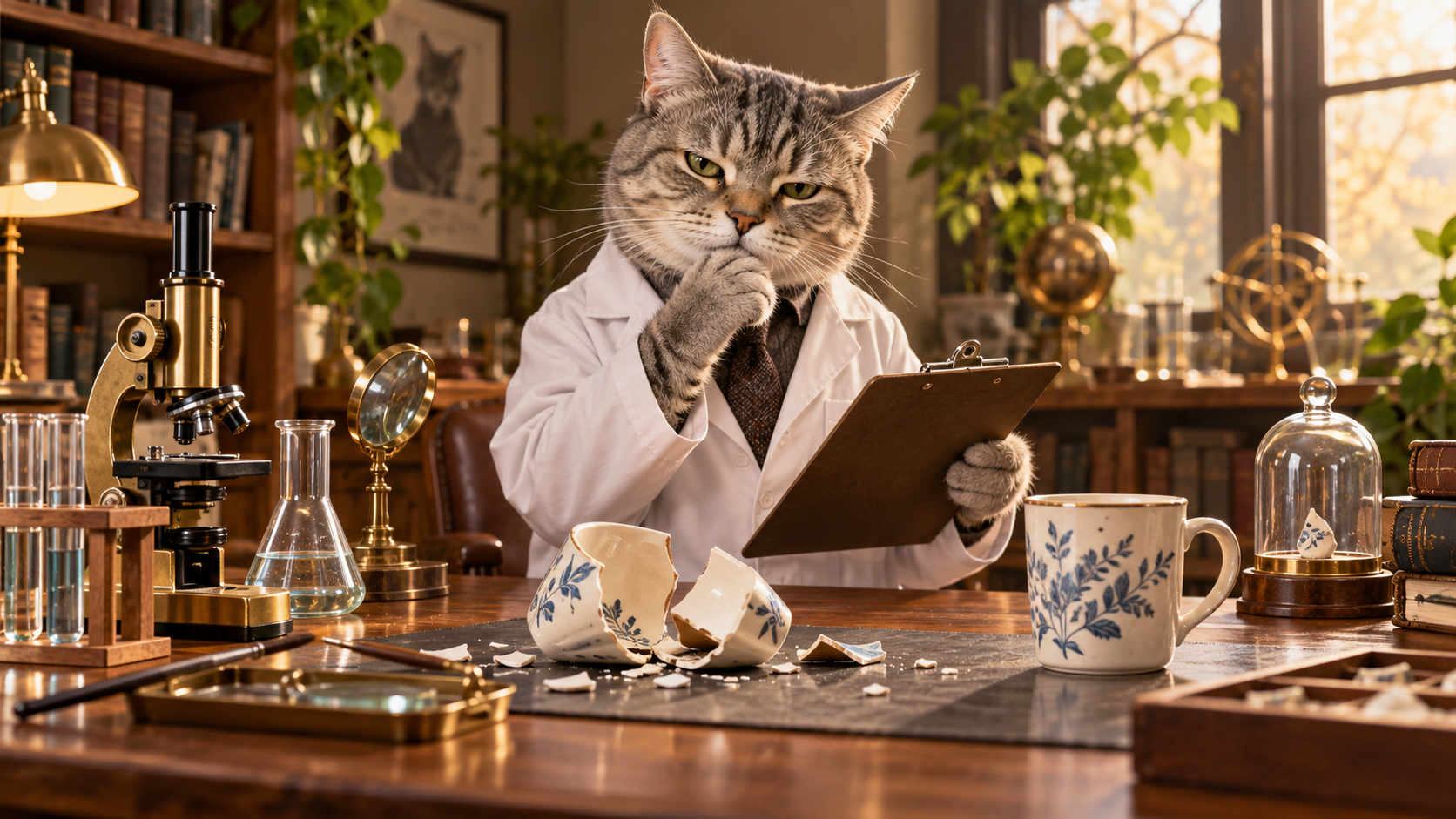
The core premise works because it does not deny the chaos. It professionalizes it. A mug has already been broken, and instead of apologizing, hiding, or pretending nothing happened, the cat treats the event as insufficient evidence. The phrase “RESULTS INCONCLUSIVE. BREAK ANOTHER ONE.” makes the next act sound like a necessary continuation of the study rather than a repeat offense. That shift from mischief to methodology is what gives the design its strongest comic engine.
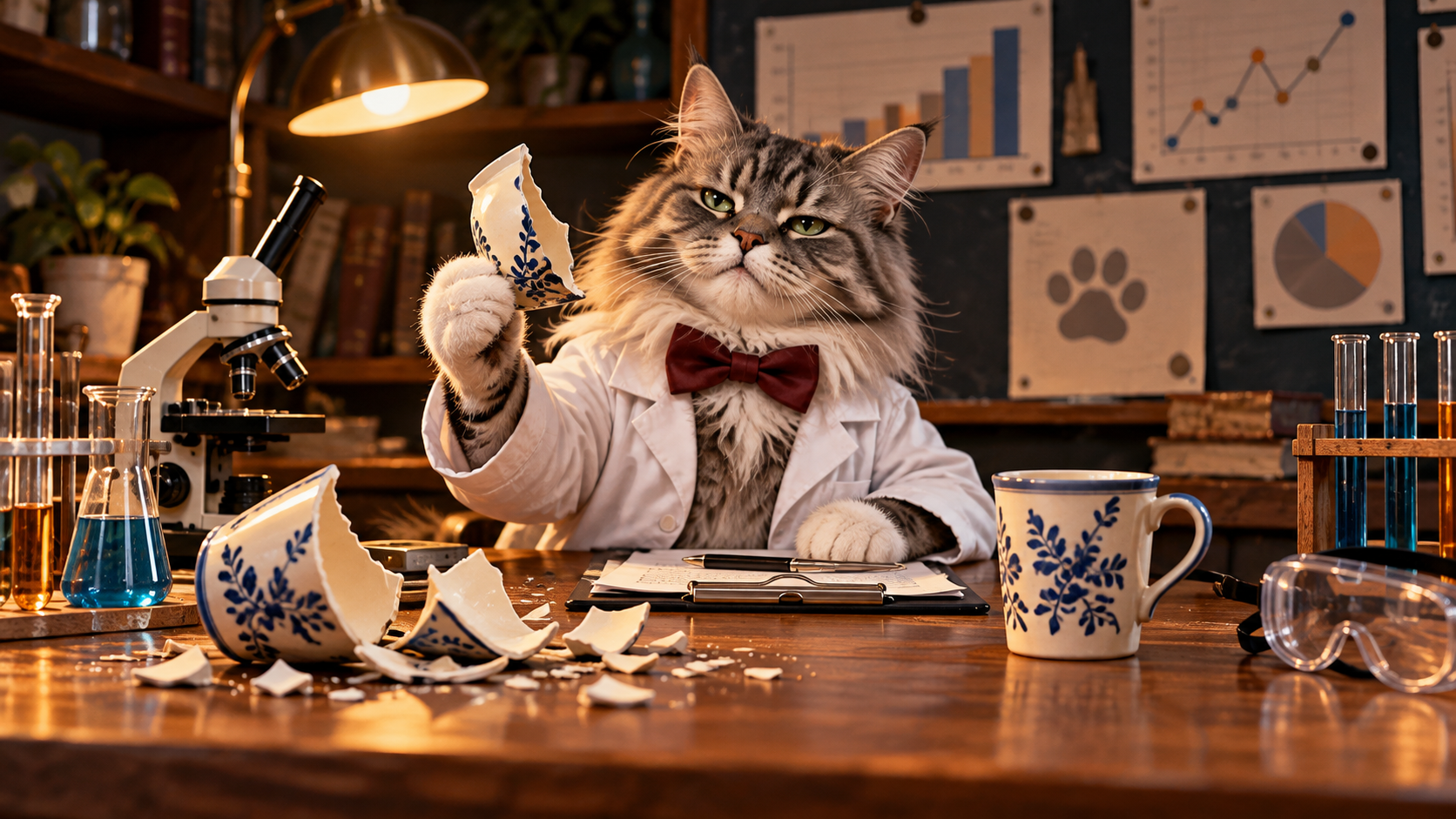
The source concept describes a cat scientist justifying the destruction of another household object because the experiment supposedly requires more data. The approved artwork makes that concept visible through laboratory cues rather than relying only on the phrase. The cat wears a white coat, peers through round glasses, and occupies a workstation surrounded by flasks, tubes, a mug, and a clipboard. A broken cup near the lower left is explicitly framed as part of the experiment, while the cat’s raised paw suggests that another test may already be underway.
The joke is effective because the scientific framework is recognizable even when the procedure is absurd. Experiments use observations, controls, repeated trials, and analysis. The design borrows that language and applies it to a behavior cat owners immediately understand. The more seriously the scene presents the process, the less reasonable the process becomes.
That is also why the line avoids generic “cat knocked something over” humor. The design is not merely illustrating an accident. It invents a rationale. The cat appears to believe that the previous breakage cannot support a valid conclusion by itself. The problem, therefore, is not that something shattered. The problem is that the dataset remains inadequate.
From the Cats Judging Humans perspective, the human complaint has already been dismissed. Methodological rigor comes first. Household objects are apparently research materials now.
The Scientist Cat Looks Guilty of Nothing
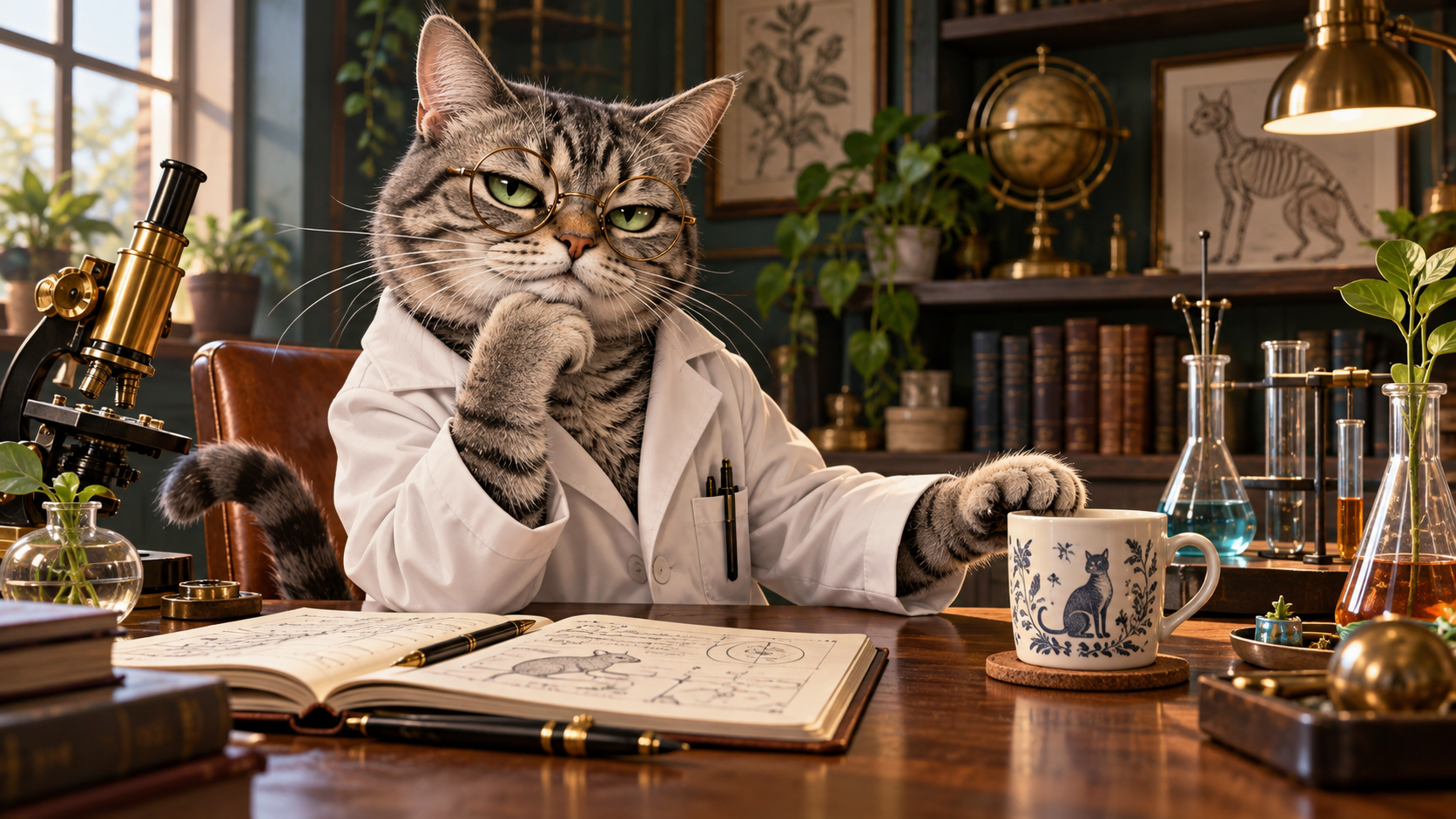
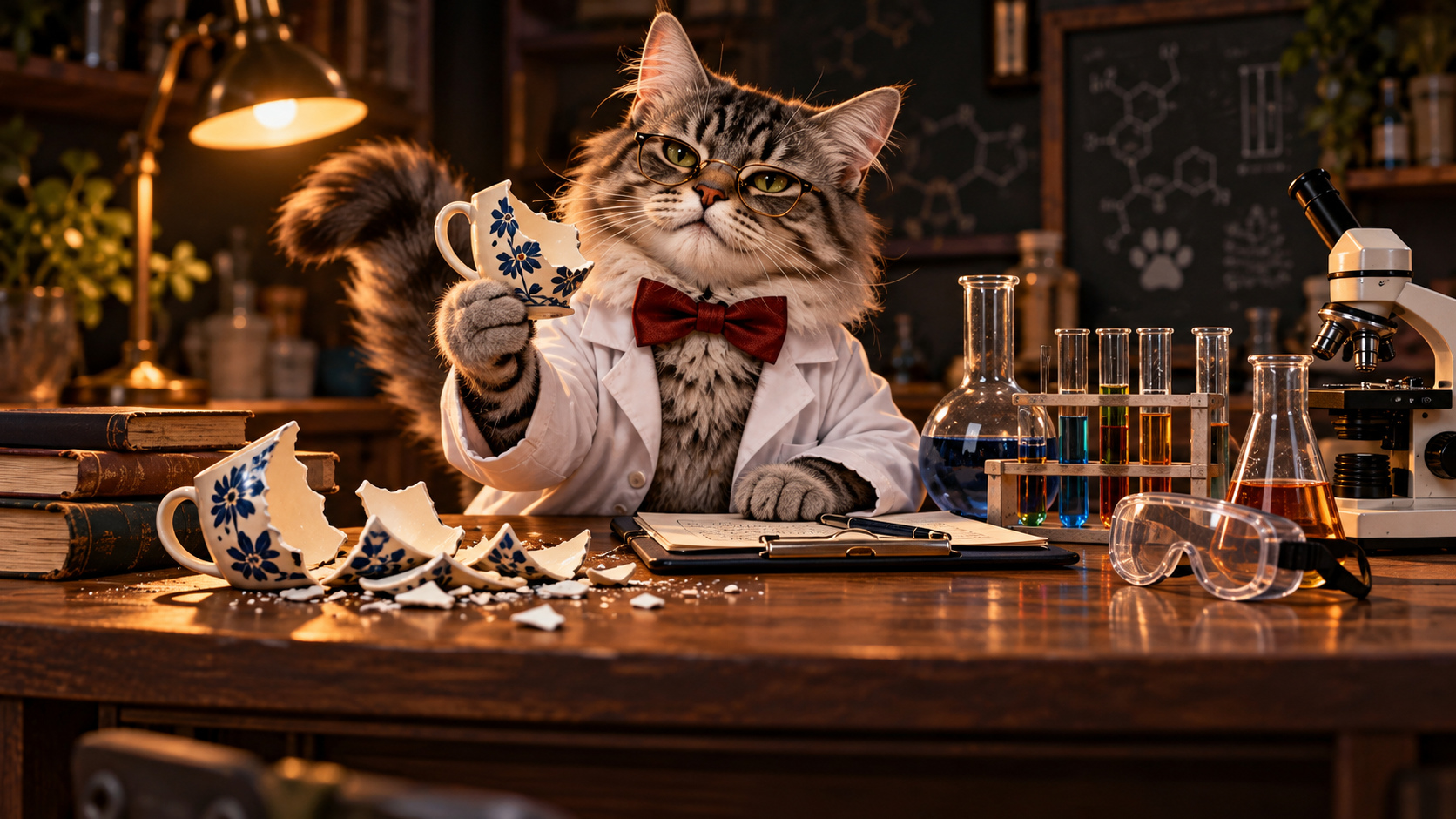
The cat’s expression carries much of the humor before the viewer reaches the words. The gray tabby is not wide-eyed, startled, or caught in the act. Instead, the face is narrowed and analytical, with heavy-lidded green eyes behind round glasses. One paw rests near the chin in a thinking pose while the other reaches toward a mug. The posture suggests evaluation, not remorse.
That distinction matters because the phrase needs a cat who appears to believe in the legitimacy of the procedure. A sheepish expression would make the design about getting caught. An overly excited expression would make it slapstick. The approved artwork chooses something drier: the cat seems mildly frustrated that the evidence has not yet reached statistical satisfaction.
The white lab coat strengthens that reading. It gives the cat a recognizable occupational role without making the character cease to look feline. The tail remains visible, the paws remain paws, and the face retains unmistakable tabby features. The costume elevates the cat into a researcher while preserving the underlying absurdity that an ordinary house cat is apparently running a laboratory.
The glasses are especially useful because they frame the eyes and emphasize scrutiny. They do not need to imply anything factual about cats or vision; they simply operate as a visual shorthand for the scientist role. Combined with the coat and the deliberate paw gestures, they make the character feel competent enough to be dangerous.
Cats Judging Humans humor works best when the feline authority figure is certain rather than frantic. This cat does not look like it is improvising. It looks like it has already written the protocol, rejected your objections, and scheduled the next trial. The human may see a mug approaching the edge. The scientist sees an opportunity to improve the reliability of the findings.
The Broken Control Sample Makes the Absurd Logic Visible
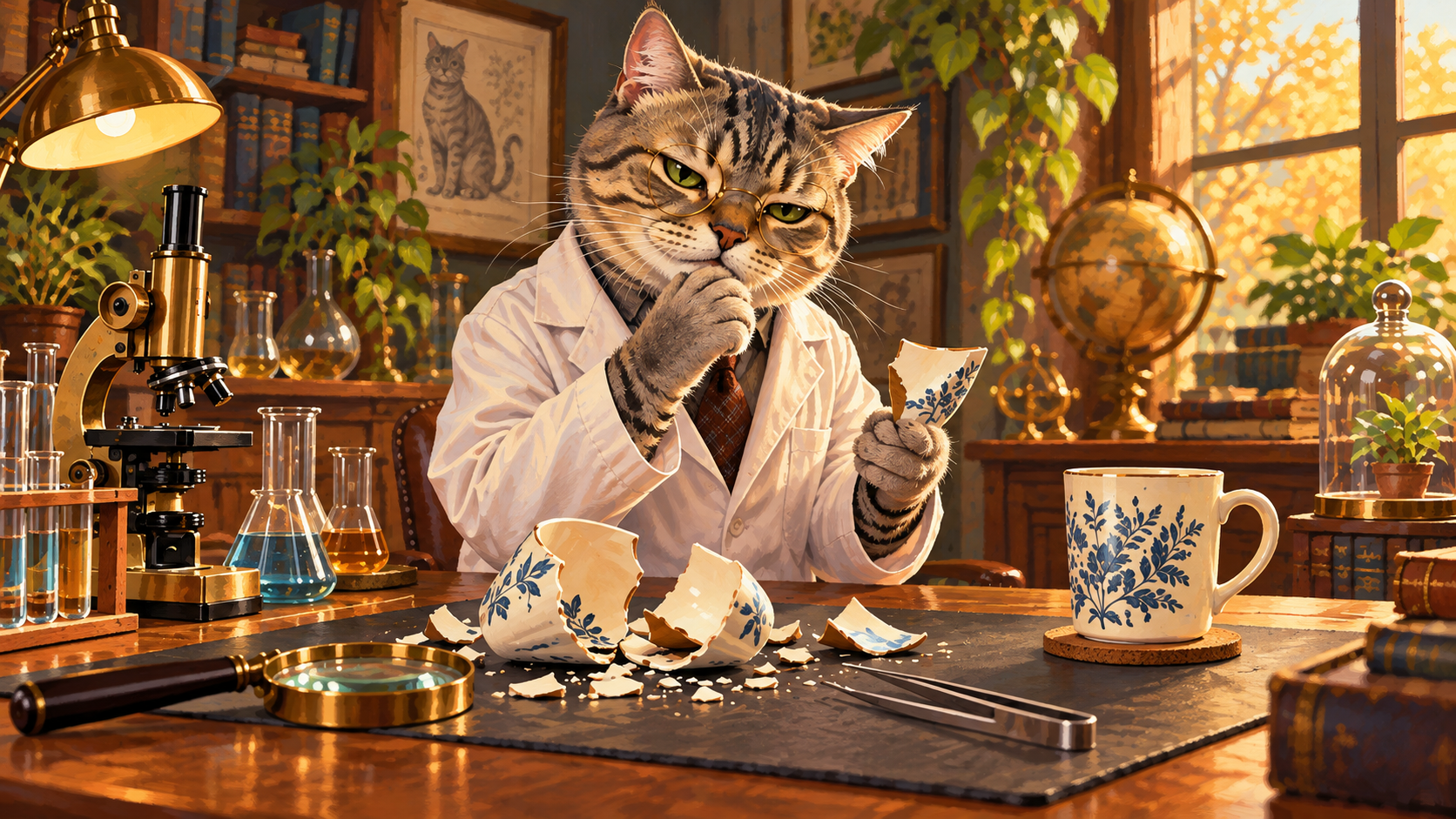
One of the most important small details in the approved artwork is the broken mug identified as “CONTROL SAMPLE #1.” It sits near the lower left of the laboratory scene with pieces scattered around it, transforming what would otherwise be ordinary household damage into formal experimental evidence. That label is part of the artwork itself, and it sharpens the joke because it gives the breakage an official role.
A control sample normally suggests comparison and procedure. Here, the object has already been destroyed, which immediately makes the scientific framing ridiculous. Yet the cat seems entirely comfortable with the arrangement. The shattered cup does not read as a mistake. It reads as prior work.
This detail also helps explain the main phrase visually. “Break another one” is not an abstract threat. One item has already been sacrificed to the study, and the scene implies that the researcher considers further testing justified. The viewer does not need a separate narrative panel showing the first incident. The debris establishes history in a single glance.
The control-sample gag also broadens the humor from simple destruction to bad methodology dressed as good methodology. The cat is not merely using scientific language; it is using it with suspicious confidence. That gives human viewers something extra to recognize, especially anyone familiar with the way official terminology can make questionable decisions sound respectable.
Cats Judging Humans turns that recognition back on domestic life. Humans may object that a favorite mug was broken. The cat has documentation proving that the object served an important research function. Whether the experiment was necessary is, apparently, outside the scope of the review.
The broken sample therefore does more than decorate the scene. It is the physical bridge between the familiar cat behavior and the laboratory satire. Without it, the scientist role would still be funny. With it, the whole argument becomes self-contained: evidence exists, results remain inconclusive, and regrettably another object must be selected.
The Clipboard Turns Destruction Into Procedure
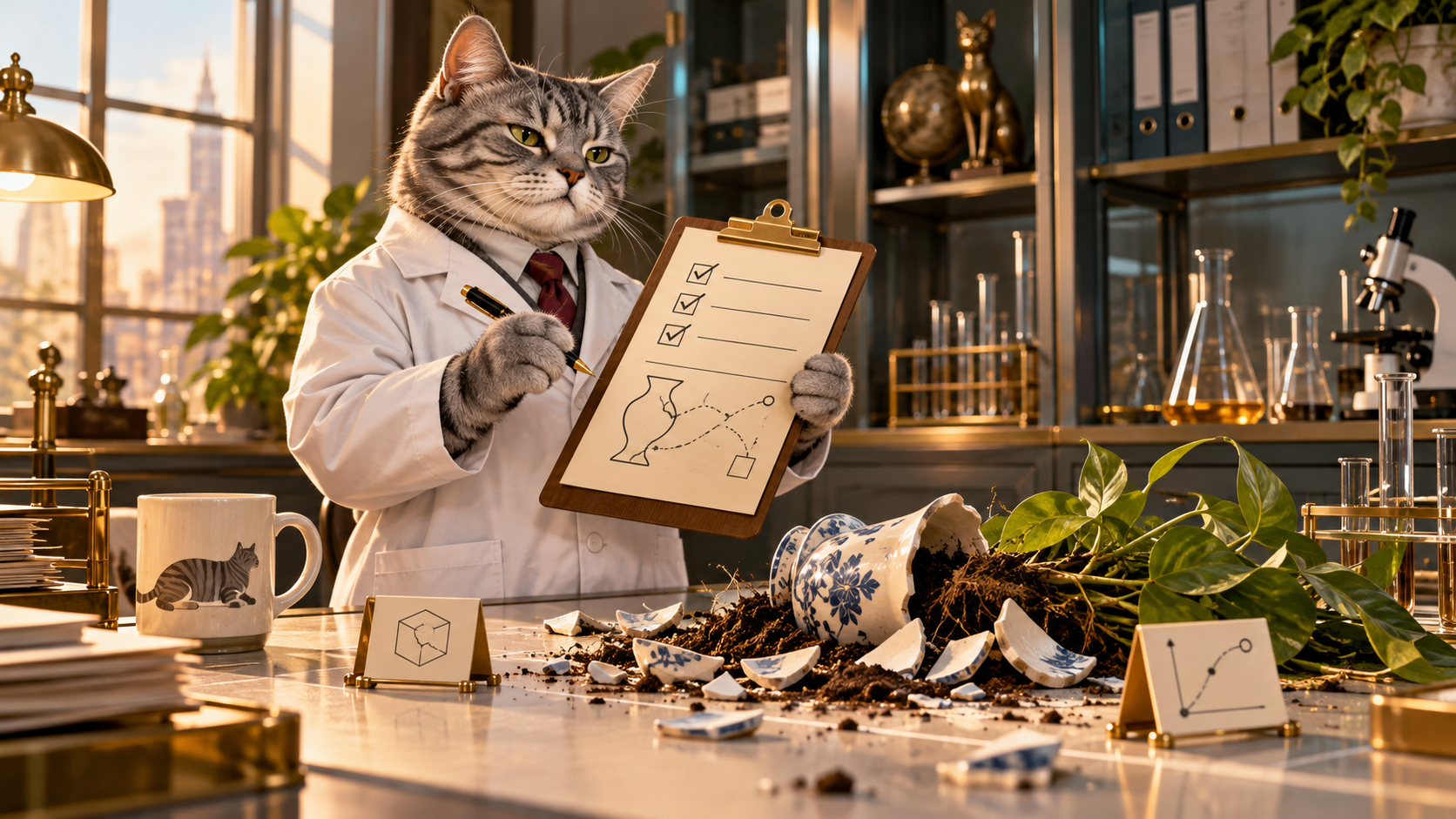
The clipboard on the right side of the approved artwork is another detail that makes the joke feel organized rather than random. It presents the cat’s work as a process with steps: a hypothesis about needing more data, followed by a sequence that includes observing, dropping, analyzing, and repeating. The exact wording belongs to the visible artwork, but its editorial function is broader: it transforms a feline impulse into something that looks like a workflow.
That is especially effective because clipboards carry an aura of accountability. They imply checklists, documentation, compliance, and official procedure. Here, all of that administrative seriousness is being used to support the least convincing possible research agenda: continue knocking things over until the result becomes satisfactory.
The humor lands in the gap between the visual form and the actual logic. A neat checklist suggests discipline. The proposed method suggests chaos. The cat stands comfortably between those two realities and appears to see no contradiction.
This also gives the design an office-adjacent quality even though the setting is a laboratory. Cats Judging Humans often works by placing cats in roles that let them evaluate human systems from above. A scientist with a checklist belongs to the same family of authority figures as an inspector, manager, supervisor, or reviewer. The cat is not simply doing something; the cat has formalized the doing.
That formalization matters because it makes the viewer imagine an entire invisible institution behind the scene. Somewhere, presumably, this protocol has been approved. Somebody authorized the mug budget. Somebody decided repetition was necessary. The fact that the only visible staff member is a cat should probably concern everyone.
The clipboard therefore serves as both prop and punchline support. It tells the viewer that the next broken object is not spontaneous. It is scheduled.
The Laboratory Props Build Credibility for a Completely Unreliable Experiment
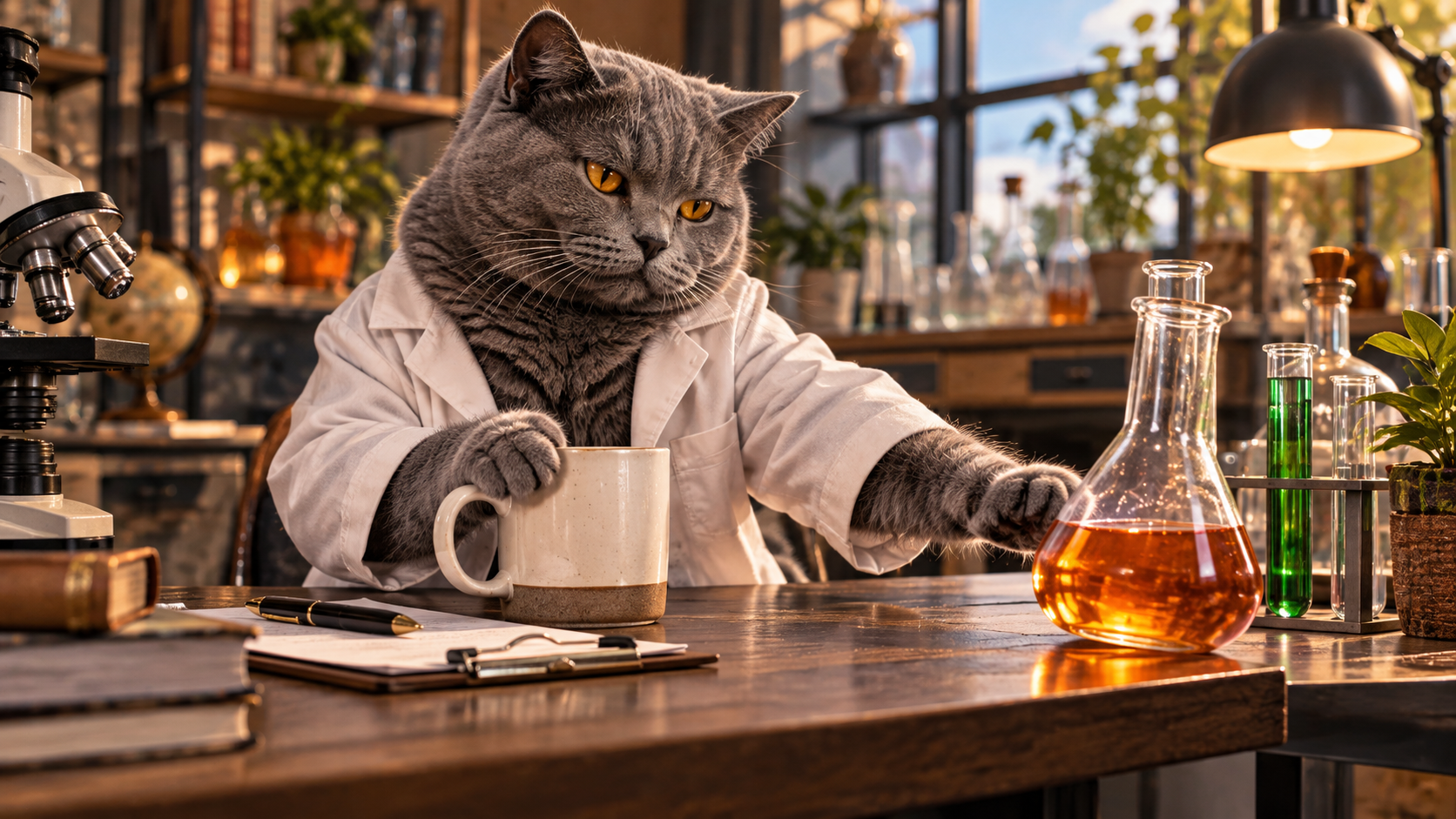
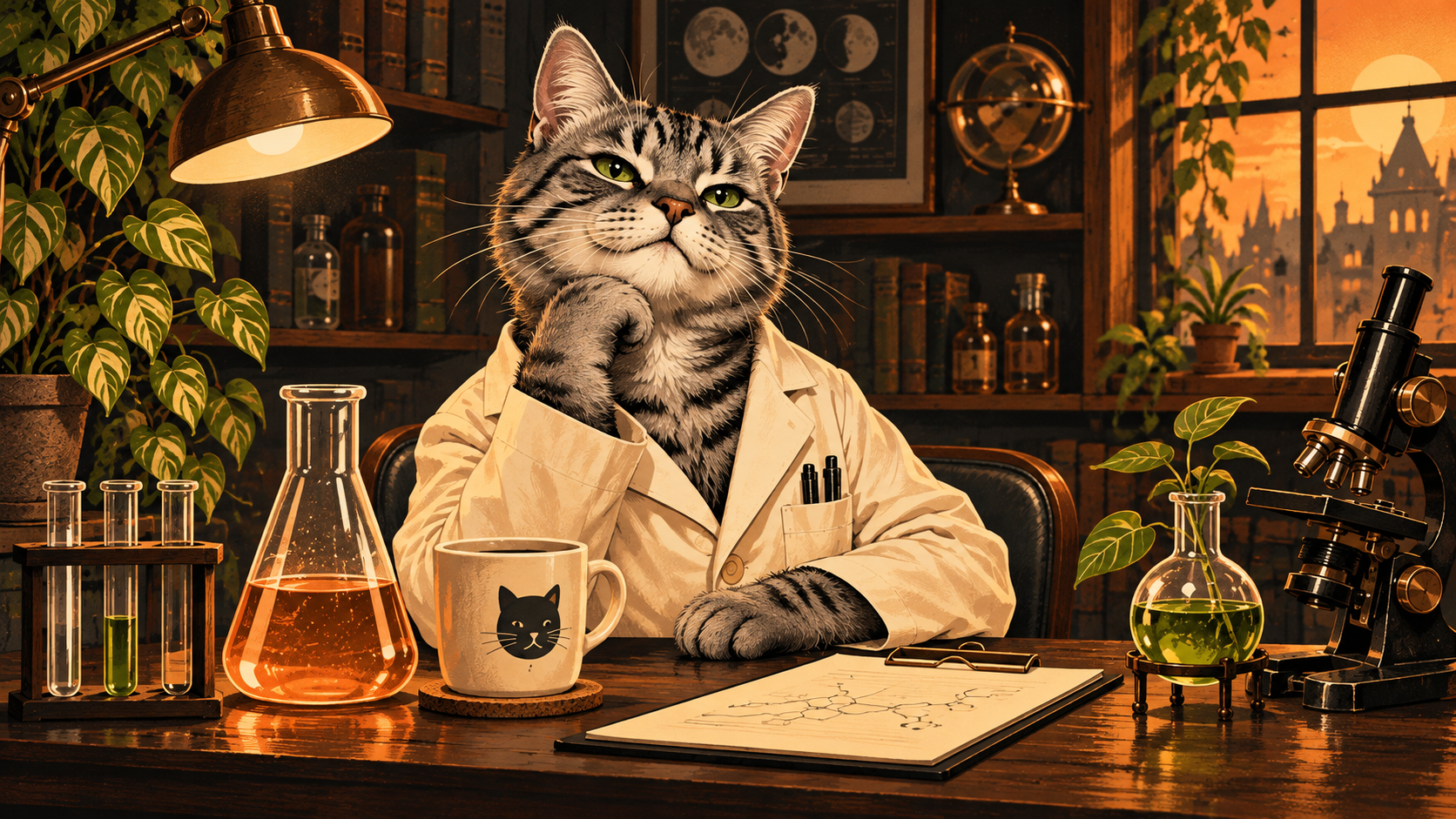
The approved artwork surrounds the cat with a compact set of laboratory props: flasks, a narrow test tube, a mug, a workbench, a pen, and the clipboard. These objects do not need to explain a real experiment. Their role is visual credibility. They create enough of a laboratory vocabulary that the viewer accepts the cat’s identity as a researcher long enough for the joke to work.
Color helps separate those props from the darker cat and workbench. One flask contains warm orange liquid, while a smaller tube holds green. The bright contents add a controlled pop of color without overwhelming the cream, black, gray, and orange palette of the main design. They also make the upper-right portion of the illustration feel active and technical rather than empty.
The mug under the cat’s paw is more important than the glassware because it links the laboratory to ordinary household life. A flask belongs in a lab. A coffee mug belongs in a home or office. Bringing both into the same scene allows the design to sit precisely between scientific parody and familiar cat-owner experience.
The approved concept describes a laboratory cat preparing to push a second object from a table. The artwork carries that idea with a paw positioned near the mug rather than depicting a dramatic crash. That restraint is smart. The viewer understands what may happen next without needing an action sequence.
The props therefore establish possibility rather than explanation. We do not need to know what the liquids are, what the experiment studies, or what measurement is being taken. Inventing those details would weaken the joke by turning a visual gag into unnecessary pseudo-science.
The best reading is simpler: the cat has enough equipment to look official, enough evidence to justify concern, and exactly enough confidence to continue.
Scientific Language Gives the Cat an Unfair Advantage
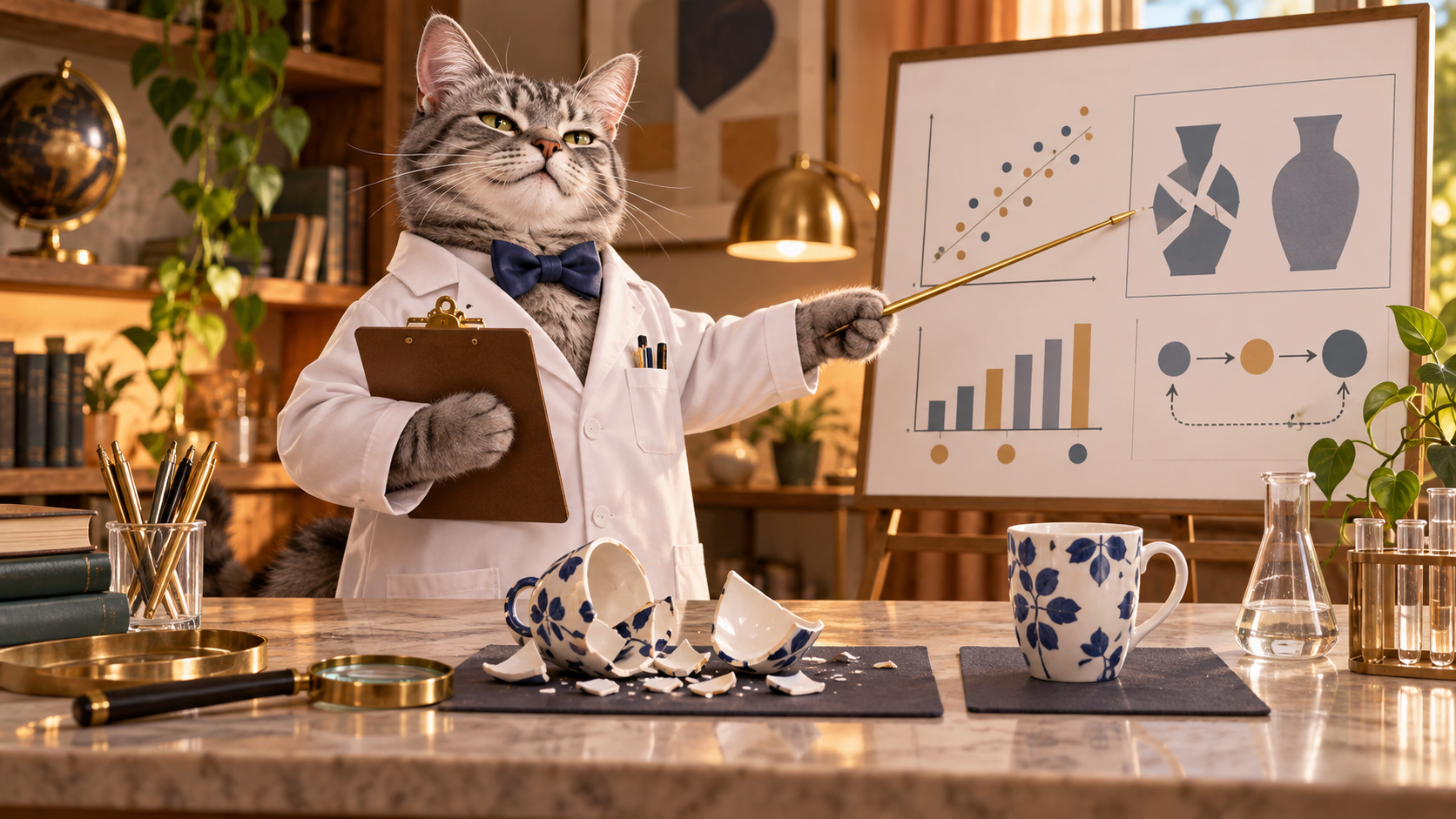
Part of the design’s appeal comes from the way scientific language can transform a ridiculous action into something that sounds legitimate. “Results inconclusive” is the kind of phrase that implies restraint, caution, and intellectual honesty. It suggests that the researcher refuses to claim more than the evidence supports. Then the second sentence immediately destroys that seriousness: “Break another one.”
That structure is efficient because the first half raises the tone while the second half reveals the actual agenda. The cat is borrowing the authority of careful research to defend a behavior humans already distrust. The mismatch is the joke.
The approved visual concept reinforces this through the cat’s role as scientist and the presence of experimental props. The scene looks organized enough that the phrase almost makes sense. Almost. The viewer is given just enough visual credibility to appreciate how badly the conclusion has been abused.
This is not a joke against science. It is a joke about rationalization. Cats are already masters of acting as though their decisions require no explanation. Giving one a laboratory merely supplies a vocabulary for that certainty. Now the cat can cite methodology.
Cats Judging Humans often benefits from institutional language because it lets feline arrogance masquerade as process. A cat that simply knocks over a mug is mischievous. A cat that declares the results inconclusive and orders another trial is an authority figure.
The phrase also avoids overexplaining itself. It does not tell the viewer what question is being studied or what result was expected. That absence is useful. The only conclusion we can confidently draw is that the cat would like another object.
From the human perspective, this is a terrible development. It is difficult enough to stop a cat from pushing things off a table. It is considerably harder once the cat has peer-reviewed itself.
The Typography Delivers the Verdict With Laboratory Confidence
The phrase occupies the lower half of the artwork in large, bold display lettering, which gives the design a strong visual hierarchy. “RESULTS INCONCLUSIVE.” appears in a large cream treatment, while “BREAK ANOTHER ONE.” is emphasized below in orange. That color shift separates diagnosis from action: first the formal finding, then the irresponsible recommendation.
The typography is heavy enough to balance the illustrated laboratory scene above it. This matters because the upper section contains multiple props and character details. Without substantial lettering, the artwork could feel top-heavy. Instead, the text forms a broad base that visually anchors the cat scientist and the workbench.
The type also supports the vintage-inspired illustration style. It feels bold and printed rather than sleek or clinical, which keeps the overall piece inside the Cats Judging Humans visual world rather than turning it into a modern science infographic. The small paw motifs at the sides further connect the text block to the feline subject.
Most importantly, the typography preserves readability. The joke depends on a two-part sentence, so the viewer needs to understand the sequence quickly. The large cream line establishes the problem. The orange line delivers the escalation. The period after each sentence makes the phrasing feel clipped and official.
That clipped rhythm is part of the character voice. The cat does not ask a question. It does not suggest another trial. It issues a conclusion and an instruction. The typography makes that authority visible.
For an apparel composition, this relationship between illustration and phrase is especially useful. The cat attracts attention, the scientific props establish context, and the lettering resolves the joke. No separate caption is needed. The entire experiment, including the catastrophically biased recommendation, fits inside one compact visual system.
The Composition Reads Like One Compact Research Emblem
The approved artwork is vertically organized, but it does not feel like a character floating above unrelated text. The cat, broken mug, laboratory bench, clipboard, glassware, and large phrase are interlocked into one compact silhouette. That cohesion gives the design the feeling of an emblem rather than a poster assembled from separate pieces.
The cat sits slightly left of center, which creates room for the laboratory bench and clipboard on the right. The raised tail fills the upper-left area and helps balance the tall flasks on the opposite side. The broken sample occupies the lower-left edge of the illustrated scene, while the bench creates a horizontal bridge across the middle.
Below that, the typography expands outward into the widest visual mass. The cream and orange text blocks create a stable foundation, while small paw icons on either side reinforce the theme without competing with the phrase. The result is a composition that widens as it descends, giving the design a grounded, substantial shape.
That structure also supports the narrative. The eye begins with the cat scientist, moves toward the mug and scientific props, notices the broken sample and checklist, then reaches the large verdict. The scene and phrase therefore operate in sequence even though everything is visible at once.
A compact silhouette is especially useful for a design with many details. The laboratory elements remain close to the cat instead of spreading into a wide scene. That containment keeps the artwork legible as a single unit and avoids the feeling of a busy collage.
The visual organization also fits the joke’s faux-professional tone. Nothing appears random, even though the underlying behavior is chaotic. The composition has been carefully controlled so the cat can continue claiming the experiment is equally controlled.
The Color Palette Keeps the Science Warm, Witty, and Feline
The artwork uses a restrained palette dominated by black, cream, gray, warm orange, and small accents of green. That choice keeps the design cohesive and helps the laboratory theme feel like part of the Cats Judging Humans brand rather than a generic educational graphic.
Cream carries much of the visual light. It appears in the lab coat, the main lettering, the mug, the clipboard paper, and several small highlights. Against the transparent background and darker illustrated elements, that cream creates strong readability without becoming stark white.
Orange provides the strongest accent. It appears inside the scientific glassware, in the lower phrase, in paw motifs, and in smaller decorative details. Because the orange is warm and muted rather than neon, it feels playful and vintage rather than hazardous or synthetic.
The gray tabby cat sits comfortably between those extremes. Its fur pattern introduces natural texture and lets the green eyes stand out. The green is used sparingly, both in the eyes and in one of the laboratory vessels, which creates a subtle visual echo without turning the palette into a rainbow.
Black outlines and shadowed forms provide structure throughout the illustration. They define the coat, glasses, bench, typography, and silhouette, keeping the many small objects from dissolving into one another.
The palette is therefore doing more than decorating a science joke. It keeps the cat visually dominant, makes the text readable, separates the props, and preserves the warm, premium character of the brand.
That warmth matters because the concept involves broken objects. The design does not feel aggressive or destructive. It feels clever and controlled. Even the chaos has been color-corrected for presentation, which is exactly the level of professionalism this research department apparently demands.
The Humor Works Because Cat Owners Already Know the Experiment
The design depends on recognition. A viewer does not need to believe that every cat pushes objects from tables, and the artwork does not make a factual behavioral claim about all cats. The joke instead draws on a familiar cultural image of feline curiosity around precariously placed household items. That shared reference is enough for the scientist framing to land immediately.
The concept becomes especially relatable because the object is ordinary. A mug is not an exotic laboratory specimen. It belongs to the human world. Its presence connects the exaggerated research setup to everyday domestic life.
Cat-owner humor often works by giving intention to behavior that humans find baffling. The cat does something inconvenient, and the human invents a motive: spite, curiosity, boredom, testing, judgment, or supervision. This design chooses the most flattering possible explanation for the cat. The mug was not knocked down for entertainment. It was sacrificed in pursuit of knowledge.
That interpretation is absurd enough to be funny while still feeling emotionally familiar. Cats often carry themselves with such confidence that humans are willing to imagine a complete internal logic behind their actions. The scientist role simply makes that invisible logic visible.
The phrase also invites the viewer to continue the story. If the first result was inconclusive, what happens after the second mug? What if those results conflict? How many household objects are required before the study reaches significance? The design wisely refuses to answer.
That open-endedness keeps the joke alive beyond the image. The human realizes that “break another one” may not be the conclusion at all. It may simply be the next line in a very expensive research program.
The Cat Scientist Fits the Cats Judging Humans Authority System
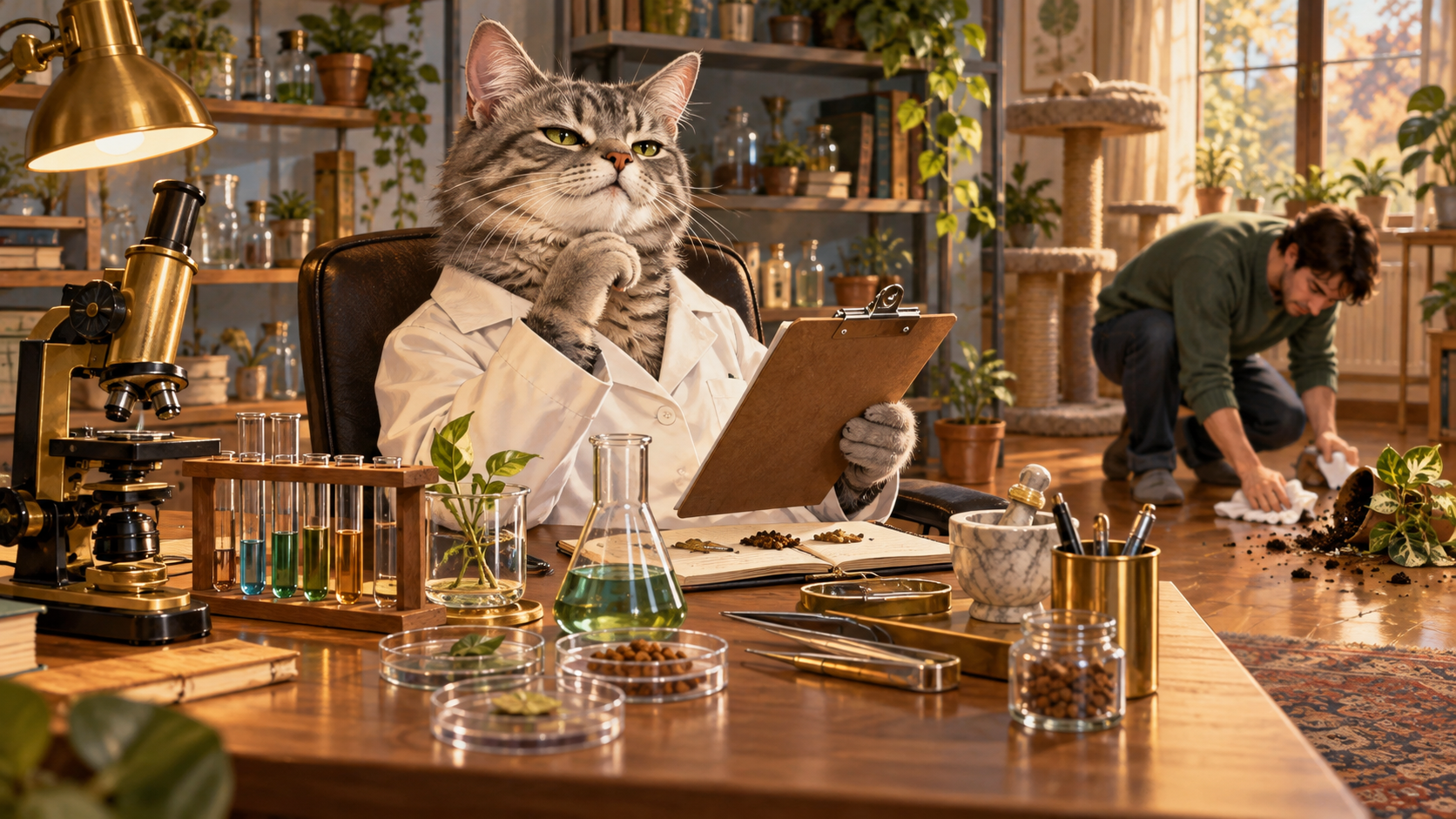
Cats Judging Humans repeatedly turns cats into authority figures because the relationship is naturally comic. A household cat already behaves with a level of certainty that can resemble management, inspection, supervision, or judgment. This design extends that idea into scientific authority.
The cat scientist is not evaluating the human directly in the same way as an HR manager or inspector might, but the human remains implicated. The objects being tested belong to the household. The consequences belong to the human. The cat controls the interpretation of the evidence.
That dynamic fits the brand because power comes from tone rather than aggression. The cat looks skeptical, competent, and slightly superior. There is no need for cruelty or hostility. The humor comes from the assumption that the cat has both the right and the expertise to continue.
The white coat, glasses, clipboard, and organized bench make the authority visible without requiring the official Cats Judging Humans logo. The design stands on its own as a character-driven joke. That is important for catalog variety: brand identity can remain recognizable through voice, composition, and feline attitude rather than through repeated branding marks.
The science setting also broadens the brand’s world. Not every cat needs to sit on a throne or behind an office desk. A laboratory provides a different kind of hierarchy—one based on knowledge, procedure, and the ability to explain away obvious destruction as research.
The central relationship remains the same. The cat sets the terms. The human deals with the consequences. And if the human questions the methodology, the researcher can always request more data.
The Design Balances Nerdy Detail With Immediate Readability
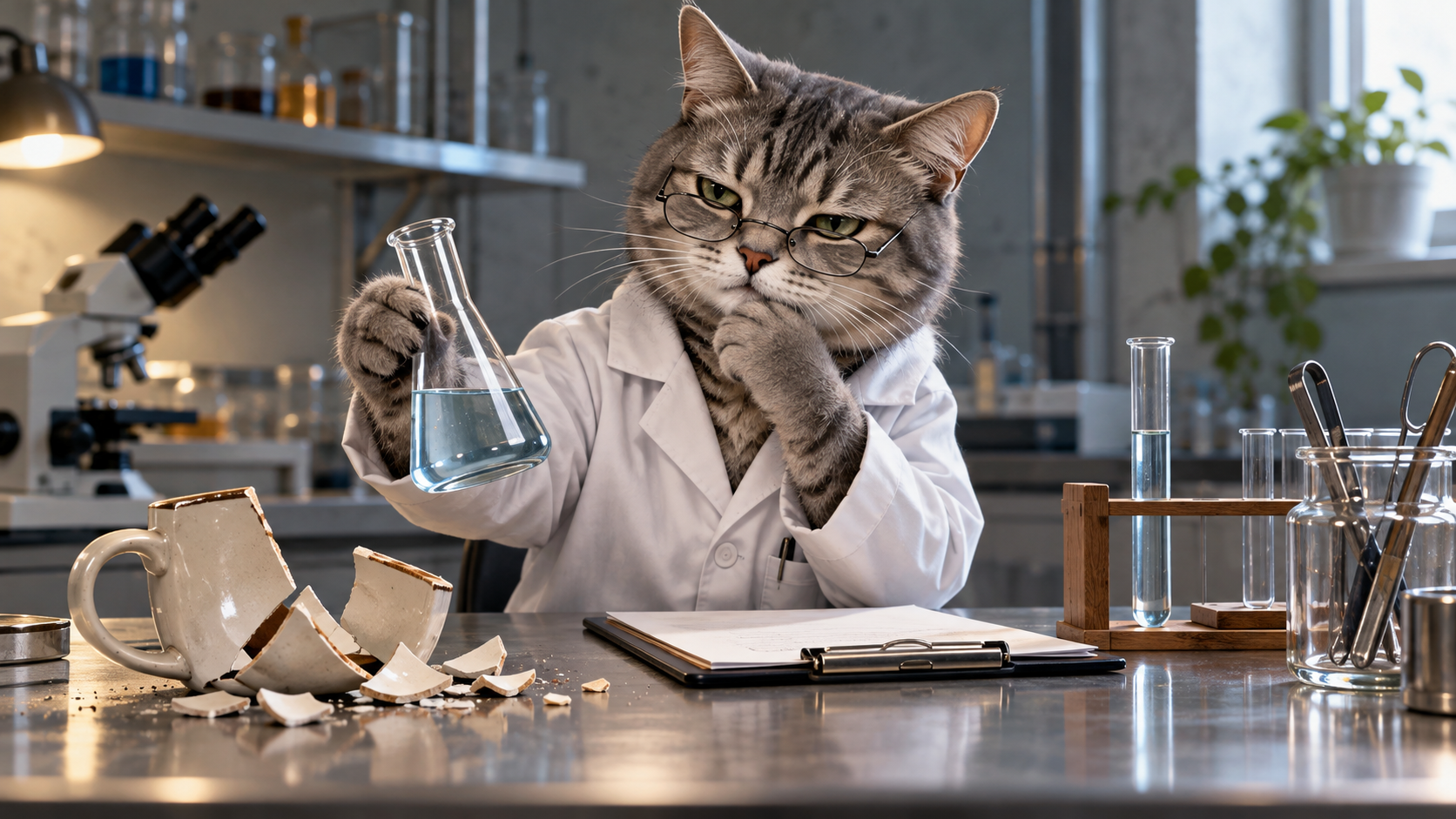
Science-themed humor can easily become overloaded with equations, labels, instruments, and technical references. The approved artwork avoids that problem by choosing a handful of recognizable props and keeping the central joke broad. There are flasks, a test tube, a workbench, a mug, a clipboard, glasses, and a lab coat. That is enough to establish the laboratory without forcing the viewer to decode a technical diagram.
The details reward closer inspection, especially the broken control sample and the checklist, but they are not required for the main phrase to work. At a quick glance, the viewer sees a scientist cat and a verdict about inconclusive results. On a second look, the props explain exactly how absurd the research program has become.
That two-level readability is useful because the design appeals both to cat humor and to a broader “nerdy” visual language without demanding specialized knowledge. A viewer does not need to understand experimental design in depth. The basic structure—test, result, repeat—is familiar enough to support the joke.
The cat’s expression also prevents the scene from becoming too cute or whimsical. It remains dry and analytical, which helps the design feel sharper than a generic cartoon laboratory.
The balance is especially visible in the way the upper scene and lower typography interact. The illustration contains the detailed joke mechanics, while the large phrase delivers the simple conclusion. Neither half tries to do everything.
That makes the design accessible without making it shallow. Someone can enjoy it immediately because a cat wants to break another object. Someone else can linger on the control sample, workflow, and visual language of research. In both cases, the same conclusion emerges: the experiment has been designed by someone with a suspiciously strong preference for additional breakage.
The Evergreen Appeal Comes From Curiosity, Rationalization, and Household Chaos
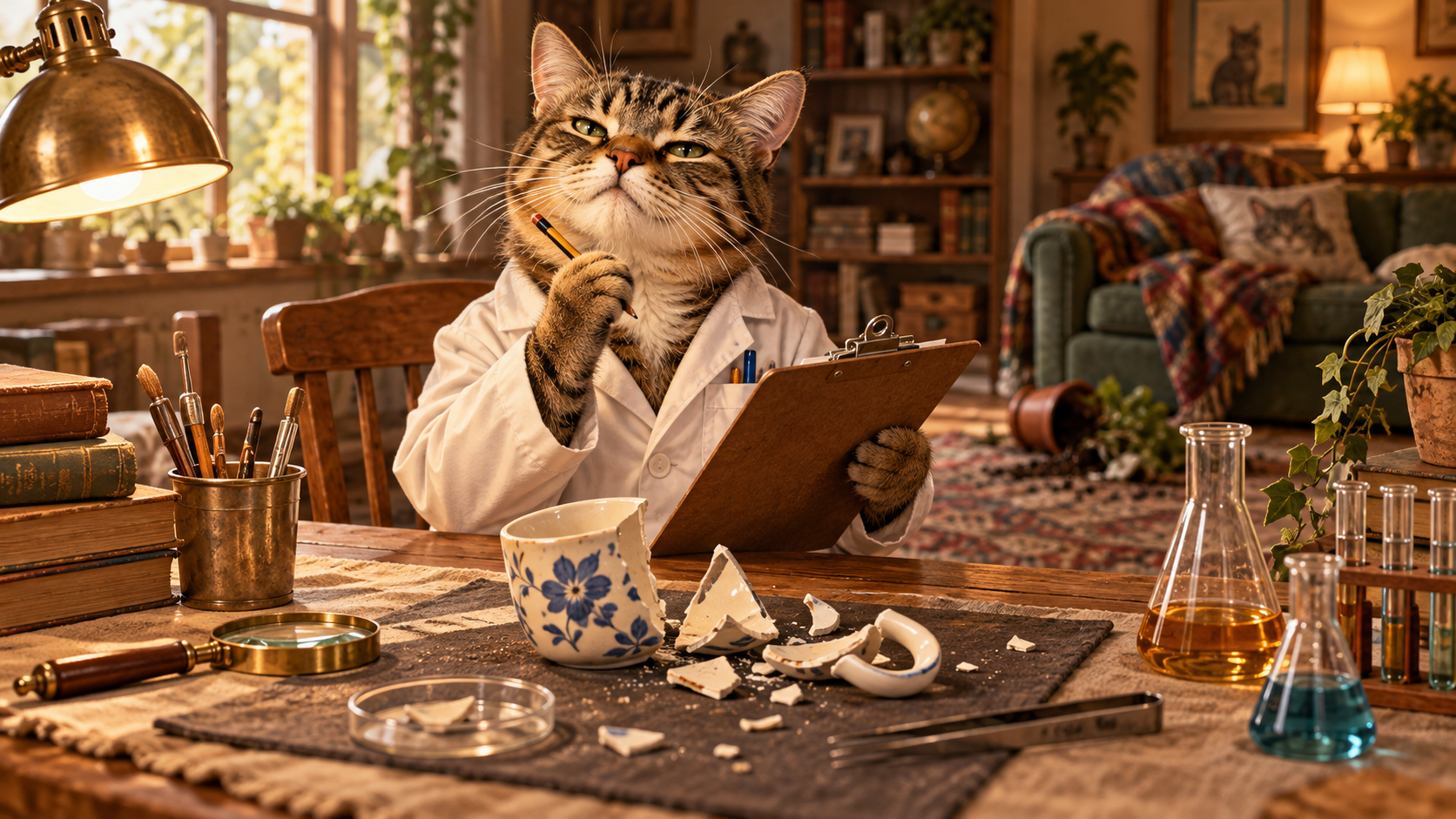
The concept is evergreen because it is not tied to a current meme, platform feature, news event, celebrity, or temporary reference. Its humor comes from durable ideas: cats are curious, humans live with fragile objects, and people are very good at inventing elaborate explanations for feline behavior.
The scientific framing adds another timeless layer because the language of experiments, evidence, controls, and repeated trials is broadly recognizable. The design does not depend on a specific technology or contemporary trend. A lab coat, clipboard, flasks, and a skeptical researcher are enough to establish the joke.
The phrase itself also has room to remain funny because it captures a general pattern of rationalization. When someone wants to do something again, “the results are inconclusive” can become a convenient excuse. The cat simply applies that logic to breaking household objects.
That makes the design relatable beyond one exact incident. A viewer can imagine mugs, glasses, pens, plant pots, or any other object becoming part of the study, but the artwork does not need to list them. The single broken control sample is enough to suggest the wider universe.
Within the Cats Judging Humans catalog, the evergreen quality also comes from role-based humor. Cats can be managers, rulers, inspectors, researchers, or supervisors because those roles all exaggerate the same basic feline confidence. The setting changes, but the power structure remains recognizable.
The scientist version is especially durable because it gives curiosity an official title. As long as humans continue placing objects near edges and cats continue looking interested in the world around them, the premise has somewhere to live.
The study may never reach a conclusion. From the cat’s perspective, that is excellent news.
Why the Joke Stays Playful Instead of Hostile
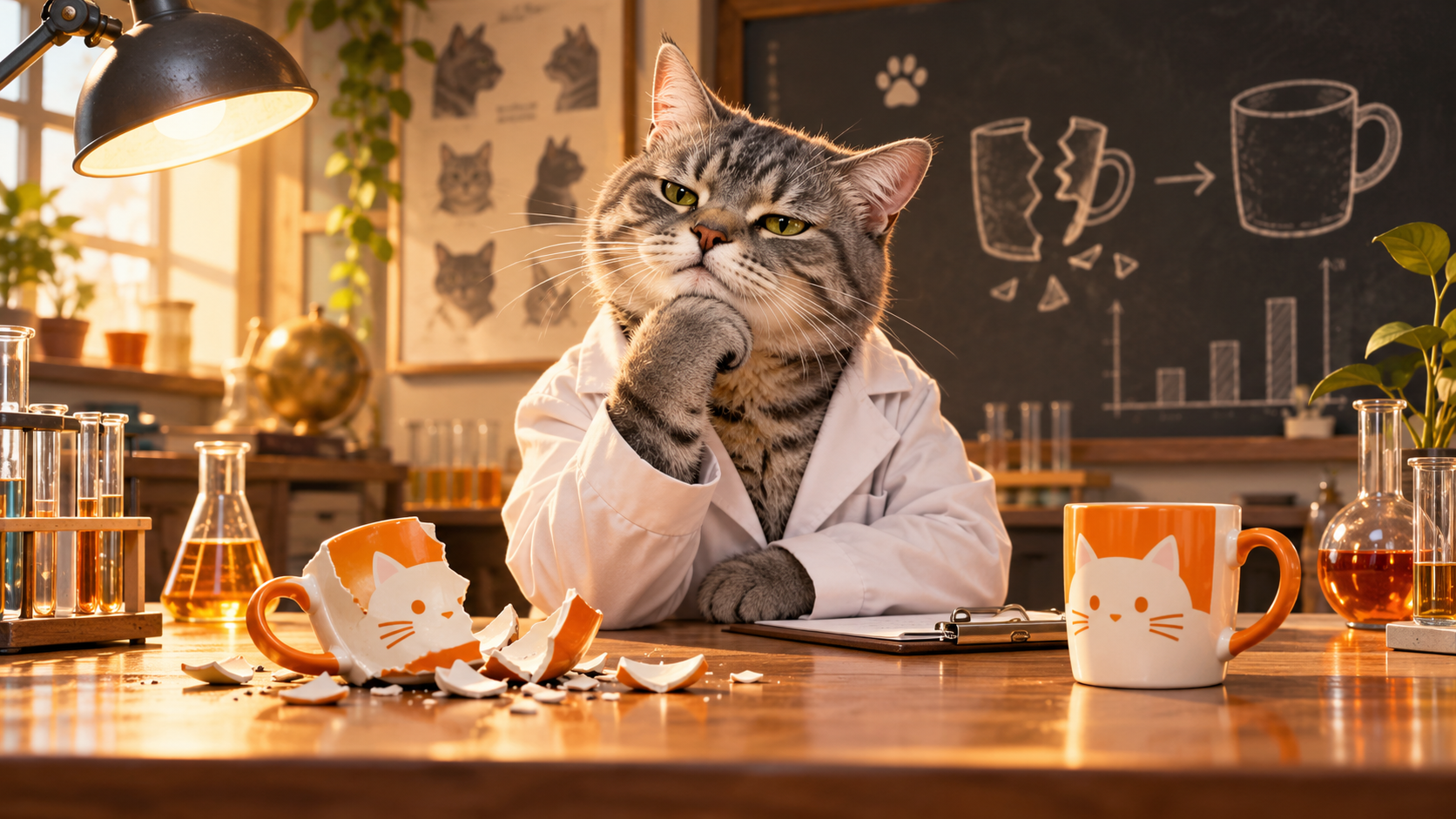
The design involves destruction, but the tone remains playful because the scene is framed as absurd research rather than aggression. The cat is not threatening a person. There is no violence, fear, or cruelty. The broken object is an ordinary mug, and the humor comes from the explanation attached to the act.
The cat’s face is skeptical and superior, but not enraged. The body language is controlled. The paw reaching toward the mug feels deliberate, which supports the scientist role, yet the overall scene remains comic rather than menacing.
That tonal balance is important for Cats Judging Humans. The brand works best when cats are judgmental, demanding, or mildly exasperated without becoming genuinely hostile. Here, the cat’s superiority is intellectual. It believes the human simply does not understand the research.
The bright cream coat, warm orange accents, and stylized props also keep the visual mood approachable. The laboratory is compact and theatrical rather than dark or dangerous. Nothing suggests hazardous experimentation beyond the terrible future of household ceramics.
The phrase contributes to that balance because it is deadpan. “Break another one” could sound aggressive in a different context, but paired with “results inconclusive” and a scientist cat, it becomes procedural nonsense. The cat is not angry. The cat is committed to replication.
This is an important difference between clever sarcasm and simple destruction humor. The broken mug is not the punchline by itself. The punchline is the cat’s refusal to accept responsibility because it has reclassified the event as research.
That keeps the viewer on the cat’s side even while recognizing the human problem. The experiment is obviously ridiculous. The researcher is obviously biased. And somehow the human is still expected to provide another sample.
The Next Trial Is Implied, Not Shown
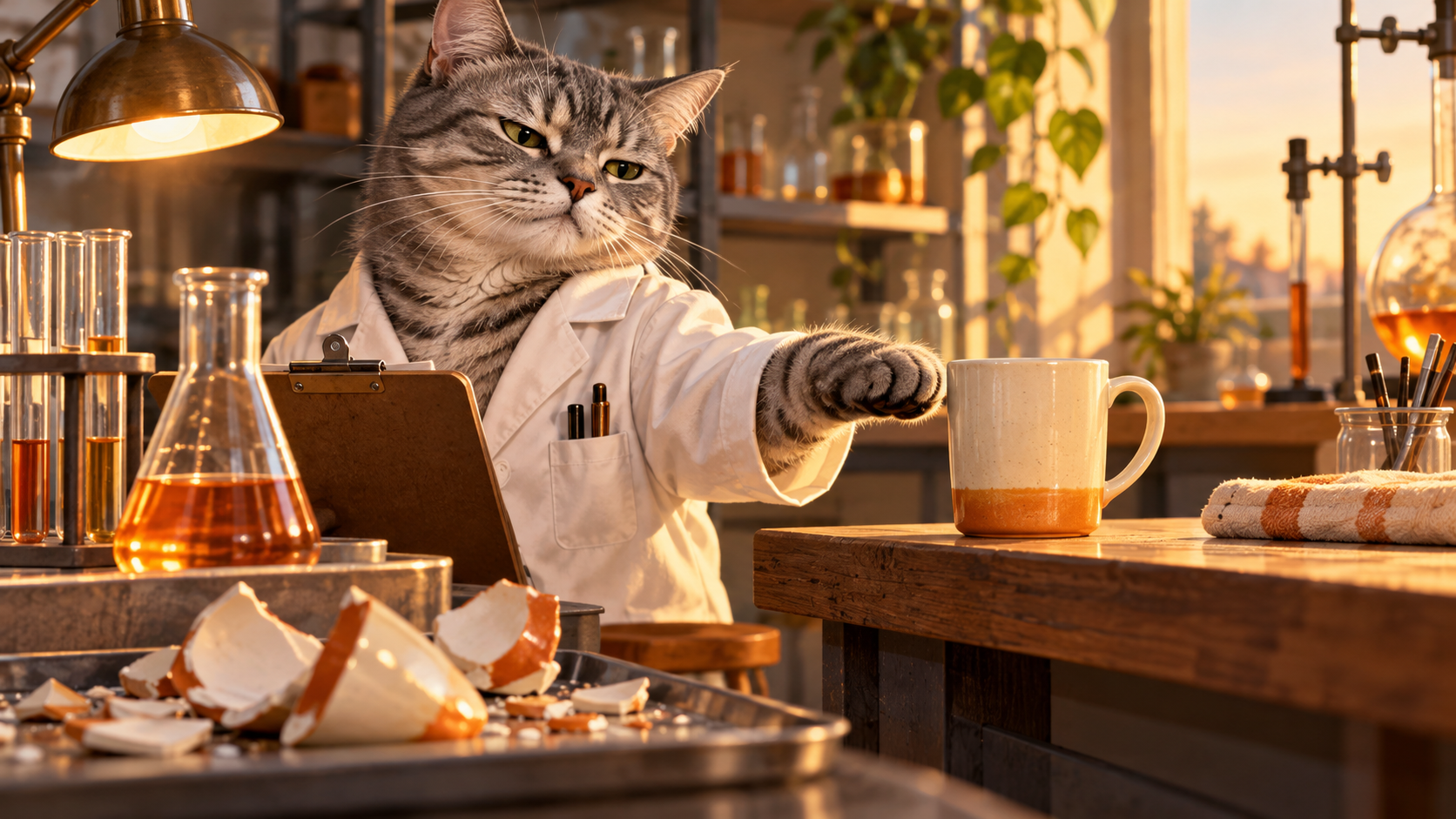
A useful visual decision in the approved artwork is that the next breakage has not happened yet. The cat’s paw is positioned near a standing mug, but the object remains intact. That moment of anticipation gives the phrase extra force because the viewer is asked to imagine what comes next rather than simply witnessing another crash.
The broken control sample establishes that the experiment has a past. The upright mug establishes that it has a future. Between those two objects sits the cat, calm enough to make the entire sequence feel intentional. The design therefore captures a complete story without showing multiple panels or stages.
That choice also keeps the tone drier than an action-heavy scene would. A mug caught midair with exaggerated motion lines could turn the joke into slapstick. Here, the cat appears to be considering the next move with professional restraint. The humor comes from the inevitability of the decision, not from the spectacle of the fall.
The phrase “Break another one” acts almost like a command issued immediately before the event. Because the viewer can see the likely candidate, the wording becomes visually specific without requiring an arrow or extra label. The cat’s paw, the mug, and the previous debris create the chain of evidence.
This moment-before-action structure is also useful for the brand voice. Cats Judging Humans is often funniest when the cat has already decided something and the human is simply late to understanding it. The researcher’s face suggests that debate is over. The next trial is a matter of procedure.
By stopping just before the impact, the artwork gives the viewer time to appreciate the absurd logic. The human can still intervene, theoretically. But given the clipboard, the lab coat, and the existing control sample, interfering with the study may require additional paperwork.
The Design Turns Rationalization Into a Feline Superpower
Beyond the immediate science joke, the design is really about rationalization: the ability to explain a questionable action in language that makes it sound necessary. The cat has not changed the facts. A mug was broken. Another mug is at risk. What changes is the interpretation. By calling the result inconclusive, the cat converts repetition from bad behavior into responsible follow-up.
That mechanism fits Cats Judging Humans because feline authority often comes from refusing the human’s framing. The human says “You broke it.” The cat says “The trial produced insufficient evidence.” The human says “Do not touch the other mug.” The cat hears “additional sample available.” The joke lives in that translation gap.
The scientist role is particularly effective because research language can sound impartial even when the researcher is obviously invested in the outcome. This cat appears to want another trial, which makes every piece of procedural seriousness slightly suspicious. The glasses, coat, clipboard, and labware do not prove objectivity; they merely make the bias look organized.
That is why the design can appeal even to viewers who are not especially interested in science-themed imagery. The deeper joke is familiar in many contexts: someone wants permission to continue, so they redefine the evidence until continuation seems justified. The cat just happens to be unusually transparent about the desired result.
The artwork keeps the idea playful by making the stakes domestic. We are not looking at a dangerous experiment or a serious institutional failure. We are looking at a mug and a cat with credentials nobody remembers approving.
The final effect is pure feline confidence. The cat does not need to win the argument because it controls the terminology. Once “breaking things” has been renamed “collecting more data,” the human has already lost the meeting.
“Results Inconclusive. Break Another One.” works because the approved artwork and phrase commit to the same absurd logic from beginning to end. The gray tabby scientist wears the coat, glasses, and expression of someone who expects professional respect. The laboratory props establish a credible research setting. The broken control sample proves that prior work has already occurred. The clipboard makes the process look documented. The raised paw suggests that the next trial is not theoretical.
Then the typography delivers the real finding: none of this has produced enough certainty to stop. The only scientifically acceptable response is apparently to sacrifice another household object. That is the Cats Judging Humans joke in its cleanest form. A familiar feline behavior has been elevated into an institution, and the human is left arguing with procedure.
The design stays warm and playful because the cat is not cruel, merely convinced. The laboratory is not dangerous, merely suspiciously well organized. The destruction is not random, merely rebranded. And the research program may continue indefinitely, because a cat capable of declaring the results inconclusive has already discovered the perfect excuse never to finish the experiment.
The final irony is that the design’s supposed search for certainty guarantees more uncertainty. Every new broken object can produce another result, another interpretation, and another excuse to continue. That circular logic is exactly why the scientist role feels so appropriate for the joke: procedure has become protection from accountability. The cat can remain perfectly serious while the human watches the sample size—and the cupboard—shrink. Nothing in the artwork suggests the researcher plans to surrender authority to an outside reviewer. The laboratory belongs to the cat, the protocol belongs to the cat, and the threshold for conclusive evidence appears to be whatever keeps the next trial available. As feline bureaucracy goes, it is impressively efficient: the experiment cannot fail if failure simply authorizes another experiment.