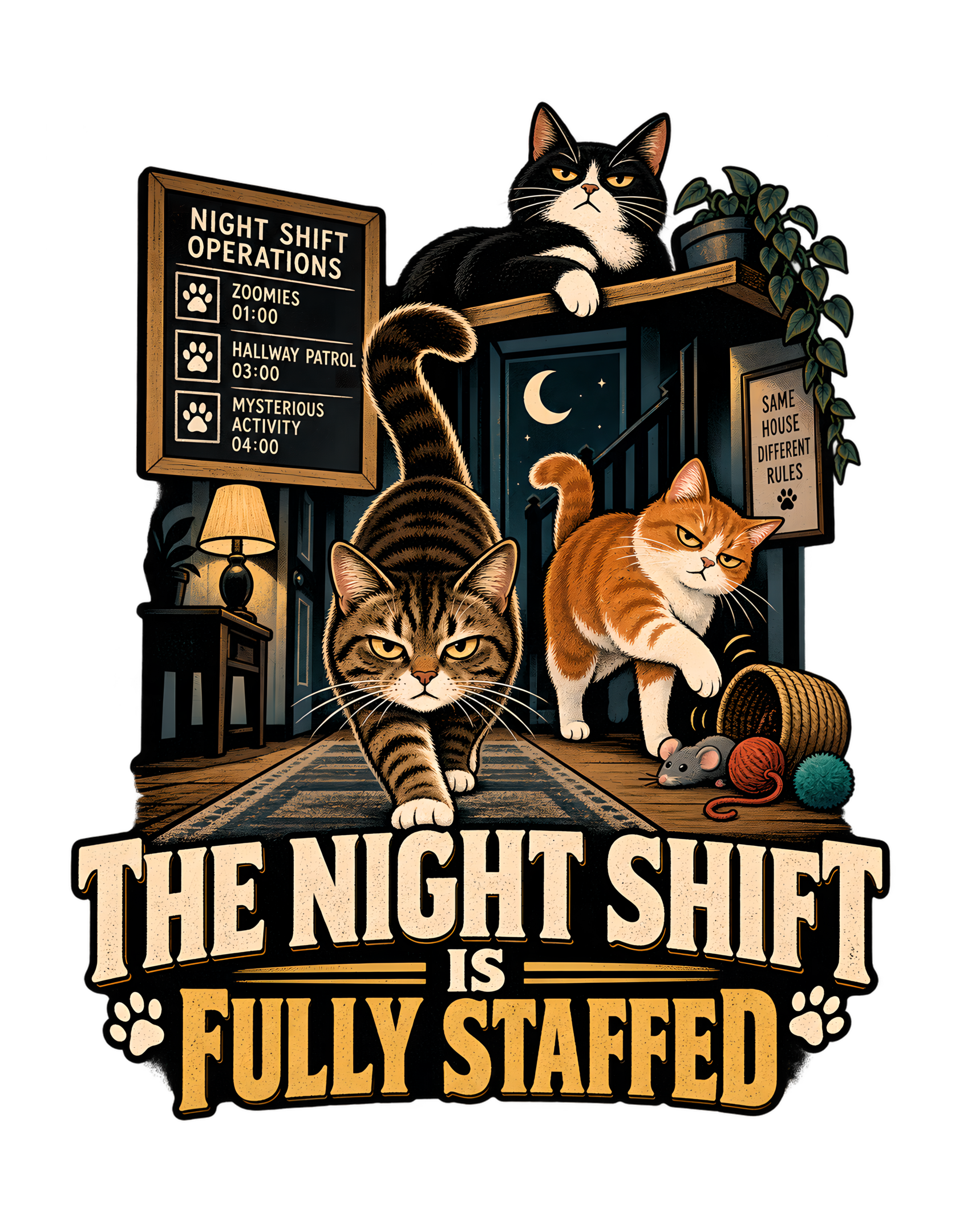
“THE NIGHT SHIFT IS FULLY STAFFED” turns an ordinary multi-cat household after dark into a fully operational overnight department. The canonical concept is simple and unusually efficient: several cats treat late-night zooming, hallway patrols, and unexplained household activity as if they are coordinated staff assignments. The approved production artwork makes that premise concrete with three cats occupying different levels of a dark home interior, a shift-board motif listing overnight duties, a crescent moon beyond the hallway, scattered toys, and a large headline that presents the operation with complete confidence.
The joke works because the scene refuses to call the cats chaotic. Instead, it gives their behavior an organizational structure. One cat is perched above the others like senior management. Another advances down the hallway with the determined expression of someone reporting for duty. A third stands near a tipped toy basket, apparently surrounded by evidence that could be interpreted either as play or as an incident report. The shift board formalizes the premise with visible entries for “ZOOMIES 01:00,” “HALLWAY PATROL 03:00,” and “MYSTERIOUS ACTIVITY 04:00.”
Cats Judging Humans is especially suited to this kind of reversal. Humans usually describe nighttime cat activity as interruption, noise, mess, or inexplicable behavior. The design gives the cats the authority to reclassify those same events as staffing, patrol, quality control, and operational readiness. The human household does not become less chaotic. It simply loses control of the terminology.
The approved artwork is the factual visual authority for this page. This article therefore stays close to what is visible and what the canonical source supports. It does not invent a specific breed identity for the cats, a household routine, a behavioral explanation, or a claim about why cats act at night. The editorial analysis stays where the design itself lives: in the comedy of multiple cats behaving as though the house has a professional overnight workforce and the humans are merely the day shift.
The Joke Begins by Reclassifying Chaos as an Organized Overnight Operation
The central comedy of “THE NIGHT SHIFT IS FULLY STAFFED” comes from a language swap. What a human might call midnight chaos becomes a staffed operation. What might normally be described as running around the hallway becomes patrol. What might look like a toy-related mess becomes suspicious activity requiring feline presence. The design does not ask the viewer to believe the cats are literally running a workplace. It asks them to recognize how easily familiar cat behavior can be reframed once the cats are given authority over the description.
That is a strong Cats Judging Humans mechanism because it places human interpretation under review. Humans tend to name behavior according to inconvenience. If the cat is moving while the human wants to sleep, the human calls it disruption. The design quietly suggests that this is a biased report written by the wrong department.
The phrase “THE NIGHT SHIFT IS FULLY STAFFED” is funny because it sounds reassuring. In a workplace, full staffing suggests competence, coverage, and readiness. In the illustrated household, the same phrase is ominous in the gentlest possible way. The cats are present. The schedule is active. The night has been planned. The humans are not part of the planning committee.
The artwork supports that reversal without needing a long explanation. Three cats are visible, each occupying a different role in the visual hierarchy. The overnight setting is clear. The operation board gives their activity a procedural framework. The large headline turns the whole scene into an official announcement.
This is why the concept works beyond a single joke about zoomies. It is really about ownership of the narrative. The humans see disorder. The cats see staffing.
Cats Judging Humans would naturally side with the department that produced documentation.
The house may be awake at 3:00 a.m.
That does not mean the system has failed.
According to management, the system is performing exactly as designed.
The workplace framing also gives the viewer a reason to reinterpret every ordinary detail in the room. A hallway becomes a route, a shelf becomes a command post, and scattered toys become evidence that an assignment is active. That transformation is the real engine of the joke: nothing about the home has changed physically, but the cats have apparently issued a new set of job titles and declared the overnight department fully operational.
Three Cats Make the Premise Feel Like a Department Instead of a Solo Incident
The approved artwork uses three cats rather than a single cat, and that choice is crucial to the premise. One cat can have a strange night. Three cats create staffing.
The composition gives each cat a distinct place in the visual system. A black-and-white cat is positioned above the others on a high interior ledge, looking outward with the expression of someone who has already seen the overnight report. A tabby cat moves toward the viewer along the hallway runner, occupying the strongest forward-driving position in the composition. An orange-and-white cat stands near a tipped basket and loose toys, surrounded by the kind of evidence that would make a human ask questions.
Together, they create the sense of simultaneous responsibilities.
The concept becomes much more specific because the cats are not stacked into one crowd. They occupy different levels and different zones of the household. That separation supports the workplace joke. The scene reads as a distributed operation rather than three animals posing together.
It also mirrors the way multi-cat homes can feel from the human perspective. Different cats may be in different places, doing different things, while the human experiences all of it as one larger household system. The design turns that system into an overnight workforce.
The source description explicitly frames the concept as a team of cats running the house after dark like a fully staffed overnight operation. The artwork follows through on that idea visually.
Cats Judging Humans adds the obvious administrative conclusion: a household with three feline employees has no staffing shortage. Whether the humans requested the coverage is irrelevant.
The three-cat structure also keeps the joke from becoming a generic “cat awake at night” graphic. It gives the design a collective identity. This is not one restless animal.
This is a department.
And, judging by the expressions, the department considers human complaints to be a daytime issue.
Using three cats also lets the design distribute personality without inventing biographies. The viewer can read one cat as supervisory, one as active patrol, and one as connected to the toy-related incident simply because of placement and pose. Those are visual roles inside the artwork, not factual claims about individual cats. The composition creates the suggestion of teamwork while leaving enough ambiguity for the viewer to supply the rest of the joke.
The Shift Board Turns Familiar Cat Behavior Into Official Job Assignments
The shift board is one of the most important visual devices in the approved artwork because it converts the joke from implied workplace humor into an actual operating schedule. The board is headed “NIGHT SHIFT OPERATIONS” and visibly lists three assignments: “ZOOMIES 01:00,” “HALLWAY PATROL 03:00,” and “MYSTERIOUS ACTIVITY 04:00.”
Those labels are concise enough to read as part of the illustration while doing significant conceptual work.
“ZOOMIES” takes a familiar human label for sudden feline movement and gives it a scheduled time slot. “HALLWAY PATROL” turns movement through the home into security work. “MYSTERIOUS ACTIVITY” is intentionally vague, which makes it one of the funniest entries because it sounds like an official category for behavior nobody intends to explain.
The board also changes the viewer’s relationship to the scene. Without it, the cats could simply be awake at night. With it, they appear to be following a plan.
That plan may not make sense to the human.
This is not presented as a concern.
The board supports the larger Cats Judging Humans worldview because paperwork creates authority. A cat that knocks something over can be accused of causing a mess. A cat that knocks something over during a scheduled overnight operation appears to be fulfilling a task.
The difference is mostly administrative.
The visible paw icons reinforce the feline ownership of the system without requiring a separate logo or explanation inside the art.
The shift board is also an efficient example of how a supporting prop can deepen a T-shirt design without competing with the main phrase. It sits to the side of the central action, readable enough to reward a closer look but subordinate to the larger headline.
Humans may have calendars.
Cats, apparently, have operations schedules.
The main difference is that the cats actually expect everyone else to respect theirs.
The board is especially effective because it looks like something humans might make to create order. Here, the cats have appropriated that visual language for activities humans would usually describe as disorder. That reversal turns organization itself into the punchline. The more formal the board appears, the funnier it becomes that one of the listed duties is simply “MYSTERIOUS ACTIVITY,” a category that seems designed to prevent follow-up questions.
The 1:00, 3:00, and 4:00 Assignments Build a Complete Overnight Story
The three visible times on the operations board create a miniature narrative even though the artwork is a single composition. At 1:00, there are zoomies. At 3:00, there is a hallway patrol. At 4:00, there is mysterious activity.
That sequence gives the night structure.
The specific joke is not that each of these activities is guaranteed to happen in every home or that the design is documenting a real feline schedule. The artwork uses times as part of its fictional workplace framing. The result is a believable parody of shift planning.
The schedule also creates escalation. “Zoomies” is recognizable and relatively harmless. “Hallway patrol” sounds more official. “Mysterious activity” is where the humans lose access to the details entirely.
By the final entry, the cats appear to have classified the operation.
Cats Judging Humans thrives on that kind of asymmetry. Humans want explanations. Cats provide outcomes.
The progression also helps the design feel complete rather than decorative. The board is not filled with random words. It gives the viewer a beginning, middle, and late-night unknown.
This layered reading matters because the main headline already delivers the broad joke quickly. The times reward a second look. Someone can understand the design from across the room, then notice the scheduled duties and realize the overnight department is more organized than expected.
The artwork therefore operates at two speeds.
First read: the cats run the night shift.
Second read: they have apparently been assigned specific hours and responsibilities.
The humans, meanwhile, have not been given a copy of the rota.
Management considers this normal.
The schedule was posted.
If the humans failed to review the overnight operations board before going to bed, that is a training issue.
The times also help the viewer imagine the unseen human experience. A person may have gone to bed expecting quiet, only to discover that the household has a completely different operational calendar. The design never needs to show a sleeping human because the schedule already implies the conflict. The night shift has hours. The humans merely failed to negotiate them before closing the bedroom door.
The High Perch Gives One Cat the Visual Authority of Senior Management
The black-and-white cat positioned above the main hallway scene creates an immediate hierarchy. It is not on the same level as the other two cats. It rests on a high ledge near a plant, looking down over the environment with a calm, unimpressed expression.
That placement gives the cat visual authority before the viewer reads any supporting details.
The design does not label this cat as a manager, and the article should not turn visual interpretation into a literal source fact. But the composition clearly allows the viewer to read the high position as supervisory.
That is exactly the kind of editorial inference Cats Judging Humans enjoys.
The cat does not need a badge.
It has elevation.
The other cats are in motion or near evidence of activity. The high cat appears comparatively still, which strengthens the impression that it is monitoring rather than participating.
The effect is subtle but important. A workplace joke becomes stronger when one figure seems to occupy a different level of authority.
This also contributes to the triangular arrangement described in the canonical visual concept. The upper cat creates the top point, while the two lower cats spread the action across the floor-level scene. That shape keeps the composition readable and gives the central tabby room to advance toward the viewer.
The elevated cat also balances the operations board on the opposite side of the composition. One side contains formal scheduling. The other contains silent feline oversight.
Together they suggest a system with both documentation and management.
Humans often assume the cat sitting quietly above them is doing nothing.
The design proposes a different interpretation.
Management is observing.
Management is taking notes internally.
Management will not be providing the notes.
The high perch also reinforces the idea that authority in this household is architectural. The cat is physically above the rest of the action, so the scene naturally gives it status without adding a title. That is useful because the image can preserve dry humor through composition rather than explanation. A single elevated pose can do the work of a management badge, a speech bubble, and a performance-review clipboard.
The Hallway Tabby Becomes the Most Visible Member of the Patrol
The tabby cat walking toward the viewer along the hallway runner is the most active focal point in the composition. Its forward motion gives the design momentum and makes the “HALLWAY PATROL” assignment on the nearby board feel visually connected to the scene.
The artwork does not explicitly identify which cat is assigned to which line item, so that connection should remain editorial rather than factual. Still, the visual pairing is deliberate enough to make the joke readable.
The tabby’s posture matters.
It is not shown sprinting wildly.
It is advancing.
That difference lets the cat read less like an animal caught in motion and more like a staff member moving through a route.
The expression is serious enough to support the joke without becoming aggressive.
This is important for Cats Judging Humans because the brand’s cats are funniest when they treat absurd situations with professional seriousness. The human recognizes the behavior as ordinary cat movement. The cat behaves as though it is performing a necessary inspection.
The hallway runner also helps direct the viewer’s eye straight toward the tabby. The perspective lines of the interior make the cat feel central to the space.
That visual structure gives the entire “patrol” concept credibility.
Humans may call it wandering.
Management calls it coverage.
The cat is not simply crossing a room.
It is moving through an assigned zone.
At least, that is what the artwork would like the human to believe.
The result is a strong example of how the design turns domestic architecture into workplace staging. A hallway becomes a patrol route. A runner becomes an operational corridor. The cat becomes the overnight employee nobody hired but everyone is apparently depending on.
The department remains fully staffed.
The central tabby also gives the viewer a direct visual connection to movement. Its placement on the runner creates a route through the image, making the hallway feel functional rather than decorative. That supports the patrol joke at a glance. Even without reading the operations board, the viewer can understand that this cat is going somewhere with purpose, or at least with the confidence required to make purpose seem plausible.
The Orange-and-White Cat Turns a Tipped Toy Basket Into an Incident Scene
On the right side of the artwork, the orange-and-white cat stands near a tipped woven basket, loose yarn, a small mouse toy, and a fuzzy ball. The arrangement creates the visual evidence of recent activity without showing the exact action that caused it.
That ambiguity is useful.
The human viewer sees a mess.
The design sees an active worksite.
This is one of the strongest examples of the concept’s core humor: familiar household disorder is reclassified as something purposeful.
The cat’s expression strengthens the joke because it does not look apologetic. It looks mildly annoyed that anyone would question the procedure.
The toys themselves remain ordinary enough to keep the scene domestic. The design does not need elaborate props or unrealistic equipment. A tipped basket and scattered play objects are enough to imply that something happened.
The operations board’s “MYSTERIOUS ACTIVITY 04:00” entry makes the right side of the composition even funnier on a second read, although the artwork does not explicitly connect the orange-and-white cat to that exact assignment.
Cats Judging Humans is perfectly happy to leave the incident unresolved.
Humans like closure.
Cats prefer plausible deniability.
The visual joke also works because the evidence is not extreme. Nothing catastrophic has happened. The scale is small enough to remain affectionate and recognizable.
This is not destruction.
This is administrative inconvenience.
The human will probably clean it up.
The cat will probably remain available for the debrief.
Management will almost certainly conclude that procedures were followed.
If the basket is still on its side, that may simply mean the investigation is ongoing.
The right-side incident scene adds another kind of humor because it is static evidence after the action. The basket is tipped, toys are out, and the cat is still present. The viewer arrives too late to know what happened. That uncertainty is perfect for the design because the overnight department has already provided a category for unexplained events. The human wants cause and effect. The cat offers a closed case file.
The Crescent Moon and Dark Hallway Make the Home Feel Like an Actual Night Shift
The nighttime setting is essential to the design because the phrase depends on the idea of an overnight operation. The approved artwork establishes that setting through a dark interior, a crescent moon visible beyond the hallway, warm lamp light, deep blue-black shadows, and a generally quiet house.
The environment feels domestic rather than industrial, which keeps the joke grounded.
This is still a home.
It has simply been claimed by the night staff.
The crescent moon does a large amount of work with very little visual space. It gives the scene an immediate after-dark cue and helps separate the cats’ operating hours from the human day.
The warm lamp on the left adds another useful contrast. The house is not completely dark or eerie. It is softly lit, which makes the feline activity feel routine rather than threatening.
That tonal choice is important.
The artwork is about cats taking the overnight shift seriously, not about turning the home into a horror scene.
The plant, framed wall sign, stairs, runner, and lamp all reinforce the domestic setting. They create enough environmental context to make the overnight behavior recognizable without overcrowding the composition.
Cats Judging Humans can therefore present the house itself as a workplace after hours.
By day, humans may believe it is a residence.
By night, the cats apparently reclassify it.
The moon is up.
The board is active.
The patrol has started.
Humans have been removed from operational decision-making.
The design’s nighttime atmosphere makes the phrase feel inevitable rather than arbitrary.
Of course the night shift is staffed.
The staff lives there.
The nighttime environment also gives the artwork a softer emotional tone than a brightly lit chaos scene would. Warm lamp light and deep shadows make the house feel calm even while the cats are supposedly operating a full shift. That contrast keeps the design playful. The visual mood says quiet domestic night; the workplace language says active operations center. The gap between those two readings is part of the appeal.
Same House, Different Rules Is the Quiet Secondary Joke in the Background
A framed sign in the approved artwork reads “SAME HOUSE DIFFERENT RULES.” It is a small supporting detail rather than the primary phrase, but it reinforces the design’s larger logic beautifully.
The house is shared.
The rules are not.
That idea sits naturally inside Cats Judging Humans because the brand repeatedly plays with the gap between human expectations and feline authority. Humans may establish daytime routines, object placement, sleep schedules, and hallway etiquette.
The cats apparently recognize a separate operating code.
The sign is useful because it does not need to explain what those different rules are. The rest of the artwork demonstrates the answer.
At night, zoomies can become scheduled work.
Hallway movement can become patrol.
Scattered toys can become operational evidence.
A high shelf can become management.
The sign quietly summarizes the entire jurisdictional dispute.
It also adds a second layer for viewers who look past the large headline. The main phrase tells us the night shift is staffed. The wall sign suggests why the shift behaves differently from the humans.
Different rules.
This kind of supporting detail is effective because it deepens the world without requiring another large block of typography. It stays within the environment and feels like part of the household.
The humor remains dry because nobody in the scene is reacting to it.
The cats do not need to point at the sign.
They are living by it.
Humans may object that there should only be one set of house rules.
The overnight department has reviewed that position.
The overnight department remains unconvinced.
The wall sign has another useful function: it makes the house itself feel complicit in the joke. The cats are not merely breaking human rules in a random moment. The environment appears to acknowledge that a separate feline system exists. That gives the artwork a small world-building quality. The viewer is not seeing an isolated incident but a household where the cats have apparently established policy.
The Vintage Poster Treatment Makes the Household Operation Feel Official
The canonical visual concept calls for a distressed vintage poster style, and the approved artwork follows that direction through textured edges, limited warm-and-dark colors, bold outlined forms, and large typography with an old printed-sign character.
That treatment is more than decoration.
It gives the joke authority.
A cleaner modern composition could still communicate cats working a night shift, but the vintage poster language makes the operation feel established, institutional, and almost historical.
This is not presented as a temporary experiment.
The department looks as though it has always existed.
The palette reinforces that effect. Cream, gold, rust, dark blue-green, black, and warm wood tones create a cohesive print-like atmosphere. The colors also help the cats remain distinct from the background without requiring neon contrast or modern interface graphics.
The distressed texture gives the artwork the feeling of something printed, posted, and reused.
That suits the shift-board premise especially well.
Cats Judging Humans often benefits from treating absurd feline authority as though it belongs inside a legitimate system. Vintage styling makes that authority feel inherited rather than improvised.
The cats are not pretending to run the night shift.
The poster looks like recruitment materials were printed years ago.
That is the joke.
The aesthetic also helps the design remain evergreen. It does not rely on a current app, interface, meme template, or digital trend. The concept could still make sense years from now because the humor is rooted in household behavior and workplace language rather than a temporary format.
Humans may think they are experiencing a new problem.
The typography suggests the overnight department has extensive institutional memory.
The vintage treatment also links the artwork to the broader Cats Judging Humans visual language without requiring a literal brand logo inside the design. Distressed texture, strong outlines, and warm limited colors create a catalog feel that can sit beside other CJH designs while remaining specific to this night-shift concept. Brand consistency comes from attitude and visual discipline, not from repeating the same cat, room, or prop in every piece.
The Large Headline Works Because It Sounds Like Reassurance From the Wrong Department
“THE NIGHT SHIFT IS FULLY STAFFED” is the largest text in the approved artwork, and it deserves to be. The phrase carries the entire conceptual reversal in one sentence.
In ordinary workplace language, full staffing is good news.
Coverage is complete.
The operation is supported.
No one needs to worry.
Applied to a house full of awake cats, the same phrase becomes an extremely specific form of reassurance that no human requested.
That is why the line is so effective.
It does not describe chaos directly.
It describes preparedness.
The cats are not framed as the problem.
They are framed as the solution.
The human is left to wonder what problem required this much overnight coverage in the first place.
The typography strengthens that effect by giving the phrase a monumental, poster-like presence. “THE NIGHT SHIFT” sits above “IS FULLY STAFFED,” with the lower words carrying especially strong visual weight.
The result reads like an official declaration.
Cats Judging Humans depends heavily on tone, and this phrase gets the tone exactly right: confident, procedural, mildly superior, and entirely untroubled by human inconvenience.
The line would be weaker if it sounded apologetic.
It would also be weaker if it were more overtly chaotic.
The deadpan workplace phrasing is what makes the cat behavior funny.
The overnight department has no problem.
The humans have a sleep problem.
Those are not considered the same issue.
Management has confirmed staffing levels.
No further recruitment is necessary.
The headline’s workplace phrasing is also what keeps the design from becoming just another nighttime-cat joke. “Fully staffed” is language humans associate with operational readiness, not pets. That unexpected register gives the phrase its identity. The cats do not appear overactive; they appear adequately resourced. The human sleep problem is therefore reframed as a successful staffing outcome, which is exactly the kind of administrative absurdity the brand handles well.
The Triangular Composition Keeps Three Cats, Props, and Typography Readable
The approved artwork contains several elements: three cats, an operations board, a moonlit hallway, a lamp, plants, a wall sign, stairs, toys, and a large headline. That could easily become crowded.
The composition avoids that problem by using a strong triangular arrangement.
The elevated black-and-white cat forms the top point. The tabby occupies the central lower axis and moves toward the viewer. The orange-and-white cat balances the right side near the toys.
This structure creates hierarchy.
The eye can enter through the cats before moving outward to the board and environmental details.
The large phrase then anchors the bottom of the artwork.
That organization matters especially for apparel art, where the design has to read as one shape rather than a collection of separate illustrations.
The approved production asset is a tall 6200 by 8000 transparent PNG, which supports the centered vertical arrangement visible in the artwork. The source metadata also records preserved aspect ratio and a production-safe margin.
Those are technical facts about the approved asset, not claims about a garment.
Editorially, the composition succeeds because every level has a function.
Top: authority.
Middle: activity.
Sides: context and incident evidence.
Bottom: conclusion.
The triangle also mirrors the “fully staffed” joke by making all three cats feel connected even though they occupy different roles and spaces.
They are visually separate.
They are conceptually one team.
Humans may see three unrelated events happening around the house.
The design sees coordinated coverage.
That is what good composition does here: it makes the joke feel organized before the viewer has consciously analyzed why.
The transparent production master and tall aspect ratio also help preserve the design as a single centered apparel composition. The artwork has enough internal structure to survive at a glance while still rewarding close inspection. That balance matters because a design this detailed could easily become visually noisy. The triangular arrangement prevents that by making the cats the first read, the board and props the second, and the headline the final anchor.
The Design Is Evergreen Because Nighttime Cat Chaos Needs No Trend to Explain It
The canonical source marks the concept as evergreen, and the artwork earns that classification.
There is no holiday reference.
There is no celebrity.
There is no platform-specific joke.
There is no current event.
There is no technology gag that will become unreadable when an interface changes.
The humor comes from a stable domestic observation: cats can be active at inconvenient hours, and humans often experience that activity as mysterious, disruptive, or strangely organized.
The design then applies workplace language to that familiar pattern.
That structure gives it long-term durability.
The specific assignments on the board are also broad enough to remain readable over time. Zoomies, hallway patrol, and mysterious activity do not depend on a particular year or trend cycle.
The vintage visual treatment further supports that durability because it intentionally avoids looking current.
Cats Judging Humans benefits from evergreen concepts like this because they can remain relevant across seasons and social platforms without needing constant rewriting.
The design also has room to resonate with multi-cat households specifically because the three-cat team is central to the composition.
That does not mean the joke is limited to people with three cats.
The broader premise is recognizable anywhere humans suspect the household becomes a separate jurisdiction after dark.
The phrase will continue to work as long as cats remain cats and humans continue to believe nighttime is for sleeping.
Management has reviewed that belief.
Management has scheduled activities accordingly.
The evergreen quality also comes from the fact that the workplace metaphor is broad rather than topical. Shift work, patrols, staffing, and schedules are durable concepts. The design does not depend on a particular office trend or corporate phrase that may disappear. It simply borrows the language of organized labor and applies it to a house full of cats at night. That premise remains understandable whenever humans continue to value sleep.
The Artwork Fits Cats Judging Humans by Making the Cats Look More Organized Than the Humans
The design fits the Cats Judging Humans world because the cats do not merely behave strangely. They appear to have a better organizational framework for their behavior than the humans have for understanding it.
That is the real judgment.
The humans may complain about noise, toys, movement, or interrupted sleep.
The cats have a shift board.
The humans may call it chaos.
The cats have staffing levels.
The humans may want an explanation.
The board already lists “MYSTERIOUS ACTIVITY,” which suggests the department is comfortable leaving some matters classified.
This is exactly the kind of asymmetry the brand uses well.
The cats are not portrayed as cruel or destructive.
They are portrayed as competent within a system the humans did not know existed.
The dry superiority comes from confidence.
The cats look as though the human misunderstanding is unfortunate but not operationally significant.
The multi-cat structure also gives the brand a broader social dynamic than a single judgmental mascot. Here, feline authority is institutional.
There is management.
There is patrol.
There is activity.
There is documentation.
The humans are simply not on the overnight org chart.
That gives the design a specific place in the broader CJH catalog. Other designs can focus on one cat supervising one human decision. This one escalates the premise into a coordinated household workforce.
The core relationship remains the same.
Cats have standards.
Humans are being evaluated.
The night shift, conveniently, is fully staffed.
Most importantly, the design preserves the CJH rule that feline superiority should feel amused rather than cruel. None of the cats needs to threaten the humans. Their authority comes from certainty, documentation, and the fact that they are already on duty. The humans are not enemies; they are simply under-informed stakeholders. That distinction keeps the joke warm enough for cat people to recognize their own households and laugh at the hierarchy instead of feeling mocked.
“THE NIGHT SHIFT IS FULLY STAFFED” succeeds because it makes a familiar household feeling look officially organized. The approved artwork gives the joke a complete system: three cats, a night operations board, scheduled zoomies, hallway patrol, mysterious activity, a moonlit interior, scattered toys, a secondary house-rules sign, and a large headline that treats all of it as competent overnight coverage.
The design never needs to argue that the cats are actually organized. The humor comes from presenting them as if they are.
That presentation is what turns nighttime movement and small household messes into workplace satire. One cat occupies the high ground like management. One advances through the hall like patrol. One stands beside a tipped toy basket like the scene is still under review. The board formalizes the schedule. The vintage poster treatment makes the department feel established.
Cats Judging Humans then supplies the larger worldview: humans think the house is theirs because they handle the paperwork during daylight hours. The cats appear to have created a second shift with different rules, different priorities, and no obvious interest in human sleep policy.
The concept is evergreen, specific, and visually self-contained.
The human may still call it chaos.
Management has reviewed the terminology.
The official designation is operations.