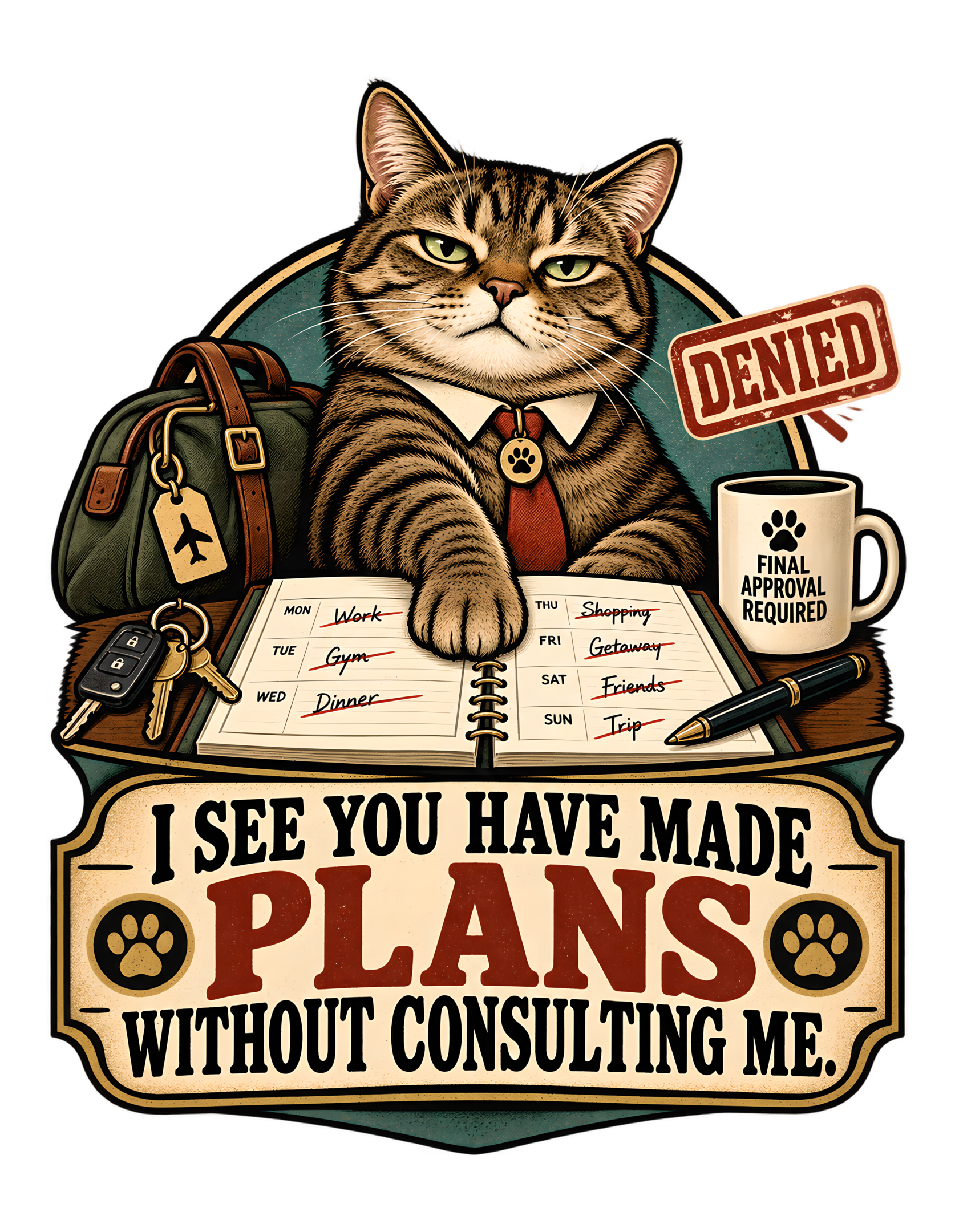
A human has opened a planner and committed the first administrative offense: making arrangements. Work appears on the schedule. So do ordinary activities outside the house, along with some plans that seem to involve leaving for rather longer. The human may have thought these were private decisions, made with reasonable independence and perhaps even a pen. The cat in I SEE YOU HAVE MADE PLANS WITHOUT CONSULTING ME. would like to correct that misunderstanding before the week proceeds any further. In the approved artwork, a stern tabby occupies the place of authority above an open weekly planner. One front paw rests firmly over the pages. Nearby are keys, a bag with a travel-themed tag, a pen, a mug announcing that final approval is required, and a conspicuous red DENIED sign. Beneath this miniature administrative crisis, the design phrase fills a large vintage-style panel. The image turns a recognizable domestic situation into an official-looking review of the human's calendar. Nobody has to explain who appointed the cat. An appointment process would presumably have required the cat's approval, creating a procedural inconvenience. The joke is not that a cat literally reads planners, owns a scheduling department, or understands every activity listed. Those are comic choices, not claims about feline cognition or behavior. The recognizable emotional center is human: many people who live with animals understand the odd guilt of preparing to go somewhere while a watchful pet remains behind. The design inflates that feeling until the household cat resembles the manager who has discovered an unauthorized decision. It never depicts danger or genuine punishment; its authority is made of posture, office props, lettering, and a profoundly unimpressed expression. This page looks closely at how the approved illustration works. The art is an original, self-contained joke about schedules, household loyalties, and the universal human desire to believe one's plans are one's own. The cat has reviewed that belief. The feedback, as usual, has not been requested.
The Unapproved Itinerary Is the Entire Incident
The wording begins after the alleged mistake has already occurred. “I see you have made plans” is not an invitation to discuss what might happen next; it is the opening line of an inquiry into a decision that appears to be settled. That timing gives the joke more bite than a simple demand for attention. The human has apparently taken initiative. The cat's imagined complaint is that initiative itself should have been brought before the appropriate authority. A fairly ordinary act of writing something down is therefore reclassified as a breach of protocol. This is a familiar human comedy wearing whiskers. People have encountered supervisors, housemates, relatives, and meeting organizers who notice a schedule change only after the decision has been made. The resulting conversation often begins with a deceptively calm observation. The design borrows that cadence and gives it to a cat who has been installed as the most important participant in the household. The disapproving expression is not an actual record of an animal's feelings. It is the artistic shorthand that allows readers to hear a dry, managerial voice coming from a silent illustration. The phrase also contains a quietly revealing word: “consulting.” Consultation suggests there ought to have been a process, but the artwork never shows a policy manual, an agreement, or any human acceptance of such a rule. The cat's authority is entirely assumed. That is what makes the premise funny rather than a lesson in how to plan a day. We recognize the posture of someone who believes the world should stop and ask their permission, even when the world has given no sign of agreeing. A good visual gag usually leaves one question open. Here it is what happens after the review. Does the human cancel everything, negotiate, or take the keys anyway? The art declines to tell us. Instead, it freezes the moment of discovery, when the cat's apparent certainty and the human's absent explanation are at their funniest. The calendar contains activities; the ruler has concerns. Any attempt to resolve the dispute would only lengthen the meeting, and management has already found the opening statement quite sufficient.
The Tabby Manager Holds the Center of the Scene
The central character is a tabby cat with striped markings, light muzzle, and narrowed, greenish eyes. Its face is directed toward the viewer rather than toward another fully illustrated character. That frontal address matters. The cat appears to be staring past the table at the person responsible for the offending schedule. Because the viewer occupies that position, the look becomes the visual equivalent of being called into an office after making a decision nobody authorized. The illustration does not require a speech bubble; the sentence below gives the gaze its invented meaning. The animal's posture is deliberately contained. It sits behind an open planner with its shoulders squared and one paw extended over the central pages. It is not depicted racing across the room, dragging away a bag, or physically blocking a doorway. Authority in this scene is staged through composure. The ordinary idea of a cat sitting near household objects becomes a parody of a formal meeting simply because the composition grants the cat the chairperson's place. The viewer is invited to laugh at the contrast, not to mistake the posture for a documented behavior of cats as a group. The tabby's striped coat also gives the illustration useful visual complexity. Its facial markings frame the eyes, and the strong contrast between dark stripes and lighter fur helps the expression remain readable. Those details create a personality on the page without inventing a biography. We do not know the cat's name, history, favorite room, or actual reaction to anyone leaving home. The artist has supplied a character sufficient for one scene: a cat presented as the presiding official in a household argument about independence. That degree of restraint is important to the brand's humor. The cat looks skeptical, but not vicious. The situation is overblown, yet no one appears endangered. It is the kind of superiority that can be enjoyed because the stakes are so low. The household schedule has been challenged, and the feline executive is already prepared to look unimpressed by the defense. A lesser committee might require evidence. This one seems satisfied with the presence of a planner and a face that has never once expected to be overruled.
A Weekly Planner Turns Private Choices Into Evidence
An open spiral-bound planner lies directly in front of the cat. Its left and right pages divide a week into named days and short handwritten activities. That familiar format makes the central accusation immediately understandable. A vague complaint about humans doing things could have been attached to almost any cat illustration. A weekly planner shows what kind of human freedom is at issue: the ordinary freedom to organize time, make commitments, leave the house, and assume that writing an entry is enough to make it real. The paper also does a subtle piece of narrative work. It is physically open, available for inspection, as if the human's private intentions have already been placed on the desk of a reviewer. This converts a routine planning tool into a prop from an administrative hearing. One can imagine the person opening it to check a date and suddenly finding that the household cat has appointed itself the approval authority. The picture does not prove any such event occurred. Its satire relies on the viewer recognizing the implied scene from the arrangement of objects. The planner is drawn with just enough specificity to read at a glance. Distinct weekday divisions and a few brief appointment labels tell the story without requiring a detailed replica of a real calendar. That balance matters for apparel art. A densely filled diary with tiny entries would draw attention away from the cat and the major phrase, and would be difficult to read at smaller sizes. Instead, the art provides a handful of recognizable activities and uses red cancellation strokes to heighten the argument. The planner feels used, but its entries remain supporting material. There is a broader observation here about human organization. We often treat a plan as a private promise to a future self: on this day, at this hour, I will do this thing. The joke adds an absurd stakeholder to that promise. The cat did not sign the original agreement, but now appears to have full access to it. The physical book makes the supposed violation visible. The calendar becomes evidence, the cat becomes a reviewer, and the invisible human becomes the person trying to remember when the household began operating under feline oversight.
One Paw Makes a Convincing Administrative Interruption
The cat's paw rests over the center of the open planner. In terms of physical action, that is almost everything the illustration needs. The gesture is not a dramatic attack on the paper or an elaborate attempt to steal the book. It is a simple interruption positioned exactly where the viewer is already looking. The paw visually occupies the meeting agenda, which is an excellent shortcut for a joke about somebody interrupting a plan while claiming the right to approve it. A cat's paw in this kind of cartoon can carry a great deal of fictional authority because it is so small relative to the imagined significance of the decision. The human has created a week of commitments. The cat has contributed one resting limb. Yet the image treats the latter as the final ruling. That disproportion is the comedy. The art makes the viewer compare the effort involved in planning with the effortless way the cat seems able to suspend everything. Nothing says superior management quite like doing less while claiming to decide more. Its placement also keeps the story unusually compact. The hand of the absent human is not needed. There is no second speech bubble announcing objections, no frantic background figure collecting abandoned luggage, and no additional animal to interpret. The single paw creates a connection between character and evidence. Without it, the tabby might simply be sitting near a notebook. With it, the character appears to be participating in the absurd review. That is an artistic reading, not a scientific claim about what a resting paw means in real feline communication. The gesture works at two scales. At close range, a viewer notices how the paw overlaps the spiral binding and page. At a smaller glance, the pale paw forms a strong shape against the planner's lighter pages and the striped body above. The visual line moves naturally from eyes to paw to schedule. This gives the illustration a cause-and-effect rhythm before anyone reads the headline. The cat appears to have found the problem. The cat appears to have taken jurisdiction. Whether the cat knows any calendar dates is wisely outside the scope of the fictional investigation.
The Red DENIED Notice Supplies an Instant Verdict
To the upper right of the tabby sits a tilted sign bearing the single word DENIED. Its bold, distressed red lettering looks like an administrative rejection notice, although the image does not show a real institution issuing it. The sign is funny because it is both immediate and wildly premature. We have no evidence of the human's request, no explanation of the grounds, and no appeal instructions. The result has simply appeared beside the alleged decision-maker, as if rejection were the most natural function of a cat-based scheduling office. In a crowded illustration, another sign might be unnecessary. Here it earns its place because it reduces a complex imaginary process to a single readable word. The viewer can read DENIED before examining the week in the planner, and that gives the scene an instant comic stakes marker. It also supports the larger phrase below by demonstrating how the supposed consultation might have ended had it occurred. The result is a small narrative circle: plans were made without permission, permission is retrospectively demanded, and the visible answer seems already settled. The angle and worn texture help this notice feel like part of the same retro visual vocabulary as the artwork's title treatment. Its red-brown tone stands apart from the surrounding teal and cream. That contrast provides a focal point without taking over the page. The sign is noticeably subordinate to the cat's face and the main phrase, which is the right hierarchy for a compact image. A giant billboard saying DENIED would make the joke too literal; this smaller notice behaves like a supporting prop on a desk full of questionable paperwork. Its humor also relies on a gentle kind of absurdity. An actual refusal of a person's plans could be rude or controlling. A cartoon cat appearing to veto work, shopping, or a visit through a miniature sign is an obviously fictional reversal of power. The target is the human impulse to treat animal attention like a managerial review, not the idea that anyone should lose autonomy. The sign is an exaggerated punchline, not advice. It says enough for the viewer to imagine an entire fictional bureaucracy. Fortunately, the appeal form appears to have been lost somewhere under the paw.
The Mug Turns Approval Into a Departmental Requirement
A mug on the right side of the illustration bears a paw graphic and the words FINAL APPROVAL REQUIRED. It is an office joke in miniature: the kind of message a department might print on a cup when its staff have become a little too attached to their own importance. Positioned close to the planner and pen, the mug makes the cat's position resemble a workplace station rather than a casual place to sit. The setting remains domestic and cartoonish, but the objects borrow the recognizable grammar of official procedure. The wording on the mug plays a different role from the large design phrase. The main sentence tells the viewer what the cat supposedly objects to. The mug quietly suggests the existence of a rule behind the objection. “Final approval” implies earlier stages, a chain of command, and a person with the right to make the last call. None of those things is shown as real. The cartoon merely hints at an astonishingly overdeveloped system of feline paperwork. An entire office has been imagined to rationalize one cat sitting beside a planner. There is also a small human-behavior observation in the choice of a mug. People love ordinary items that announce an identity: manager, planner, expert, person who has already had too many meetings. The image transfers that habit to a cat. The feline official has apparently acquired not just power but the desk accessory required to publicize it. That detail makes the satire warmer. We are laughing at a recognizably human ritual of workplace self-importance through an animal character who cannot actually participate in the routine. Aesthetically, the pale ceramic cup provides a useful counterweight to the bag on the other side. It is bright enough to be legible, but its narrow shape does not block the cat or the printed phrase. The paw motif connects it back to the feline premise without adding an unrelated character or brand. The object occupies little space while expanding the fictional world. In this world, even beverages have learned that a cat may reserve final sign-off. The drink is not listed on the calendar. The approval process for refreshments remains classified.
The Travel Bag Makes Leaving Home a Concrete Possibility
On the left side of the desk sits a compact bag with contrasting straps and an attached travel-themed tag. It is an economical visual cue: whatever some of the schedule entries mean, the human may be preparing to go somewhere. The bag does not tell us a destination, duration, ticket status, or reason for leaving, and the source does not support inventing those particulars. What it does show is enough for the joke: the possibility of departure exists, and the cat's imagined management structure may regard that possibility as highly irregular. The bag shifts the picture slightly beyond the boundaries of a paper calendar. A weekly schedule is abstract. It holds words representing future activity. A bag suggests that those words might soon produce motion beyond the home. Put beside the planner, it creates a bridge from intention to action. That is why the cat's theatrical disapproval has something specific to react to within the scene. The human is not merely daydreaming about having a social life; objects nearby hint that the schedule might be carried out. The visual also introduces a deliberately mundane contrast. Travel accessories are associated with personal choice, readiness, and movement. The cat is associated with stillness and the authority of a seated supervisor. They inhabit opposite sides of the composition, creating a quiet argument without requiring any human figure to appear. The bag says that a person has reasons to leave. The cat's expression, in the cartoon's invented language, asks who authorized reasons in the first place. Neither prop needs a speech bubble to contribute. It is tempting to embellish the story with imaginary vacations, dramatic separations, or claims about how real cats respond to luggage. The design does not require them. The actual message is funnier because it stays close to daily life: humans make plans, place a bag nearby, and sometimes imagine that the animal looking on is personally offended. Here that feeling has been promoted into an official hearing. The bag remains an ordinary bag. The person may still depart. The fictional committee just wants everyone to know the paperwork was not submitted through the proper channel.
Keys and a Fob Put Human Independence on the Table
Near the bag, a set of keys and a dark key fob rest on the surface. These are small elements compared with the cat's head and the large phrase, but they make the satire more concrete. Keys symbolize the ability to open a door, leave a place, and return. In the context of the artwork, they suggest the human has practical access to a world beyond the approval committee. That is a helpful visual contrast. The cat may own the meeting, at least in the invented narrative, but the human appears to own the practical tools for getting on with a day. The keys do not establish where the person intends to travel or what kind of vehicle, if any, will be involved. The artwork does not provide a full itinerary. Their job is simpler: to make the act of going out recognizable as a possibility. The key fob's dark shape and the metallic rings also add variety to the objects across the desk, helping the left side feel occupied without filling it with a second story. Every supporting detail should earn its footprint in a compact apparel design. A subtle tension follows from these objects. The human presumably made the plans and possesses the means to act on them, yet remains the absent party in a scene controlled by a seated cat. The joke asks who has the true authority: the person with the calendar and keys, or the creature capable of making that person feel as though departure requires an apology. There is no factual answer about a particular household, and the image wisely offers none. It lets viewers bring their own memories of leaving for work or a social event while an animal watches. Cats Judging Humans thrives on that kind of harmless reversal. A small pet becomes the supervising adult, while the person entrusted with transportation and scheduling is reduced to an applicant. The keys remind us that the reversal is imaginary. A living person still has choices; the illustration has simply inserted a comedian's version of feline management between intention and execution. If an office were genuinely this strict, the keys might need to be checked out at reception. Here they lie in plain sight, pending the results of an entirely fictional review.
The Marked Appointments Turn Ordinary Life Into a Dispute
The weekly planner contains short activity labels distributed across the days. Work, gym, dinner, shopping, a getaway, friends, and a trip are all suggested through handwritten entries, with several struck through in red. This mix matters because it broadens the joke beyond one special occasion. Human independence is not represented only by a dramatic journey or an exotic adventure. It also includes regular duties, exercise, errands, meals, and people one has promised to see. The cat's imagined objection is therefore hilariously indiscriminate. The week itself appears to be the problem. Each entry carries a slightly different kind of human obligation. Work is a commitment that may not feel optional. Shopping can be practical. Dinner may be routine or social. Time with friends belongs to personal relationships. By allowing these categories to coexist, the image avoids asking the viewer to share one particular lifestyle. Many people can identify an entry that resembles something on their own schedule. The cat's fictional grievance applies to the general principle that humans spend time somewhere else, not to a supported claim about which activity a real animal dislikes. The red lines introduce a second possible reading: somebody has already begun editing the agenda. The approved illustration shows the marks; it does not show the hand that made them. That distinction is worth preserving. In the story we can playfully imagine the cat taking charge, but we should not describe a visible scene of the animal crossing out each appointment. The drawn evidence is the altered schedule and the paw placed in the middle. The joke comes from their juxtaposition. This variety of entries also helps pacing. A viewer first absorbs the big accusation, then notices specific reasons the cat might find fault in the imaginary world. Each small discovery extends the original joke instead of introducing a separate gag. In a conventional office, crossing off an appointment may be a relief. Here it looks like the work of a department whose mission is to prevent unauthorized fun or, perhaps, unauthorized anything. The cat has not offered replacement dates. The planning office appears to specialize in objections rather than solutions. It is a familiar organizational problem, delivered at feline scale.
The Collar and Tie Give the Cat a Corporate Vocabulary
A crisp light collar and deep red tie sit beneath the tabby's face, while a small round medallion with a paw symbol reinforces the feline character. These are not elaborate garments that conceal the animal beneath a human costume. They are compact signs of a role: the cat has been dressed, in the language of illustration, for office authority. A tie can turn a seated animal into a recognizable parody of a supervisor within seconds. The art does not need an actual company name or invented job title to make that reading available. The costume works because it remains subordinate to the cat's face and stripes. The collar outlines the chest, the tie points down toward the planner, and the medallion contributes a small visual echo of the paw that rests on the pages. Together they connect character and action. This kind of coordination matters when the artwork must stay readable on an object rather than in a full-page comic. No separate costume explanation is required. The viewer sees an unimpressed feline in managerial attire, then looks down to find the evidence of the alleged workplace violation. There is an affectionate satire of human self-presentation here. People frequently signal professional authority with clothing and small accessories, even when their actual influence over a situation is uncertain. The cartoon applies that recognizable shortcut to an animal that could not meaningfully administer a human calendar. The result is a mock promotion. The cat is no longer merely present while the human plans. It has apparently assumed responsibility for compliance, sign-off, and the tone of the next meeting. The red tie also harmonizes with the DENIED notice and the large red emphasis in the lettering below. It gives the illustration a small thread of color that helps bind its upper and lower regions. This is a design reason, separate from the narrative joke, for choosing such a concise costume. The accessory is not random decoration; it reinforces the theme and helps organize the palette. The fictional manager's wardrobe is therefore doing real visual work. The employment contract, however, remains unsigned. Management seems to consider appointment by facial expression entirely sufficient.
The Vintage Lettering Makes the Reprimand Unavoidable
The phrase occupies the large lower panel of the artwork in bold, high-contrast vintage-inspired lettering. It reads exactly: I SEE YOU HAVE MADE PLANS WITHOUT CONSULTING ME. Most of the sentence appears in dark text against a light background, while PLANS receives a dramatic warm-red emphasis. That choice establishes a quick reading hierarchy. The reader first hears the stern observation, then lands on the forbidden object: plans. The final words reveal the specific offense. It is not what the person intends to do. It is that nobody thought to hold a consultation. The sentence has a deliberate conversational rhythm. “I see” sounds like a calm opening, perhaps even one delivered after a long silence. “You have made plans” identifies the act. “Without consulting me” introduces the unreasonable standard that makes the complaint funny. The structure gives readers time to accept the tone of an official reprimand before the requirement exposes its absurdity. A shorter line such as “No plans allowed” would be a command rather than a mock discovery. This full sentence gives the cat a particular voice: disapproving, observant, and serenely convinced of its own importance. The type is large enough to compete with the detailed illustration above, which is necessary for the piece to work as a self-contained graphic. Decorative text can become difficult at a distance, but the principal words are organized into a strong centered block. The warm red on PLANS aligns with the red refusal sign and the cat's tie, unifying the idea of a challenged schedule through color. Small distressing in the letterforms adds a retro texture without needing an invented historical origin or a specific printing claim. This is where the design most plainly behaves like a Cats Judging Humans statement rather than a generic drawing of an animal beside stationery. The text does not describe the cat from the outside. It lets the cat address the viewer as though the outcome of the conversation were already certain. Because the person being reprimanded does not appear, anyone reading the design can momentarily occupy the position of the accused. A wall calendar is optional. The sensation of being reviewed by a creature who never requested the meeting is universal enough.
Teal, Cream, Rust, and Black Organize the Retro World
A limited family of deep teal, cream, rust-red, golden accents, and strong dark outlines gives the illustration its warm retro character. The colors separate the cat's natural-looking striped coat from the supporting office props and the large text panel. Rather than scattering bright accents everywhere, the image reserves them for moments that matter: the tie, the denial sign, highlighted lettering, and warm trim. That discipline keeps the composition from feeling like a noisy catalogue of desk objects. Even at a quick glance, the central cat remains the primary subject. The teal backing is particularly useful as a quiet middle color. It helps distinguish the tabby's silhouette from the surrounding negative space without creating a fully illustrated room. The cream panel below gives the phrase a stable, readable surface. Rust-red adds emphasis where the joke needs a little extra theatrical authority. None of these treatments needs a claim about historical print methods, specific inks, or product color accuracy. They are visible choices within the approved illustration, and they work together as an aesthetic rather than a technical specification. The dark contours have two related jobs. They make the cat, bag, mug, and lettering legible as separate components, and they give the complete artwork a clear silhouette. In a detailed editorial picture, subtle tones can carry much of the scene. In an apparel-oriented graphic, stronger outlines help hold the design together even when reproduced smaller. The approved production asset itself is a high-resolution transparent PNG, but visual appreciation should not turn that fact into unsupported assurances about how every product or material will reproduce the design. The picture's color relationships can be described without inventing manufacturing promises. The palette also contributes to the joke's tone. A pale, whimsical candy palette might make this manager seem harmlessly dreamy. A cold corporate gray could make the scene feel more severe than intended. Warm rust and cream give the authority a vintage, slightly theatrical quality. The viewer understands that the cat is performing a parody of status rather than issuing a real warning. Management has chosen a dignified color scheme for an undignified exercise in calendar policing. At least the design committee appears more competent than the scheduling committee.
A Compact Badge Holds the Entire Office Parody Together
The approved artwork is a centered, self-contained graphic rather than a panoramic depiction of a home office. A rounded teal field sits behind the tabby, desk objects spread to either side, and a prominent cream text panel anchors the lower section. The outside of the illustrated shape is transparent in the production image, so the main silhouette does not depend on a drawn room or a rectangular background. That matters both visually and editorially: all the evidence needed for the joke is contained within one compact arrangement. The composition uses an effective hierarchy of scale. The cat's face is large enough to communicate attitude. The paw and planner make the supposed dispute visible. Smaller props indicate the practical world of human appointments and the fictional world of approvals. Finally, the huge sentence provides the exact accusation. A viewer can move through those levels without being forced to read every small label. At a greater distance, the dominant face and phrase carry the premise; at closer range, the mug, keys, bag, and denial notice reward attention. Balanced does not mean perfectly symmetrical. The left side carries the travel bag and keys, while the right side contains the mug, pen, and denial sign. These groups serve different parts of the story and have different silhouettes. Their visual weights nevertheless keep the cat centered. The asymmetry is purposeful: departure cues cluster toward one side, bureaucratic cues toward the other, and the cat sits between them as the invented final authority. The picture offers a miniature conflict in the arrangement of objects before the viewer even reaches the sentence. This concentration prevents the scene from becoming an unrelated collage. Every major prop feeds one question: who gets to decide what happens on the human's calendar? The artwork does not need a second cat, a full person, an office building, or an elaborate calendar interface. Its editorial clarity comes from being selective. A simple joke has been dressed in convincing enough detail to feel like a complete little world, without distracting readers from the absurd premise. The committee has apparently rejected visual clutter as well. For once, its decision is easy to support.
The Invisible Human Makes Every Viewer the Applicant
No complete human character appears in the approved image. We see possessions and plans: a book of appointments, keys, a bag, and a pen. Those objects imply a person with a life outside the frame, but the picture does not supply a face, age, identity, or personal story. That omission is one of the design's stronger narrative decisions. A specific illustrated owner might become a second protagonist, competing with the tabby for attention. By leaving the human unseen, the artwork allows the viewer to step into that role with almost no explanation. This works especially well because of the grammatical construction. The sentence says “you,” not “my owner” or “the person who lives here.” It addresses somebody directly. Whoever reads it becomes the individual whose planning habits have just been noticed. The cat's face reinforces the effect by confronting the viewer rather than looking off toward a drawn person. The relationship therefore feels immediate: the art is not simply reporting that a cat dislikes an itinerary; it is staging an imaginary encounter in which the reader has been summoned to account for one. The absence of the human also keeps the humor gentle. There is no caricatured person being made foolish, no frightened visitor, and no visible argument. The supposed offense is innocent: scheduling normal activities. The cat's response is exaggerated enough to make the criticism absurd. That lets viewers laugh at the position they have been assigned without feeling that any particular type of person is the target. Anyone who has made arrangements and imagined a pet disapproving can recognize the emotional shape, even if they would never attribute such elaborate thoughts to a real animal. From a visual storytelling perspective, the anonymous human is present through traces rather than through a body. The planner indicates decisions; the keys and bag indicate possible movement; the pen indicates organization. Those traces are sufficient. The viewer supplies the rest, turning one static artwork into a little personalized scene. In the CJH universe, people are routinely evaluated by cats without being asked whether they consent to the evaluation. This design commits the same joke at the level of the composition. The applicant is whoever stopped to read it. The decision is already printed.
The Complaint Teases Human Expectations, Not Real Animal Needs
A comic statement about a cat demanding consultation works because the premise is impossible in literal terms. An animal cannot participate in the sort of calendar-approval process the image depicts. The tabby cannot read a weekly schedule in the administrative manner being parodied, issue a professional rejection stamp, or establish a binding policy about meetings and travel. The artwork makes no factual case that cats do these things. It borrows human institutions and transfers them to a feline character for the sake of a familiar, playful exaggeration. That separation matters when the joke touches real relationships with animals. People sometimes feel reluctant to leave a pet when they have plans, and they may invent humorous stories about the look an animal gives them. Those are human interpretations of an everyday experience, not proof of what any particular cat intends. The piece creates an imaginary voice for the tabby while leaving actual feline needs and behavior outside its evidence. That is not a weakness. It is what permits the satire to remain warm instead of pretending to offer behavioral expertise. The scene is also careful about power. The fictional cat behaves like an overbearing manager, but the visible confrontation is limited to a paw on paper and a stern-looking face. Nobody is harmed or threatened. No real visitor is publicly shamed, and there is no suggestion that a person should abandon necessary responsibilities. Even the DENIED sign is funny precisely because a pet's invented refusal has no real administrative force. The contrast between grand authority and modest physical action keeps the humor from turning mean. There is an underlying kindness in recognizing that humans often organize their lives around those they care about, including animals, while still needing to do ordinary human things. A pet may be an important part of the home without literally serving as its scheduling supervisor. Cats Judging Humans can treat the gap between those truths as fertile comedy. The imaginary department may demand written notice of a trip to the grocery store. The real reader remains free to shop, work, meet friends, or stay home. The cat's employment status is entirely theatrical, and the joke is better for admitting it.
An Evergreen Calendar Joke Belongs in the CJH Universe
The concept does not depend on a holiday, a trending phrase, a celebrity, or the design of a particular digital platform. Its source identifies it as evergreen, and the approved illustration supports that classification with familiar tools: a planner, keys, a bag, a mug, and a pen. Those objects may take different shapes over time, but the act of making plans and discovering that somebody else has opinions about them remains easy to recognize. The humor begins with an ordinary human habit rather than with a passing reference that a reader must already know. It also has a distinctive position within the Cats Judging Humans world. The brand's broad premise is that cats assess human conduct with an air of superior certainty. This design turns that idea into an appointment-review system. The cat is neither a royal figure demanding tribute nor an office supervisor moving a deadline. It is a household authority objecting to the fact that a schedule exists outside its consultation process. That narrow focus makes the artwork memorable. Instead of announcing that cats rule the home in general, it selects one precise act—putting activities on a calendar—and makes that the basis of the verdict. Several design choices reinforce its independence from a one-off meme. The bold phrase is legible without a caption. The feline character has a clear role and expression. The supporting props form a complete situation with no need for an invented backstory. The vintage framing makes the scene feel like a deliberate original illustration rather than a screenshot of a fleeting online joke. These are observable creative qualities, not claims about sales performance, audience response, or product availability. The image can be discussed on its own merits even before anyone considers where it is displayed. Most importantly, the artwork recognizes the recurring comedy of human self-importance. We fill our calendars as though the world has accepted our priorities. Then we look at a cat and jokingly imagine that approval has been withheld. The cat, for the purposes of this illustrated universe, need only sit there and look unimpressed. The human supplies the guilt; the design supplies the paperwork. It is an efficient division of creative labor. Management has declined the itinerary, but approved the joke. No additional meeting has been scheduled to discuss the contradiction.
I SEE YOU HAVE MADE PLANS WITHOUT CONSULTING ME. turns a simple household moment into an entire imaginary approval process. The tabby's direct stare gives the piece a character, its paw on the planner establishes the supposed offense, and the crossed-out week suggests what is at stake. A DENIED notice, a final-approval mug, keys, a travel bag, and a pen supply the supporting evidence. The big retro lettering delivers the judgment that every object has been quietly preparing the reader to hear. The result is effective because the premise remains small even while the ceremony becomes grand. This cat is not conquering a city, running an actual company, or enforcing a real behavioral rule. It is occupying a desk, apparently finding fault with the fact that a human has written down ordinary activities. The comedy is the disproportion between that ordinary act and the authority the image pretends to give its feline reviewer. Its warm colors and compact presentation make the criticism playful, not harsh. The most enduring part of the design may be the missing human. The phrase addresses whoever is looking at it, which means the viewer can temporarily become the person who dared to plan a week without seeking clearance. That is a thoroughly Cats Judging Humans kind of promotion: the animal gets management, and the person gets a meeting they never arranged. The schedule is still theirs. The imaginary objection will probably outlast it. Management requests that next week's calendar arrive earlier, although nobody has established who gave management a mailbox.