The human approaches. The cat does not rise. The entrance appears to be permissible, but only because the approaching party has brought something worth considering. In THE HUMAN MAY APPROACH WITH SNACKS, Cats Judging Humans turns an ordinary moment of offering a cat a treat into a miniature royal audience. The concept is simple enough to recognize immediately: a cat has the important seat, a human supplies refreshments, and the terms of engagement are not being negotiated by the person with opposable thumbs.
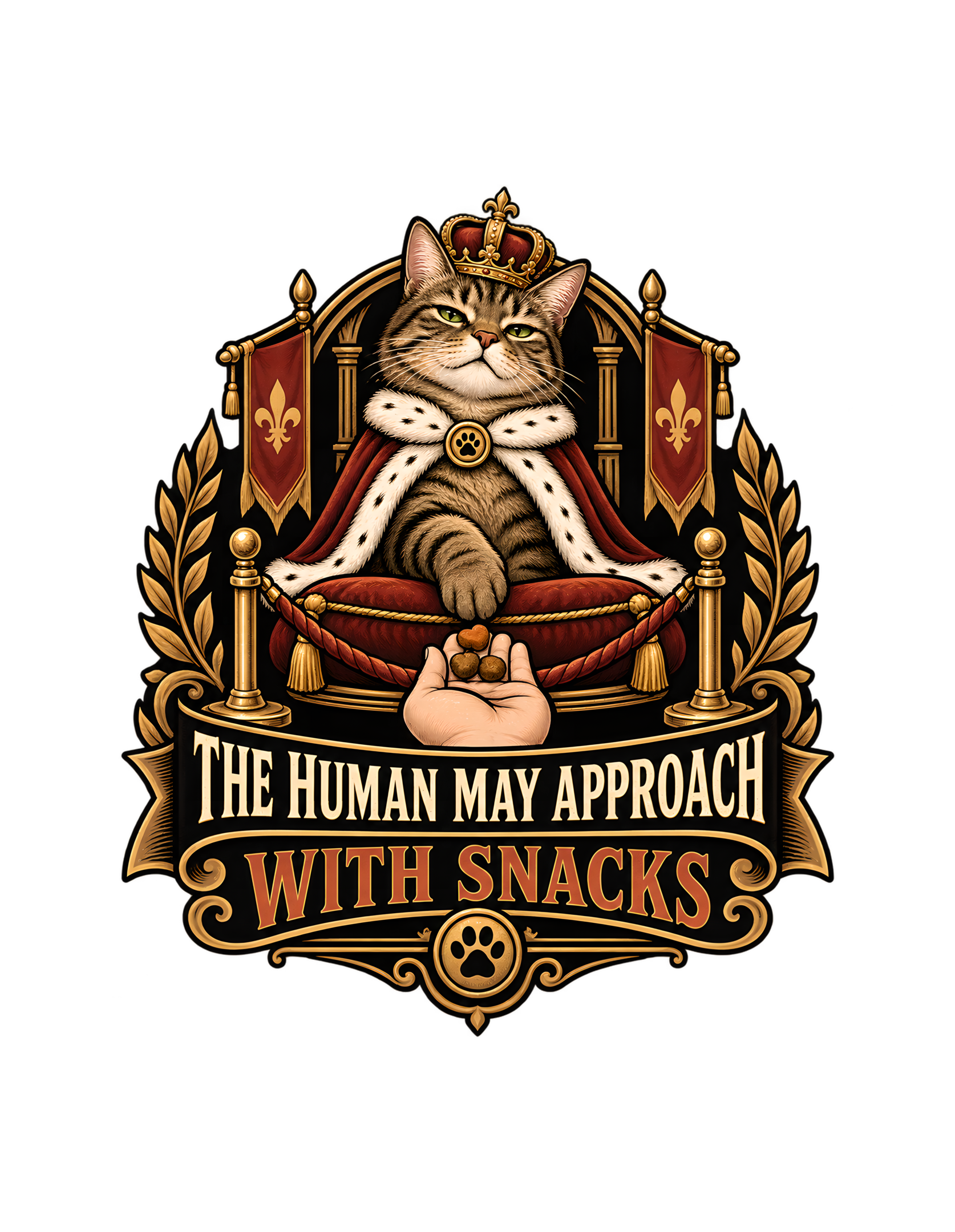
The approved artwork stages that reversal with a crowned tabby cat on a deep red throne-like cushion, framed by rich gold decoration and hanging banners. Below the seated figure, a human hand presents a few small brown treats. A low ceremonial cord marks the space between the throne and the visitor; the large vintage-style lettering announces the condition of approach. It is an unusually elaborate scene for an everyday exchange. That disproportion is exactly what makes it funny. Where a human sees a hand offering snacks, feline management has identified a formal matter of access privileges.
The visual is not a literal account of cat behavior or a claim that cats understand monarchy, contracts, or etiquette. Those are the comic tools of this particular design. The source concept describes a regal tabby allowing a human to approach when refreshments are included; the approved artwork gives that idea an unmistakable hierarchy. The cat sits still, apparently satisfied with the arrangement. The human is reduced to an offering hand. Each side has a role, though the distribution of authority would be difficult to defend at a meeting of humans.
This page examines the design as visual storytelling and domestic satire: how its words grant permission, why its royal costume matters, how the small human gesture carries the entire premise, and how an ornate badge remains understandable without a complicated backstory. The underlying joke is recognizable to anyone who has ever felt obliged to negotiate for a cat's attention. The verdict comes with paperwork in spirit, if not in fact: audience granted, pending snacks.
Permission Is the Punch Line, Not the Snack
The funniest word in THE HUMAN MAY APPROACH WITH SNACKS may be “may.” It turns an ordinary movement toward a familiar animal into something requiring formal clearance. A human could have said, “I brought you something,” and created a straightforward moment of affection. This cat, however, appears to have reframed the whole interaction as a question of whether access is authorized. The reward is not only the food. The reward is the privilege of entering the relevant portion of the household.
That distinction gives the design more structure than a generic joke about a cat loving treats. If the phrase merely announced a preference for snacks, the picture would illustrate appetite. Instead, the wording implies a system: a visitor, a gatekeeping authority, a condition, and an outcome. The human arrives with an offering and, under the terms indicated, becomes eligible for an audience. The figure receiving that offering need not move an inch. The entire procedure has been arranged around the cat's convenience.
The source concept supports that reading by describing limited audience privileges when refreshments are included. It does not specify the precise rules, consequences, or prior negotiations of this imaginary court. Those remain deliberately open. What matters is the comic reclassification of a daily gesture. Bringing a treat is no longer just a friendly action; in the world of the design, it resembles compliance with entry policy. The exaggeration stays playful because nothing suggests punishment, anger, or danger. This is a bureaucratic fantasy executed with velvet and gold rather than with stern notices.
The viewer can also recognize a human habit hiding inside the joke. People invent rituals around access all the time: knocking, requesting an appointment, checking whether a visit is convenient, or arriving with a small gift. The cat has adopted the familiar outline and removed the part where the two sides have equal standing. A person entering their own living space becomes a petitioner. The regal expression reinforces that imbalance without needing speech bubbles or a second character. The central comic achievement is that a few snacks can apparently transform a human from an interruption into an acceptable guest. Management emphasizes that permission is conditional, not transferable.
The Phrase Turns a Person Into “The Human”
The title does not say “You may approach.” It says “THE HUMAN MAY APPROACH.” That impersonal phrase is a quiet piece of characterization. The cat's world has been organized into two categories: the individual of importance, who is already seated on the throne, and the human, identified by species and function rather than by name. The grammar sounds like a ceremonial announcement made on behalf of someone too distinguished to deliver their own instructions.
“The human” creates comic distance. A friend, housemate, or caregiver would ordinarily have a name and a relationship. In this imagined royal hall, those distinctions appear to have been suspended while the court evaluates whether the visitor has fulfilled the snack requirement. That is dry Cats Judging Humans territory: the person who may pay for the furniture is nevertheless discussed as a supporting figure in somebody else's domestic kingdom. The line lands because it makes the everyday hierarchy feel official.
The wording also keeps the joke inclusive. The artwork supplies a generic offering hand without inventing a complete fictional owner, recognizable face, or personal history. Anyone looking at the scene can mentally occupy that role. The design does not need to specify who purchased the treats, how long the human has lived with the cat, or whether the offering succeeds. The conditional declaration and the visible gesture are enough. When the image withholds those particulars, it becomes less about one incident and more about a common feeling: the household animal has somehow become the host.
There is a second comic effect in the formal third-person voice. It sounds as though the verdict has been issued by a herald or an office that handles the monarch's schedule. Yet no herald appears. The cat's motionless self-possession and the oversized lettering perform that work on their own. This is why the phrase feels like a decree rather than a caption explaining a picture. The artwork does not ask the reader to laugh at a clumsy person. It asks the reader to recognize a status change that no human formally approved. A modest visitor may enter, provided the visitor remembers their place and their refreshments. The identity check is mercifully brief.
A Tabby Monarch Makes Authority Look Effortless
At the center of the approved artwork sits a brown tabby cat with a composed, faintly skeptical expression. Its greenish eyes are half-lidded, its head faces forward, and its front paws rest calmly together. There is no frantic movement, exaggerated grin, or theatrical anger. The cat looks comfortably installed in a role it regards as entirely ordinary. That restraint makes the regal premise work. The scene is lavish, but the main character does not appear impressed by the production.
A monarch costume can easily overpower a joke if the animal underneath becomes difficult to read. Here, the tabby markings remain apparent across the face and body, while the ears, muzzle, and narrow gaze preserve a recognizable feline personality. The visual communicates the cat's authority through presence rather than through aggression. The character's expression can be read as tolerant, skeptical, mildly bored, or simply unhurried. Those are interpretations invited by the illustration, not factual claims about a particular animal's emotions. The important shared quality is composure.
The canonical source names a regal tabby receiving visitors; the approved artwork takes that instruction in a clear direction. The cat sits centrally, elevated above the approaching hand, inside a throne-like arrangement. Unlike a more hectic cartoon, it does not need to snatch at the offered food or lean down to investigate. The absence of a dramatic reaction is part of the status difference. If the human wants something to happen, the human must initiate. The cat may continue being the cat. It is an extremely efficient division of labor, particularly from the throne's perspective.
Cats Judging Humans thrives when a character behaves as though the absurd rules of the setting require no explanation. The tabby does not announce itself as royalty; the decorative framing and the posture make that assignment for it. This lets the design stay playful. A more confrontational expression could turn the moment into a demand. A startled expression could make the scene seem like a surprise. The chosen face makes it resemble a routine approval process. The viewer sees a small domestic animal and understands a grand imaginary title. The cat's accomplishment is maintaining that title while doing almost nothing. Some forms of leadership are apparently seated.
The Crown and Cape Give the Joke Its Royal Vocabulary
A small ornate crown sits above the tabby's head. A deep red cape with pale spotted trim falls across its shoulders and toward the throne. Gold medallion-like details make the outfit feel ceremonial rather than practical. These objects are visual shorthand: without needing a line of explanation, they tell the viewer which kind of authority the cat has chosen to impersonate. The distinction is useful. A cat wearing an office tie might be a manager. A cat wearing a crown is not reviewing your quarterly goals. It is reviewing your right to approach.
The crown's placement matters because it reads immediately near the highest point of the character. The eye finds the ears and the crown together, making the regal identity clear even before the viewer notices the hand or the large phrase. The cape then reinforces the same idea at a larger scale. Its red and cream areas spread across the seated figure, adding visual weight while leaving the face visible. The costume supports the subject rather than hiding the cat inside a generic historical character.
The decorative language is deliberately theatrical. Nothing in the canonical source suggests an actual monarchy, a historical kingdom, or any factual ritual involving cats. The crown and cape are there to elevate a very small domestic negotiation into a grand invented ceremony. That contrast is the source of the humor. A few little snacks would ordinarily be an unremarkable offering; placed before this royal costume, they acquire the apparent importance of tribute. The viewer understands both versions at once, which is where the smile happens.
The costume also makes the design specific within a larger family of cat jokes. Feline superiority can be expressed through smug looks, blocked keyboards, stolen chairs, or interruptions. This piece expresses it through pageantry. It borrows the visual grammar of status—crown, mantle, gold fittings—and applies it to a relationship whose recognizable reality is much simpler. The cat has not become a different animal, and the human has not entered a real court. Ordinary pet-related affection is simply being interpreted by a very confident fantasy government. The royal wardrobe is approved. The budget for human dignity remains under review.
The Red Cushion Becomes a Throne Without Needing a Palace
The cat's seat is compact, but the illustration treats it as the center of the world. A richly colored red cushion supports the tabby inside gold posts and an arched backing. The scale is deliberately intimate. Rather than showing an enormous hall filled with courtiers, the composition concentrates the trappings of royalty around one seated animal. That economy is good storytelling. The viewer does not need a full architectural tour to understand who supposedly controls the room.
The cushion contributes a soft domestic cue to an otherwise ceremonial arrangement. Its padded surface is an entirely believable place for a cat to sit, even though the banners and ornamental posts inflate it into a throne. The design therefore preserves contact with an everyday cat-owner experience: a favored spot can acquire the status of a private kingdom without any formal announcement. The royal framework magnifies that feeling. From a human viewpoint, it may be a soft seat. From the fictional feline viewpoint, it is a seat of government.
The artist also uses the cushion to establish a reading hierarchy. The cat's face sits above its rounded body, and the deeper red material visually supports the whole figure. Gold outlines separate the cushion from the black background, so the viewer can identify the throne without mistaking it for an elaborate piece of typography. The setting does not overwhelm the character. It holds the cat in place as the central authority, with the approaching hand clearly lower in the composition.
That vertical relationship is quietly important. The person offers snacks from below, while the cat remains above, centered and comfortably seated. The image could have shown the human crouching, kneeling, or speaking, but it does not. The visible hand alone supplies the necessary difference in roles. The seat's elevation completes the message. Nobody appears to be forcing the human into a humiliating pose; the satire depends on an exaggerated hierarchy that cat people can enjoy without cruelty.
The small throne also keeps the humor portable. It can be understood without naming a particular home or imagining a specific historical court. Comfort has been promoted to sovereignty. The only unresolved administrative question is who will clean the cushion afterward. Management considers that outside its own department.
An Offering Hand Does More Than a Whole Human Character Could
A generic human hand reaches upward from the lower center of the artwork, holding several small brown snacks. The hand is a remarkably efficient supporting character. There is no face to identify, no dialogue to follow, and no clothing or surroundings that would establish an invented story about the person. Yet its position and contents communicate everything essential: someone has approached the seat of authority with an offering. The cat's permission, announced in the lettering below, suddenly has an object.
This is one of the design's strongest choices. A fully illustrated human might compete with the cat for attention or give the scene a specific emotional tone. A smiling face could make the exchange openly affectionate; a worried one could suggest intimidation. The visible hand avoids those complications. It can be read as tentative, respectful, or simply helpful, but the image does not force a biography onto the visitor. The hand functions as evidence for the condition in the phrase, not as an additional protagonist.
The treats themselves are kept small. They do not become an enormous feast or a detailed product presentation. Their visual role is not to prove a particular brand, recipe, ingredient, or nutritional claim. The canonical source supports only a generic offering of a few treats, and that is exactly how the joke should be read. Their identity matters less than the fact that the visitor remembered to bring them. In the invented court, that simple detail is enough to transform the approach from presumptuous to potentially acceptable.
There is also a neat reversal of ordinary portrait conventions. Human hands in art often perform the central action while animals are passive subjects. Here, the hand acts, but the cat holds the power of interpretation. The person can extend a gift; only the monarch can decide whether it qualifies. This changes a familiar feeding gesture into a tiny drama of social access without depicting conflict. The hand is neither an enemy nor a servant in a literal sense. It represents humanity's willingness to participate in a relationship whose rules are jokingly dictated by the animal. The snack department has received the application. Processing time depends on royal interest.
A Ceremonial Cord Turns Personal Space Into Protocol
Across the front of the throne, the approved artwork shows a curved red cord supported by small gold posts. It is a minor prop with an outsized narrative effect. A cord implies a boundary: one side is reserved, and crossing from the other side may require permission. Placed between the cat and the approaching hand, it turns a private moment into a staged public audience. The phrase now feels less like a spontaneous remark and more like an official exception to standing rules.
The source visual concept mentions a simple ceremonial boundary line, and the finished image interprets that cue in a recognizable way. It does not invent an elaborate guard detail or a complicated set of barriers. A single curved cord is enough to tell the eye where the cat's space begins. Its position also gives visual shape to the word “approach.” The visitor has not already taken possession of the throne area. The visitor remains on the near side, visibly presenting the condition that might permit closer contact.
The joke is especially gentle because the barrier is ceremonial rather than defensive. The image does not suggest danger, punishment, or a hostile animal protecting territory. It borrows the familiar idea of a museum rope or a cord around a reserved space and applies it to a cat on a cushion. The result is pompous rather than frightening. One can laugh at the over-formalization of personal space without mistaking it for a realistic description of feline boundaries or behavior.
As visual design, the cord also guides the viewer's eye. Its shallow curve echoes the rounded throne cushion and helps separate the hand from the cat's seated body. It keeps the exchange legible even within an ornate badge. The gold posts provide small repeating accents that harmonize with the crown and surrounding trim. Thus the prop earns its place aesthetically as well as comically; it is not clutter added for the sake of decoration.
In everyday life, a person may try to judge whether a cat wants company. The design converts that social caution into pageantry. A reasonable impulse—do not assume you are welcome—has been processed by an imaginary royal protocol office and returned with a snack requirement attached. There is a boundary, an applicant, and a discretionary waiver. At least the paperwork is edible.
Twin Banners Turn One Cat Into an Entire Royal Institution
Behind the throne hang two red banners, one on either side of the central figure, each bearing a gold ornamental motif. They are small relative to the cat, but together they help the image feel like an institution rather than a costume photograph. The symmetry suggests that the throne has been prepared for a formal occasion. One cat has received the decorative budget of a whole royal household. In Cats Judging Humans terms, that allocation sounds entirely plausible.
The banners matter because they repeat the same visual language as the cape and cushion. Deep red establishes continuity; gold symbols reinforce ceremony. The matching shapes frame the ears and upper body without obscuring the face. They also extend the scene upward, balancing the weight of the large typography at the bottom. Without the banners, the illustration would still have a cat monarch, but the space behind the character would be quieter. With them, the role feels established and unmistakable.
The objects do not imply a factual geographic location, dynasty, or historical period. The artwork is a fictional royal tableau using broadly recognizable decorative cues. Assigning the banners to a real heraldic tradition or inventing a kingdom's history would give the image a level of factual specificity that its source does not support. The art is doing something simpler: borrowing the appearance of ceremony to make a tiny domestic condition seem grand. Their message is visual, not documentary.
The matching banners also provide a lesson in how repetition can clarify rather than clutter. Many ornate compositions become difficult to read because every small object competes for attention. Here the paired forms have the same color family, similar placement, and comparable visual weight. The viewer recognizes them as a single framing device. The eye remains free to travel toward the cat's face and then downward to the offering and the phrase. The decorations support the central joke rather than telling separate stories.
The result feels knowingly disproportionate. A person has arrived with snacks, and the scene responds with a throne, royal robe, crown, banners, and formal text. That excess is funny because the underlying transaction remains so small. The court has been dressed for an event of state. The event is a hand holding a few treats. Ceremonial significance has never been assigned more efficiently—or more self-servingly.
Vintage Typography Delivers the Decree in Two Beats
The phrase appears across two large lines near the base of the design. “THE HUMAN MAY APPROACH” fills the upper line in bold light lettering, while “WITH SNACKS” receives a warm red-orange treatment below. That ordering gives the joke its timing. For a brief moment, the reader encounters a grand permission: the human may approach. The second line then reveals the fine print. The condition is not political allegiance, a password, or an elaborate ceremony. It is snacks.
This two-beat structure is important because the image contains plenty of royal decoration. A viewer could recognize the cat monarch from the crown alone, but the exact relationship between cat and human emerges through the words. The first part establishes authority; the second part converts authority into a familiar domestic negotiation. The type does not simply repeat what the hand shows. It provides the official-sounding rule that makes the hand funny. Without the condition, the offering could be affectionate generosity. With the condition, it becomes a required credential.
The type itself borrows from vintage badge and heraldic display styles: broad capitals, strong outlines, contrasting fills, and an arched frame. Its weight is sufficient to hold the lower half of the composition beneath the cat. That helps the complete artwork remain legible as one graphic rather than two disconnected components. The letterforms feel ceremonially confident, though nothing about the message warrants such gravity. This is exactly the mismatch the design needs. The typography behaves as if the court has spent weeks preparing an announcement about three pieces of food.
The phrase also avoids a conversational speech bubble. That choice keeps the statement impersonal and enduring. A speech bubble might suggest something the cat said at one particular moment. A decorative banner suggests a standing rule of the realm. The eye reads it as a proclamation, while the imagination supplies the ridiculous administration behind it. The image does not require a fictional date, signature, or herald to make the document feel final.
For readers encountering the design quickly, the short wording performs efficiently. One subject, one permission, one condition: that is the whole comic mechanism. Someone can appreciate the line at a glance and later inspect the courtly details. The biggest surprise is not that a cat wants refreshments; it is that the cat has adopted the linguistic authority to approve visitors. The decree has been posted. Nobody appears to have consulted the human.
The Balanced Badge Keeps Its Ornate Story Readable
The approved composition is richly decorated, yet its large-scale structure is unusually disciplined. The cat faces forward in the center. Throne posts and hanging banners establish a nearly symmetrical upper frame. Gold branches open outward along the sides. The offering hand sits beneath the seat, and the large lettering completes the lower portion. The viewer can trace a straightforward path from monarch to petitioner to condition, even if not a single decorative leaf receives close inspection.
That is a valuable design decision. Ornateness is appropriate for the royal joke, but visual noise would weaken the central exchange. If the scene included many attendants, a crowd of humans, shelves of snacks, or a sprawling palace interior, the viewer would have to determine which elements mattered. This artwork instead concentrates on the minimum participants needed for the gag. One cat. One human hand. One visible offering. One decree. The ceremonial vocabulary makes those few elements feel grand without requiring additional narrative branches.
The use of a badge-like silhouette further unifies the picture. Curved banners and decorative flourishes surround the text, so the words do not seem pasted onto an unrelated illustration. Conversely, the cat does not float over a separate slogan. The decorative frame ties the upper royal image to the lower declaration. At a distance, the artwork should first read as a cat-centered vintage emblem. Closer attention then reveals why a human hand has entered this formal arrangement and what the words require.
There is also deliberate restraint in what lies outside the main graphic. The uploaded artwork has transparency around its outer silhouette; no illustrated palace room stretches into the surrounding area. That negative space is part of the source presentation, although it should not be mistaken for a factual promise about any particular garment or printing process. Editorially, it lets the badge stand alone. The eye is not asked to separate essential content from a busy scenic background.
This hierarchy resembles the joke's own structure. The cat is supreme, the offer matters, and everything else exists to dignify the decision. The design's formal balance communicates that order before the reader fully decodes the wording. Gold branches, posts, banners, and typography all serve the same institution. The visitor has brought refreshments; the decoration has brought prestige. Even the most extravagant royal authority occasionally benefits from a well-managed visual hierarchy.
Black, Burgundy, Gold, and Cream Set a Dry Comic Mood
Color does more than make the design look regal. The approved artwork uses deep black negative space, warm gold decoration, burgundy-red throne fabrics and banners, and light cream lettering. The tabby's brown and gray markings sit comfortably within that family without disappearing into it. These relationships establish a visual mood that is rich and formal but still approachable. The gold is warm rather than fluorescent, and the red has enough depth to suggest ceremony instead of urgency.
The palette helps manage two different kinds of attention. The cat's pale muzzle and eyes remain readable against darker facial markings, making its expression the emotional center. The gilded frame then creates a halo of importance around the seated figure. The large cream phrase below provides a bright, legible base, while the warm accent on “WITH SNACKS” distinguishes the condition from the permission. The viewer does not need to consciously name these colors to experience the reading order they create.
Gold is especially comic in this context because it exaggerates importance. The subject of the decree is tiny and domestic, but the palette gives it the weight of a grand announcement. Burgundy and cream contribute the feel of upholstery and ceremonial cloth, making the throne credible as an imagined royal seat. None of these treatments requires the scene to represent a particular real dynasty, place, or century. They are broad visual associations selected for a contemporary piece of cat satire.
The color discipline also prevents the artwork from drifting toward children's-book chaos. A brighter rainbow could make the court seem whimsical in a different way, but this piece asks the cat to remain dryly unimpressed. Restrained hues support that attitude. The viewer sees a character taking itself seriously, while the snack requirement reveals the absurdity. The joke is sharper when the visual package looks more dignified than the proposition inside it.
The approved design contains textured linework and ornamental highlights, but the article cannot claim that these represent any particular ink formula, printing method, garment fabric, or color guarantee. Those would be separate technical matters. As a matter of illustration, the palette succeeds by separating face, costume, framing, and words within one coherent vintage vocabulary. The court's color committee has evidently met and reached consensus. Whether the human was invited is not visible and, given the hierarchy, seems unlikely.
Snack Tribute Is a Familiar Gesture With an Absurd Promotion
A person offering a cat food or treats is a small, ordinary human action. The artwork's originality lies not in depicting that action but in changing what the action supposedly means. It becomes tribute. The hand holds a few small morsels, and the seated cat is presented as someone deciding whether a visitor has earned access. Nothing about the food itself needs to be extraordinary. Its symbolic role does the work. In this imaginary court, the most mundane household item has become a diplomatic instrument.
That shift makes the humor more recognizable than an elaborate invented royal backstory would. People who live with cats may understand the comedy of approaching an animal with an offering, waiting for interest, or finding that attention seems conditional on something the cat wants. The design plays with that perceived imbalance rather than attempting to document a universal behavioral rule. It is not a factual statement that all cats demand treats for contact or that particular snacks reliably produce affection. The source describes a comic condition of audience privileges, and the illustration sticks to that premise.
The offering also creates an appealingly small measure of success. The grand design suggests an entire kingdom, yet all that is required from the visitor is a handful of little treats. The contrast softens the satire. A king in a serious drama might demand territory, taxes, or grand declarations of loyalty. This feline ruler appears to evaluate refreshment logistics. The scale of the demand is domestic, while the form of the demand is majestically excessive. That mismatch keeps the scene playful.
The gesture can also be read as a gentle observation about human affection. We frequently show care through practical acts: bringing something enjoyable, remembering preferences, or approaching at an appropriate time. The cat's imagined policy hilariously misfiles that care under ceremonial compliance. The human may have intended to be kind. The royal office has classified the act as an admissible offering. Neither reading cancels the other; the joke depends on holding both at once.
That duality gives the page a positive note beneath its sarcasm. The cat is visibly superior in the imaginary hierarchy, but the human is allowed a way to participate. There is an invitation, even if it comes with a ridiculous prerequisite. The scene is not about rejecting companionship. It is about making companionship sound like a privilege issued by management. The treats are small. The administrative significance is apparently enormous.
The Joke Respects the Cat While Teasing Human Expectations
Cats Judging Humans succeeds when the target is recognizable human behavior rather than cruelty toward either side of the relationship. This artwork makes the human a petitioner, but it never shows that person frightened, hurt, or publicly embarrassed. We see only an open hand making an offering. The cat is poised, not threatening. The cord and crown communicate boundaries and superiority through pageantry, not force. As a result, the hierarchy can be exaggerated almost extravagantly while the mood stays friendly.
The viewer may laugh because people sometimes speak about animals as though they set the terms of the household. A cat can appear to choose a favorite chair, decide when a lap is acceptable, or ignore a person who is trying very hard to be interesting. Those observations belong to familiar cat-owner humor; this artwork does not assert that every cat behaves identically. It uses the broader social feeling—that animal attention can seem selective—as the opening for a royal fantasy. The important word is “seem.” The crown does not convert a fictional monarch into a scientific account of temperament.
The design also avoids humiliating the human character. The offering hand is anonymous and calm, and the phrase simply declares what is allowed. The human's problem is not incompetence or malice. It is an overestimation of their own authority in a home shared with a cat. That is gentle satire, aimed at the kinds of assumptions people make about everyday relationships. The person has agency and has chosen to bring snacks; the cat is the one whose reaction has been comically promoted into sovereign approval.
This is a meaningful tonal difference from a harsher joke about punishment for failing to provide food. No threat is necessary. The cat's stillness conveys confidence; the typography supplies the rule; the props make it official. The drama remains entirely inside the imaginary ceremony. The viewer can appreciate the feline attitude without mistaking it for hostility. That makes the visual more welcoming to a broad audience, including people who enjoy sarcastic cat humor but not aggressive punch lines.
Underneath the royal joke sits an ordinary relationship founded on attention and the little rituals humans build around pets. The artwork turns one of those rituals into a decree, then gives its subject the dignity of a king. The human is not banished. The human may approach. Management would simply prefer that everyone read the conditions first.
The Design Works as Editorial Art Before It Becomes a Product
The approved piece is sufficiently complete to function as visual commentary on its own. A viewer does not need to know where it might be displayed or sold in order to understand the joke. The large sentence provides its central idea; the regal tabby supplies the character; the hand, treats, and ceremonial boundary establish the situation. Those elements form a self-contained miniature narrative. The article therefore has something worth discussing beyond a product listing: how one compact image transforms a familiar domestic exchange into an invented courtly protocol.
That independence is important for a design landing page. A catalog entry could simply restate the title and invite a purchase, but that would miss the craft behind the concept. Here, visual form changes meaning. The cat's expression shifts the mood from frantic excitement to bored confidence. The crown shifts the role from pet to ruler. The hand shifts the absent human from owner to petitioner. The phrase shifts snacks from a nice gesture to the official requirement for an audience. Each component alters the interpretation of the same simple moment.
The visual also rewards more than one viewing distance. At a quick glance, a cat monarch and a bold snack-related phrase establish the premise. On closer inspection, the viewer can notice the tiny offerings, the cord's separation of visitor and throne, the mirrored banners, the gold laurels, and the paw emblem. These details provide additional comic coherence without demanding that every tiny element be deciphered. The joke is available immediately; the decorative structure provides reasons to linger.
Nothing in that editorial reading requires a claim about garment availability, sizing, materials, shipment, performance, or popularity. The supplied source provides a published marketplace listing, but the page's analysis should not turn the artwork into an invented shopping guarantee. The canonical system can supply the correct marketplace destination separately. The prose can focus on what is actually visible and why it works, preserving the distinction between an interpretive description and a technical product specification.
This gives the design a durable identity within the brand's wider catalog. It is not generic merchandise decorated with a cat. It is an original joke built from language, character, posture, ornament, and an exchange between animal and human. The product context may provide a place to encounter that joke. The artwork supplies the reason to remember it. The cat has issued a policy so concise that nobody needs a training manual. A second reading is available, provided refreshments have been considered.
An Evergreen Royal Audience Extends the CJH Universe
The concept has no need for a trending meme, seasonal reference, celebrity, platform interface, or topical headline. A person offering a cat a snack is understandable without a date attached, and the comic feeling of negotiating for an animal's attention is equally portable. That gives the design an evergreen basis. The official source marks the concept that way; the image supports the classification by relying on familiar household relationships and broadly recognizable royal imagery rather than on a temporary cultural reference.
The royal role also expands Cats Judging Humans without abandoning the brand's governing idea. Other comic cats might supervise work, evaluate human decisions, or establish ownership of furniture. This one controls access to its presence. It is not annoyed about an unfinished task, frustrated with a calendar, or demanding a change to the kitchen schedule. The humor is ceremonial. Human attention is acknowledged, but only after it comes bearing the required offering. The cat's sense of superiority feels consistent with the brand while the dramatic setting gives the episode a distinct identity.
That specificity helps the joke stay memorable. It would be easy to write a broad phrase saying that cats are in charge. Instead, THE HUMAN MAY APPROACH WITH SNACKS puts that claim into action. The viewer sees the exact form of the relationship: the seated monarch, the cord, and the hand holding snacks. The royal costume may be absurd, but the transaction makes intuitive sense. The idea needs no additional fictional characters, historical background, or elaborate narrative machinery. It transforms one commonplace gesture into a formal announcement and leaves the reader to supply their own household memories.
There is also a useful limitation in the premise. The design does not tell the audience how the cat behaves after the treats arrive. The verdict is about approach, not a guarantee of unlimited affection, friendship, or continued access. That narrowness keeps the joke sharper. Readers can imagine that the next royal decision might be entirely different, but the artwork wisely stops at the strongest moment: permission has been conditionally granted. A self-contained gag does not need an invented sequel to feel complete.
Cats Judging Humans is at its best when it lets feline confidence expose the funny parts of human expectation. This design does exactly that through a miniature coronation of everyday pet etiquette. The visitor comes in good faith; the cat is presented as a ruler; the artwork treats their meeting with disproportionate solemnity. Tomorrow's human may bring the same snacks and receive a different imaginary ruling. For the moment, the court is accepting applications. Management has prepared a throne for itself and a very clear task for everyone else.
THE HUMAN MAY APPROACH WITH SNACKS works because the entire royal spectacle serves one small, recognizable exchange. A tabby cat sits above an approaching hand. A few treats are offered. Instead of treating the encounter as ordinary kindness, the artwork calls it a conditional audience before a monarch. The cat's composed expression makes that wildly inflated interpretation seem entirely routine, while the crown, cape, cushion, cord, banners, and gold details make the imaginary protocol visually complete.
The words sharpen what the scene already suggests. “The human” becomes an unnamed visitor; “may approach” becomes a privilege; “with snacks” supplies the condition. The humor depends on their order. A person can understand the joke immediately, then enjoy the smaller touches of visual authority at closer range. The piece is ornate without losing its focal character or its simple cause-and-effect story. The regal style does not hide the domestic premise. It makes that premise funnier.
For Cats Judging Humans, the design offers a particularly good kind of superiority: the cat has invented an elaborate institution around a request that might otherwise require a hopeful look. The human remains welcome, at least provisionally. No anger, aggression, or insult is needed to make the hierarchy clear. This is a playful portrait of the ways people project status, intention, and rules onto everyday moments with cats—not a factual account of feline monarchy or a promise about how any real animal will react.
The page stands as an editorial celebration of that comic reversal. The visitor has brought the proper offering. The throne is occupied. The decree is visible. Whether the applicant is granted a longer audience remains a matter for feline discretion. Humanity should consider this a favorable decision and avoid asking for the minutes.