
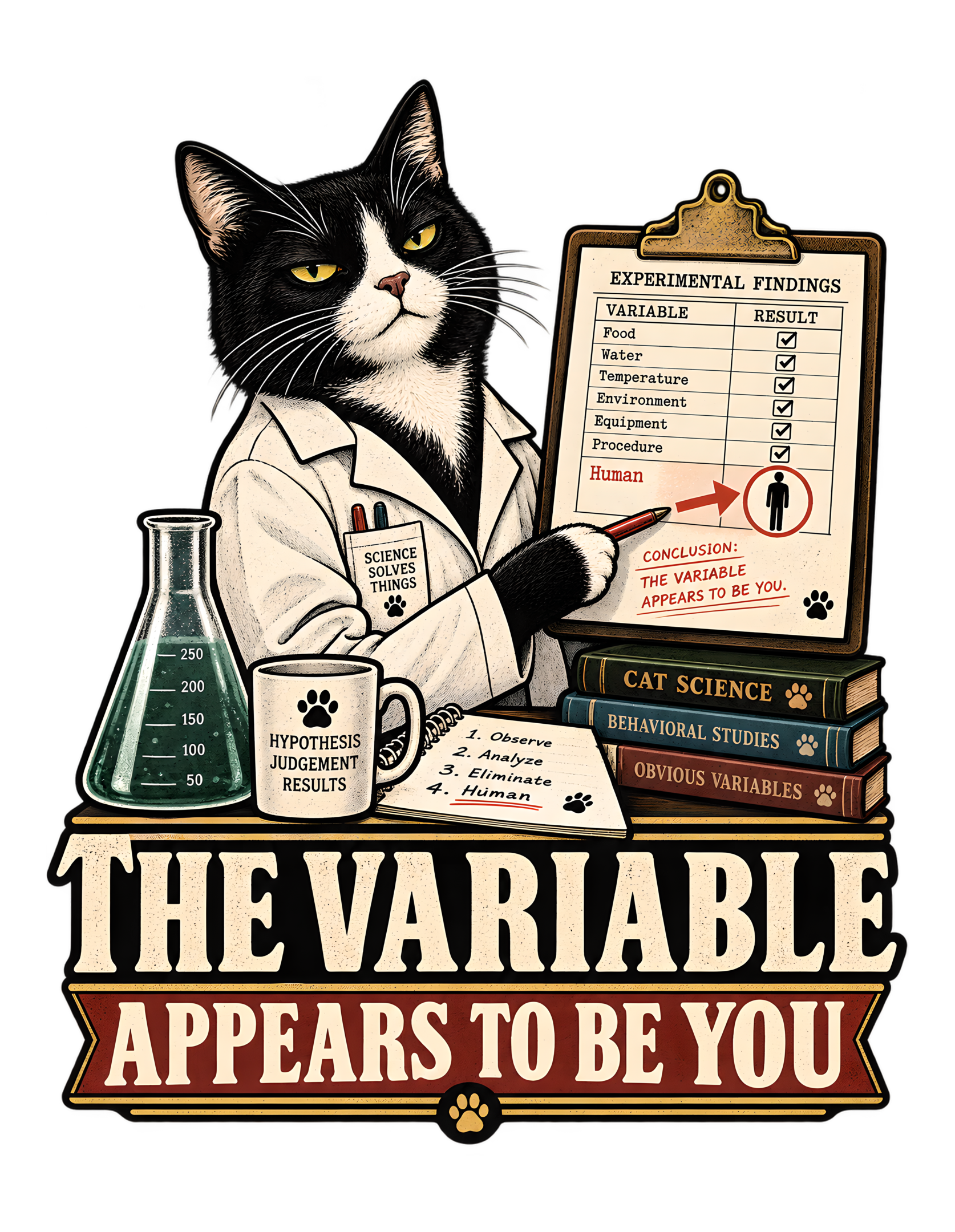
“THE VARIABLE APPEARS TO BE YOU” turns a troubleshooting habit into a formal feline verdict. The canonical concept is exact: a cat scientist concludes that the unexplained problem in the experiment is not the setup, not the data, and not the cat. The human is the remaining variable.
The supplied visual concept gives that conclusion a clear scientific hierarchy. A tuxedo cat in a simple laboratory coat stands beside a compact experiment setup with a beaker, notes, and a chart where one highlighted variable points toward a generic human silhouette. The cat looks calm and certain rather than excited. That restraint matters because the joke is not about a dramatic discovery. It is about a result the cat seems to consider obvious.
The wording strengthens the same idea. “Variable” sounds analytical. “Appears to be” sounds cautiously professional. “You” removes the human’s final escape route. The phrase therefore lands like the final line of a report rather than a casual insult.
That makes the design especially well suited to Cats Judging Humans. The human expects to be the observer. The cat quietly takes control of the experiment, the evidence, and the interpretation. The human becomes the thing being measured.
The retro document-parody structure, bold typography, restrained lab props, and clear scientific hierarchy all reinforce that reversal. The design does not need chaos, technical jargon, or hostility. Its strength comes from calm organization.
The approved production artwork remains immutable. This page does not replace, redraw, or alter it. It explains the source-supported concept around it while keeping unsupported product claims, technical claims, and marketplace details out of the editorial body.
The humans requested analysis.
The cat completed it.
The variable appears to be you.
The Joke Begins With a Human Search for External Causes
The concept begins with a familiar human reflex: when something goes wrong, we inspect the external factors first. We question the tools, process, timing, instructions, environment, or data. The possibility that the operator is the unstable element often arrives later, usually after more comfortable explanations have failed.
The canonical concept turns that pattern into the experiment itself. The setup is not the problem. The data is not the problem. The cat is certainly not the problem. Once those possibilities are removed, the human remains as the unresolved variable.
That structure makes the phrase feel earned rather than random. The viewer can imagine a careful elimination process even though the source never defines the exact experiment. Because the experiment stays unspecified, the joke can apply to work, household tasks, technology, planning, or any other situation where humans become creative about assigning causes.
Cats Judging Humans benefits from that breadth. The brand does not need one incompetent fictional owner. It needs a recognizable human habit placed under feline review. The cat scientist supplies the review without drama, and the human supplies the uncomfortable conclusion.
The result is less about science than accountability. Humans wanted a root-cause analysis. The cat found one. Management regrets that the root cause is currently listed under “you.”
The section’s value comes from keeping the factual layer narrow while letting the editorial interpretation focus on human behavior. The source supplies the cat scientist, the experiment structure, the highlighted human variable, and the calm certainty. The humor can grow from those facts without inventing a specific failed experiment.
Visually, the source also keeps the hierarchy disciplined. The cat remains the authority, the laboratory remains context, and the human remains the suspicious input. That separation prevents the composition from becoming a generic science collage and keeps the judgment readable.
The Cats Judging Humans voice works here because the cat never needs to become cruel. The human condition is the joke. Feline confidence is simply the delivery system, and the formal scientific framing makes that confidence feel more official than the situation deserves.
The Word Variable Turns an Insult Into Procedure
The word “variable” is the concept’s most efficient piece of scientific language. A blunt phrase such as “you are the problem” would communicate judgment, but it would lose the procedural quality that makes the design distinctive. A variable sounds measurable, comparable, and documentable.
That vocabulary gives the cat institutional distance. The cat is not arguing with the human. The cat is classifying an input. This keeps the tone dry rather than hostile and makes the judgment feel more official than emotional.
The source-supported chart reinforces the word visually. One highlighted variable points toward a generic human silhouette, so the viewer understands that something has been isolated after comparison. The graphic does not need detailed equations or readable labels. Its role is to make the accusation look organized.
For Cats Judging Humans, that organization is part of the comedy. Feline superiority becomes funnier when it appears professionally administered. The human is not merely wrong; the human has become a documented factor affecting the result.
A variable is not even necessarily guilty. It is simply influential. That technical neutrality makes the conclusion more politely devastating. Management is not accusing you. Management is reporting a correlation.
Visually, the source also keeps the hierarchy disciplined. The cat remains the authority, the laboratory remains context, and the human remains the suspicious input. That separation prevents the composition from becoming a generic science collage and keeps the judgment readable.
The Cats Judging Humans voice works here because the cat never needs to become cruel. The human condition is the joke. Feline confidence is simply the delivery system, and the formal scientific framing makes that confidence feel more official than the situation deserves.
The section’s value comes from keeping the factual layer narrow while letting the editorial interpretation focus on human behavior. The source supplies the cat scientist, the experiment structure, the highlighted human variable, and the calm certainty. The humor can grow from those facts without inventing a specific failed experiment.
Appears to Be Gives the Verdict a Perfectly Polite Edge
The phrase does not say “the variable is you.” It says “the variable appears to be you.” That small qualification creates the design’s dryest layer of humor because it sounds like the cautious language of a researcher who refuses to claim more than the evidence supports.
The caution is obviously unhelpful to the human. The chart already points toward a human silhouette, the cat is calm, and the conclusion seems settled. “Appears to be” therefore behaves like professional courtesy after the verdict has effectively been reached.
This wording also fits the canonical direction that the cat should look calm and certain rather than excited. Excitement suggests a surprising breakthrough. “Appears to be” sounds like confirmation of something the researcher already suspected.
Cats Judging Humans uses that emotional restraint well. The cat does not need to celebrate, insult, or argue. The human receives one procedural courtesy: technically, the conclusion is framed as provisional.
Perhaps another test could change the result. The research department is willing to collect more data. Confidence in a different outcome remains low.
The Cats Judging Humans voice works here because the cat never needs to become cruel. The human condition is the joke. Feline confidence is simply the delivery system, and the formal scientific framing makes that confidence feel more official than the situation deserves.
The section’s value comes from keeping the factual layer narrow while letting the editorial interpretation focus on human behavior. The source supplies the cat scientist, the experiment structure, the highlighted human variable, and the calm certainty. The humor can grow from those facts without inventing a specific failed experiment.
Visually, the source also keeps the hierarchy disciplined. The cat remains the authority, the laboratory remains context, and the human remains the suspicious input. That separation prevents the composition from becoming a generic science collage and keeps the judgment readable.
The Tuxedo Cat Scientist Occupies the Position of Authority
The canonical visual concept specifies a tuxedo cat in a simple laboratory coat. That choice gives the design immediate contrast and formality. The black-and-white markings naturally support a composed, professional character without requiring elaborate costume or theatrical props.
The cat must remain the authority because the entire joke depends on who controls interpretation. If the equipment dominated the composition, the design would become generic science humor. If the human dominated, the judgment would feel defensive. The cat needs to own the process.
The simple coat makes that role legible while preserving restraint. The character should look like someone who belongs in the laboratory, not someone performing “science” for the viewer. The source’s calm-and-certain direction reinforces the same impression.
This authority structure is central to Cats Judging Humans. Humans create systems and assume they control them. The cat steps into the highest-value role and quietly treats human behavior as the thing requiring analysis.
The human may have built the laboratory. The cat appears to run it. The distinction is not currently open for peer review.
The section’s value comes from keeping the factual layer narrow while letting the editorial interpretation focus on human behavior. The source supplies the cat scientist, the experiment structure, the highlighted human variable, and the calm certainty. The humor can grow from those facts without inventing a specific failed experiment.
Visually, the source also keeps the hierarchy disciplined. The cat remains the authority, the laboratory remains context, and the human remains the suspicious input. That separation prevents the composition from becoming a generic science collage and keeps the judgment readable.
The Cats Judging Humans voice works here because the cat never needs to become cruel. The human condition is the joke. Feline confidence is simply the delivery system, and the formal scientific framing makes that confidence feel more official than the situation deserves.
The Compact Experiment Setup Keeps the Hierarchy Clean
The source describes a compact experiment setup, and that scale is ideal for the concept. The design needs enough laboratory context to support the phrase, but not so much equipment that the viewer has to decode a separate science scene before reaching the joke.
A compact setup creates an efficient reading order: cat scientist, experiment context, chart, human variable, verdict. The scene can feel complete without becoming crowded, and the bold phrase can retain real visual weight.
That economy also supports the retro document-parody structure. The design behaves more like a controlled report or institutional graphic than a cinematic laboratory. The experiment is present because it establishes context, not because it is the main spectacle.
Cats Judging Humans benefits from the visual discipline. Human problems may feel complicated to humans, but the cat appears to have reduced the matter to a small, manageable investigation. The contrast makes feline competence look almost unfair.
The experiment does not need more machinery. It already produced the one result management required.
Visually, the source also keeps the hierarchy disciplined. The cat remains the authority, the laboratory remains context, and the human remains the suspicious input. That separation prevents the composition from becoming a generic science collage and keeps the judgment readable.
The Cats Judging Humans voice works here because the cat never needs to become cruel. The human condition is the joke. Feline confidence is simply the delivery system, and the formal scientific framing makes that confidence feel more official than the situation deserves.
The section’s value comes from keeping the factual layer narrow while letting the editorial interpretation focus on human behavior. The source supplies the cat scientist, the experiment structure, the highlighted human variable, and the calm certainty. The humor can grow from those facts without inventing a specific failed experiment.
Visually, the source also keeps the hierarchy disciplined. The cat remains the authority, the laboratory remains context, and the human remains the suspicious input. That separation prevents the composition from becoming a generic science collage and keeps the judgment readable.
The Beaker and Notes Suggest Process Without Inventing the Science
The beaker and notes provide scientific context while keeping the actual experiment undefined. That is useful because the source supports the appearance of testing and documentation, but it does not supply a real technical procedure, measurable result, or scientific claim.
The beaker tells the viewer that experimentation occurred. The notes imply observation and record-keeping. Neither object needs readable content. Their purpose is to create the impression of method, not to simulate a real laboratory protocol.
The notes are especially effective for Cats Judging Humans because they suggest the cat has been documenting human behavior longer than the human realized. The final conclusion may feel sudden to the viewer, but the visual language implies a history of evidence.
That implication stays safely inside editorial humor. The page does not need to invent what the notes say or what the beaker contains. The source-supported role of those props is enough.
The human may request access to the notebook. Research policy currently classifies those materials as feline internal documents.
The Cats Judging Humans voice works here because the cat never needs to become cruel. The human condition is the joke. Feline confidence is simply the delivery system, and the formal scientific framing makes that confidence feel more official than the situation deserves.
The section’s value comes from keeping the factual layer narrow while letting the editorial interpretation focus on human behavior. The source supplies the cat scientist, the experiment structure, the highlighted human variable, and the calm certainty. The humor can grow from those facts without inventing a specific failed experiment.
Visually, the source also keeps the hierarchy disciplined. The cat remains the authority, the laboratory remains context, and the human remains the suspicious input. That separation prevents the composition from becoming a generic science collage and keeps the judgment readable.
The Cats Judging Humans voice works here because the cat never needs to become cruel. The human condition is the joke. Feline confidence is simply the delivery system, and the formal scientific framing makes that confidence feel more official than the situation deserves.
The Chart Converts Feline Suspicion Into an Official Finding
The chart is the design’s strongest bridge between visual humor and verbal judgment. A skeptical cat can have an opinion. A scientist with a chart can appear to have a result. The canonical visual concept uses one highlighted variable pointing toward a generic human silhouette to make that result immediate.
Charts normally suggest comparison, neutrality, and analysis. The design borrows that expectation and gives it to a cat whose neutrality is, at best, questionable. That conflict of interest is not a flaw in the joke. It is the joke.
The chart also lets the phrase and image reinforce one another without duplicating information. The phrase says the variable appears to be you. The chart points toward the human. The viewer understands the conclusion from either direction.
For Cats Judging Humans, this is perfect institutional comedy. The cat does not simply believe the human is the problem. The cat has documentation that appears to support the belief.
The methodology may deserve review. Unfortunately, the current reviewer is the same cat who approved the methodology.
The section’s value comes from keeping the factual layer narrow while letting the editorial interpretation focus on human behavior. The source supplies the cat scientist, the experiment structure, the highlighted human variable, and the calm certainty. The humor can grow from those facts without inventing a specific failed experiment.
Visually, the source also keeps the hierarchy disciplined. The cat remains the authority, the laboratory remains context, and the human remains the suspicious input. That separation prevents the composition from becoming a generic science collage and keeps the judgment readable.
The Cats Judging Humans voice works here because the cat never needs to become cruel. The human condition is the joke. Feline confidence is simply the delivery system, and the formal scientific framing makes that confidence feel more official than the situation deserves.
The Human Silhouette Makes the Accusation Universal
The source uses a generic human silhouette rather than a detailed person, and that keeps the concept broad. The design does not accuse one fictional owner. It accuses the role of “human” itself, which is far more useful for a brand built around observing human behavior.
A detailed person would introduce unnecessary specifics: age, gender, profession, clothing, expression, or relationship to the cat. The silhouette strips all of that away and preserves the only detail that matters to the experiment.
The result is more personal because the viewer can step into the role. There is no separate character to blame. The highlighted silhouette can become anyone, including the person currently reading the page.
The silhouette also protects the visual hierarchy. The cat remains the character with personality and authority. The human remains evidence. Human behavior stays central to the joke without making the human visually dominant.
Humanity invented diagrams to simplify complex systems. The cat has used one to simplify humanity.
Visually, the source also keeps the hierarchy disciplined. The cat remains the authority, the laboratory remains context, and the human remains the suspicious input. That separation prevents the composition from becoming a generic science collage and keeps the judgment readable.
The Cats Judging Humans voice works here because the cat never needs to become cruel. The human condition is the joke. Feline confidence is simply the delivery system, and the formal scientific framing makes that confidence feel more official than the situation deserves.
The section’s value comes from keeping the factual layer narrow while letting the editorial interpretation focus on human behavior. The source supplies the cat scientist, the experiment structure, the highlighted human variable, and the calm certainty. The humor can grow from those facts without inventing a specific failed experiment.
Visually, the source also keeps the hierarchy disciplined. The cat remains the authority, the laboratory remains context, and the human remains the suspicious input. That separation prevents the composition from becoming a generic science collage and keeps the judgment readable.
Calm Certainty Is Funnier Than a Dramatic Breakthrough
The canonical source explicitly directs the cat to look calm and certain rather than excited. That emotional choice changes the entire joke. Excitement suggests discovery. Calm certainty suggests confirmation.
The cat does not appear surprised that the human is the problematic variable. The cat appears mildly surprised that the humans required an experiment to establish it. That is a much stronger Cats Judging Humans position.
The calm expression also aligns with the phrase. “Appears to be” is restrained language. A frantic scientist would fight against that tone. A composed scientist makes the wording feel like professional understatement.
This restraint keeps the design playful rather than cruel. The cat does not mock the human openly. The cat simply reports. The embarrassment comes from the conclusion, not from hostility.
Management is not celebrating your failure. Management is filing it.
The Cats Judging Humans voice works here because the cat never needs to become cruel. The human condition is the joke. Feline confidence is simply the delivery system, and the formal scientific framing makes that confidence feel more official than the situation deserves.
The section’s value comes from keeping the factual layer narrow while letting the editorial interpretation focus on human behavior. The source supplies the cat scientist, the experiment structure, the highlighted human variable, and the calm certainty. The humor can grow from those facts without inventing a specific failed experiment.
Visually, the source also keeps the hierarchy disciplined. The cat remains the authority, the laboratory remains context, and the human remains the suspicious input. That separation prevents the composition from becoming a generic science collage and keeps the judgment readable.
The Cats Judging Humans voice works here because the cat never needs to become cruel. The human condition is the joke. Feline confidence is simply the delivery system, and the formal scientific framing makes that confidence feel more official than the situation deserves.
The Retro Document-Parody Structure Turns Science Into Bureaucracy
The canonical source describes a retro document-parody structure, which gives the concept a second layer beyond laboratory humor. A document implies filing, review, and permanence. The result exists whether the human agrees with it or not.
That administrative tone suits Cats Judging Humans because the brand often treats feline judgment as policy, procedure, inspection, approval, or review. Here, scientific authority and bureaucratic authority overlap.
The beaker establishes the experiment. The notes imply documentation. The chart organizes the evidence. The bold typography states the conclusion. Each element supports the impression that the cat has produced a formal record.
The retro treatment also keeps the design from feeling like a modern software dashboard or generic infographic. The joke is not about interface design. It is about institutional certainty.
The report has been filed. Human disagreement was not listed as a required field.
The section’s value comes from keeping the factual layer narrow while letting the editorial interpretation focus on human behavior. The source supplies the cat scientist, the experiment structure, the highlighted human variable, and the calm certainty. The humor can grow from those facts without inventing a specific failed experiment.
Visually, the source also keeps the hierarchy disciplined. The cat remains the authority, the laboratory remains context, and the human remains the suspicious input. That separation prevents the composition from becoming a generic science collage and keeps the judgment readable.
The Cats Judging Humans voice works here because the cat never needs to become cruel. The human condition is the joke. Feline confidence is simply the delivery system, and the formal scientific framing makes that confidence feel more official than the situation deserves.
The section’s value comes from keeping the factual layer narrow while letting the editorial interpretation focus on human behavior. The source supplies the cat scientist, the experiment structure, the highlighted human variable, and the calm certainty. The humor can grow from those facts without inventing a specific failed experiment.
Bold Typography Delivers the Phrase Like a Final Report Line
The phrase functions as the final finding, so the typography must behave like a conclusion rather than a decorative caption. The source specifically calls for bold typography and a clear scientific hierarchy, which supports the wording’s structure.
The phrase narrows in three steps. “The variable” establishes the analytical frame. “Appears to be” introduces professional caution. “You” makes the result personal. The typography can preserve that sequence while giving the verdict enough weight to anchor the composition.
A speech bubble would make the line feel conversational. A report-like typographic treatment makes it feel documented. That difference is essential because the cat’s authority depends on appearing to have completed a process.
The character supplies personality, the props supply context, and the type resolves the joke. None of those parts needs to overtake the others.
The human may wish to dispute the finding. The font suggests the document has already been finalized.
Visually, the source also keeps the hierarchy disciplined. The cat remains the authority, the laboratory remains context, and the human remains the suspicious input. That separation prevents the composition from becoming a generic science collage and keeps the judgment readable.
The Cats Judging Humans voice works here because the cat never needs to become cruel. The human condition is the joke. Feline confidence is simply the delivery system, and the formal scientific framing makes that confidence feel more official than the situation deserves.
The section’s value comes from keeping the factual layer narrow while letting the editorial interpretation focus on human behavior. The source supplies the cat scientist, the experiment structure, the highlighted human variable, and the calm certainty. The humor can grow from those facts without inventing a specific failed experiment.
Visually, the source also keeps the hierarchy disciplined. The cat remains the authority, the laboratory remains context, and the human remains the suspicious input. That separation prevents the composition from becoming a generic science collage and keeps the judgment readable.
The Humor Targets Rationalization Rather Than Science
The laboratory setting could have made the design a joke about science, but the canonical concept points toward a more durable target: rationalization. Humans are very good at searching for explanations that preserve their own innocence.
We question the setup. We question the data. We question the tools. We question everyone else. The cat scientist removes those comfortable possibilities and leaves the human as the unresolved factor.
That means the scientific frame is not being mocked as useless. It is useful enough to produce an uncomfortable conclusion. The more organized the process appears, the harder it becomes for the human to dismiss the result.
Cats Judging Humans adds one obvious complication: the researcher is a cat with a strong incentive to exclude feline responsibility. The viewer can see that bias and still enjoy the internal logic.
The science worked. The human simply dislikes the output.
The Cats Judging Humans voice works here because the cat never needs to become cruel. The human condition is the joke. Feline confidence is simply the delivery system, and the formal scientific framing makes that confidence feel more official than the situation deserves.
The section’s value comes from keeping the factual layer narrow while letting the editorial interpretation focus on human behavior. The source supplies the cat scientist, the experiment structure, the highlighted human variable, and the calm certainty. The humor can grow from those facts without inventing a specific failed experiment.
Visually, the source also keeps the hierarchy disciplined. The cat remains the authority, the laboratory remains context, and the human remains the suspicious input. That separation prevents the composition from becoming a generic science collage and keeps the judgment readable.
The Cats Judging Humans voice works here because the cat never needs to become cruel. The human condition is the joke. Feline confidence is simply the delivery system, and the formal scientific framing makes that confidence feel more official than the situation deserves.
The Design Makes Human Self-Confidence Part of the Experiment
The concept reverses one of humanity’s favorite assumptions: that the human is the neutral observer standing outside the problem. In this design, the human is inside the system and has been identified as the questionable variable.
That reversal gives the joke more depth than a simple claim that cats are smarter. The real target is human certainty. We like to believe we define the frame, operate the system, and interpret the result.
The cat scientist quietly removes that privilege. The notes belong to the cat. The chart is interpreted by the cat. The human becomes material rather than evaluator.
That structure is pure Cats Judging Humans. The human thinks the cat is being observed. The cat appears to have been collecting evidence about the human all along.
Some troubleshooting sessions would end much faster if the operator were included in the test. Management has already included you.
The section’s value comes from keeping the factual layer narrow while letting the editorial interpretation focus on human behavior. The source supplies the cat scientist, the experiment structure, the highlighted human variable, and the calm certainty. The humor can grow from those facts without inventing a specific failed experiment.
Visually, the source also keeps the hierarchy disciplined. The cat remains the authority, the laboratory remains context, and the human remains the suspicious input. That separation prevents the composition from becoming a generic science collage and keeps the judgment readable.
The Cats Judging Humans voice works here because the cat never needs to become cruel. The human condition is the joke. Feline confidence is simply the delivery system, and the formal scientific framing makes that confidence feel more official than the situation deserves.
The section’s value comes from keeping the factual layer narrow while letting the editorial interpretation focus on human behavior. The source supplies the cat scientist, the experiment structure, the highlighted human variable, and the calm certainty. The humor can grow from those facts without inventing a specific failed experiment.
The Cat Remains Blameless Because It Controls the Evidence
The canonical concept removes the cat from suspicion before the human is even introduced. Not the setup. Not the data. Not the cat. That sequence formalizes one of the brand’s recurring comic ideas: feline responsibility is rarely volunteered.
The laboratory turns that attitude into procedure. The cat is not merely innocent. The cat is the investigator, note-taker, chart-reader, and interpreter. That is an extraordinary concentration of authority.
The humor comes from the obvious bias. The party excluded from blame is the same party controlling the evidence. The design does not need to hide that conflict because the conflict is the point.
Cats Judging Humans thrives on circular logic that feels emotionally recognizable. The cat behaves as though the only reasonable explanation must be elsewhere. The scientific setup simply gives that confidence paperwork.
Independent review has been requested. Management was unable to locate an independent cat.
Visually, the source also keeps the hierarchy disciplined. The cat remains the authority, the laboratory remains context, and the human remains the suspicious input. That separation prevents the composition from becoming a generic science collage and keeps the judgment readable.
The Cats Judging Humans voice works here because the cat never needs to become cruel. The human condition is the joke. Feline confidence is simply the delivery system, and the formal scientific framing makes that confidence feel more official than the situation deserves.
The section’s value comes from keeping the factual layer narrow while letting the editorial interpretation focus on human behavior. The source supplies the cat scientist, the experiment structure, the highlighted human variable, and the calm certainty. The humor can grow from those facts without inventing a specific failed experiment.
Visually, the source also keeps the hierarchy disciplined. The cat remains the authority, the laboratory remains context, and the human remains the suspicious input. That separation prevents the composition from becoming a generic science collage and keeps the judgment readable.
The Concept Stays Evergreen Because Human Blame-Shifting Does Too
The source marks the concept as evergreen, and the underlying human behavior supports that classification. Nothing depends on a holiday, current event, celebrity, platform interface, or temporary meme format.
People will continue troubleshooting. People will continue searching for external causes. People will continue becoming uncomfortable when the final unresolved factor points back toward themselves.
The cat scientist gives that pattern a durable visual form: laboratory coat, compact experiment, notes, beaker, chart, human silhouette, and verdict. Those elements remain readable without tying the design to one profession or era.
The retro document-parody structure also helps. It makes the artwork feel self-contained rather than dependent on a contemporary interface style. The generic human silhouette keeps the target universal.
As long as human confidence continues to exceed human error awareness, the research department will remain fully funded.
The Cats Judging Humans voice works here because the cat never needs to become cruel. The human condition is the joke. Feline confidence is simply the delivery system, and the formal scientific framing makes that confidence feel more official than the situation deserves.
The section’s value comes from keeping the factual layer narrow while letting the editorial interpretation focus on human behavior. The source supplies the cat scientist, the experiment structure, the highlighted human variable, and the calm certainty. The humor can grow from those facts without inventing a specific failed experiment.
Visually, the source also keeps the hierarchy disciplined. The cat remains the authority, the laboratory remains context, and the human remains the suspicious input. That separation prevents the composition from becoming a generic science collage and keeps the judgment readable.
The Cats Judging Humans voice works here because the cat never needs to become cruel. The human condition is the joke. Feline confidence is simply the delivery system, and the formal scientific framing makes that confidence feel more official than the situation deserves.
The Cat Scientist Expands the Cats Judging Humans Authority System
The design fits Cats Judging Humans because it gives the cat a new kind of institutional authority without changing the core relationship. The brand does not need every cat to sit on a throne, manage an office, inspect a household, or supervise a desk.
A laboratory introduces a different hierarchy: knowledge, procedure, evidence, and interpretation. The cat controls all four. That variety keeps the catalog from depending on one repeated costume or setting.
The tuxedo cat scientist still feels native to the same brand world. The cat is composed. The human is questionable. The cat has documentation. The human has objections. The cat decides which of those matters.
The source’s simple coat, restrained props, chart, human silhouette, calm expression, and bold phrase make the concept recognizable through voice and structure rather than through repeated branding marks.
Only the department has changed. Welcome to research.
The section’s value comes from keeping the factual layer narrow while letting the editorial interpretation focus on human behavior. The source supplies the cat scientist, the experiment structure, the highlighted human variable, and the calm certainty. The humor can grow from those facts without inventing a specific failed experiment.
Visually, the source also keeps the hierarchy disciplined. The cat remains the authority, the laboratory remains context, and the human remains the suspicious input. That separation prevents the composition from becoming a generic science collage and keeps the judgment readable.
The Cats Judging Humans voice works here because the cat never needs to become cruel. The human condition is the joke. Feline confidence is simply the delivery system, and the formal scientific framing makes that confidence feel more official than the situation deserves.
The section’s value comes from keeping the factual layer narrow while letting the editorial interpretation focus on human behavior. The source supplies the cat scientist, the experiment structure, the highlighted human variable, and the calm certainty. The humor can grow from those facts without inventing a specific failed experiment.
“THE VARIABLE APPEARS TO BE YOU” succeeds because every source-supported element points toward the same conclusion.
The tuxedo cat occupies the role of scientist. The simple laboratory coat makes that role visible. The compact experiment setup keeps the hierarchy clear. The beaker and notes imply process. The chart turns suspicion into a formal finding. The generic human silhouette makes the accusation universal. The calm expression turns discovery into confirmation. The retro document-parody structure makes the result feel filed rather than improvised. The bold typography delivers the final line.
The phrase completes the mechanism on its own. “Variable” sounds analytical. “Appears to be” sounds cautious. “You” removes the human’s final protection.
Nothing needs to become louder than that.
The concept does not need a real scientific procedure, a detailed human character, or a complicated backstory. Its strength comes from restraint. The human is the problem because the cat controls the process that identified the problem. The viewer understands the conflict of interest and accepts it because that bias is the joke.
The approved production artwork remains immutable. This page explains the source-supported concept without altering the master or inventing unsupported product facts.
The humans requested a diagnosis.
Management has completed the report.
The variable appears to be you.