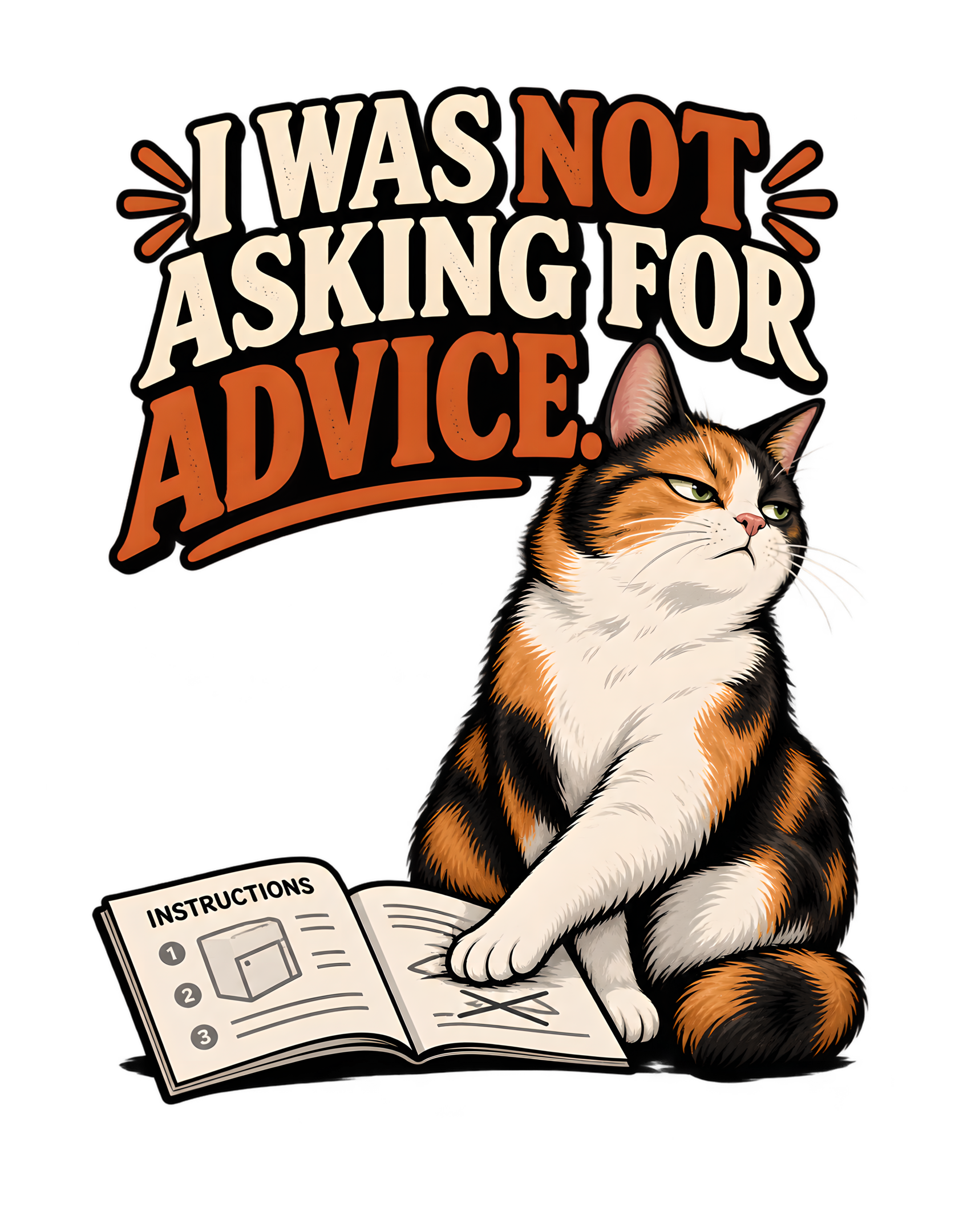
“I WAS NOT ASKING FOR ADVICE” begins with a social experience humans know very well and cats appear uniquely qualified to judge: unsolicited guidance. The canonical concept is concise. A calico cat responds to human input with the unmistakable expression of someone who never requested it. The supplied visual concept places that cat upright beside a small open instruction booklet, looking away with deep disinterest while one paw rests dismissively across the page as though the discussion has already concluded. The phrase leads the composition in large type above the compact editorial portrait.
That is enough to establish the entire joke. The human side of the scene believes information is being offered. The feline side appears to believe a procedural boundary has been crossed. The booklet represents helpfulness, instruction, and the familiar human urge to explain. The cat’s posture and expression reject the premise that advice was ever needed. Nothing dramatic has to happen. The humor lives in the mismatch between human intention and feline reception.
Cats Judging Humans is built for this kind of reversal. Humans like to think they are the ones providing structure, rules, recommendations, and competent oversight. The cat in this design quietly reorganizes that hierarchy. It does not debate the advice. It does not ask follow-up questions. It simply looks as though the consultation was scheduled without authorization.
The canonical source describes the concept as evergreen, which fits the joke. Unsolicited advice is not tied to a trend, season, platform, or news cycle. The reaction is equally durable: a composed cat who appears to have already formed an opinion and is not recruiting additional input.
This page treats the supplied canonical source and approved production artwork as the only factual authorities. Where the source is specific, the page is specific. Where it is silent, the analysis stays interpretive and openly humorous rather than inventing product claims, materials, technical details, or behavior presented as fact.
The Joke Works Because the Human Thinks Advice Is Helpful
The central premise depends on a familiar human habit: offering guidance because guidance feels useful. The phrase “I WAS NOT ASKING FOR ADVICE” does not deny that the human may have meant well. It rejects the assumption that good intentions automatically create permission to advise.
That distinction is what gives the joke its dry edge.
The canonical concept does not require the human to be foolish, hostile, or incompetent. In fact, the humor is stronger if the unseen human is simply trying to be helpful. The cat’s reaction then becomes disproportionate in exactly the way Cats Judging Humans prefers: the human believes a contribution has been made, while the cat appears to classify that same contribution as unnecessary interference.
The open instruction booklet reinforces the human side of the exchange. A booklet suggests explanation, procedure, and a belief that there is a correct way to do something. The cat’s dismissive paw turns the object into evidence of a conversation that has already gone on too long.
This is not a joke about rejecting all knowledge. It is a joke about status.
Who asked whom?
Who believes they are qualified to instruct?
Who gets to decide when a discussion is over?
Cats Judging Humans answers those questions in the obvious feline direction.
The cat does not need to destroy the booklet or perform an exaggerated reaction. The visual concept is built around restraint. Sitting upright, looking away, and resting one paw across the page says more than a dramatic tantrum would. The cat appears certain that no additional explanation is necessary.
That gives the design a broader human-relatable layer as well. Most people have experienced advice arriving before a request. The feline version simply removes social politeness from the response.
Management has received your suggestion.
Management would like to clarify that suggestions were not being collected.
The premise is also stronger because the advice itself remains undefined. A specific topic would narrow the audience, while an unspecified instruction lets the viewer supply their own example. The cat’s rejection therefore operates at the level of process: the problem is not necessarily what the human said. The problem is that the human assumed the floor was open.
That structure keeps the human recognizable rather than villainous. Helpful people often overestimate the value of immediate input, and the design turns that tiny social mistake into the thing being judged. The cat never has to prove the advice wrong. It only has to establish that the consultation was never commissioned in the first place.
The Calico Cat Gives the Design a Distinct Visual Center
The canonical visual concept specifies a calico cat, which gives the design a recognizable feline subject without requiring extra characters or scenery. The cat is the emotional center of the artwork because the entire joke depends on reading its attitude.
The source does not provide a detailed coat-pattern map, eye color, body size, or breed identity, so the article should not invent those details. “Calico cat” is enough.
What matters more is the role the cat plays inside the composition.
The cat sits upright beside the instruction booklet and looks away with an unimpressed expression. That posture keeps the animal visually composed rather than chaotic. The design is not about a cat losing patience in an explosive way. It is about a cat who believes the human’s advice is beneath serious consideration.
That quiet superiority fits the Cats Judging Humans voice particularly well.
A more frantic pose would shift the joke toward disruption. A frightened pose would change the emotional meaning entirely. A smiling or eager expression would weaken the rejection. The canonical direction instead gives the cat an editorial stillness: the animal appears to have reviewed the situation and reached a conclusion.
The calico appearance also helps the character remain visually specific while the joke stays universal. The viewer does not need to identify a breed or understand a specialized behavior. They only need to recognize a cat with an expression that says the discussion was never invited.
That gives the design a strong balance between character and category. It is not a generic silhouette with text, but it is also not dependent on a detailed backstory.
The cat’s job is simple.
Sit upright.
Look unimpressed.
End the meeting.
Management appreciates role clarity.
For future editorial imagery, the calico identity should remain stable because it is one of the few explicit visual facts in the source. The artwork can vary supporting environments elsewhere on the website, but the design itself should continue to be described through the supplied portrait concept rather than embellished with unsupported coat or breed details.
That discipline also protects the page from drifting into generic black-cat or tabby-cat humor. The source chose a calico, and the editorial treatment should honor that choice. The visual specificity belongs to the design, while the broader social joke remains accessible to any viewer who understands an unimpressed feline expression.
The Open Instruction Booklet Turns Human Guidance Into a Physical Prop
The small open instruction booklet is one of the most important parts of the canonical visual concept because it gives the unseen human advice a visible form.
Without it, the phrase could still work as a general statement about unwanted opinions. With the booklet, the joke becomes more concrete. Somebody has apparently gone to the trouble of providing instructions. The cat has apparently gone to the trouble of refusing them.
That makes the composition feel like a complete interaction rather than a slogan floating over a portrait.
The booklet also introduces a subtle workplace-and-household crossover. Instructional material implies process. Process implies rules. Rules imply that someone believes there is a correct method. Cats Judging Humans immediately finds the flaw in this system: the human has assumed the cat is participating in it.
The cat’s dismissive paw across the page is therefore more than a pose. It changes the booklet from a source of authority into an object being closed out of the conversation.
The source does not state what the booklet contains. That omission is useful. The design does not need a visible list of instructions because the exact subject of the advice is irrelevant. The joke is about the act of advising, not the topic.
That keeps the design broad.
The human could be explaining behavior.
The human could be demonstrating a household rule.
The human could be offering a suggestion nobody requested.
The cat’s answer remains the same.
This is also why the booklet should stay small relative to the cat and typography. It supports the joke without becoming the main subject.
The human brought documentation.
The cat brought authority.
One of those things is winning.
The booklet also creates a useful contrast between object and expression. It is small, practical, and supposedly informative. The cat is larger, emotionally decisive, and uninterested. That imbalance makes the human tool look almost ceremonial in its uselessness: all that guidance has arrived, and none of it has secured an audience.
Because the booklet remains generic, it can symbolize any form of unsolicited expertise. That gives the design a wider emotional range than a booklet with visible instructions would have. The object tells us that guidance exists; the cat tells us what happened to its authority the moment it entered the room.
The Dismissive Paw Is the Quietest Possible Way to End the Discussion
The canonical visual concept gives the cat one especially effective gesture: a paw resting dismissively across the open page.
That gesture works because it is controlled.
The cat is not shredding the booklet.
It is not batting it across the room.
It is not performing a theatrical rejection.
The paw simply occupies the page.
That physical placement says the discussion has ended because the cat has decided it has ended.
Cats Judging Humans often works best when feline power is presented as procedural rather than aggressive. The cat does not need force. It has confidence.
The gesture also gives the phrase a visual counterpart. “I WAS NOT ASKING FOR ADVICE” is a verbal boundary. The paw is the physical boundary.
The human may continue speaking.
The page is no longer available.
That pairing helps the design feel coherent instead of relying on typography alone.
The source does not specify which paw, the exact angle, or how much of the booklet is covered. Those details belong to the artwork itself rather than the factual editorial record. What the source does establish is the gesture’s meaning: dismissive closure.
That makes the paw one of the clearest examples of how small body language can carry a large joke.
There is also a useful contrast between the cat’s upright posture and the paw’s casual placement. The cat appears formal enough to judge the situation while still treating the advice as something that requires almost no effort to reject.
Management did not raise its voice.
Management simply closed the agenda item.
The paw’s restraint also protects the brand tone. A destructive gesture could make the cat seem angry. A resting paw looks more like policy enforcement. The humor stays dry because the cat appears to be ending access to the document, not staging a protest. Human advice has simply lost authorization.
That makes the gesture one of the strongest pieces of visual economy in the concept. A single paw does the work of a speech, a refusal, and a meeting adjournment. The design does not need extra props or reaction marks because the body language has already supplied the necessary punctuation.
Looking Away Makes the Rejection Funnier Than Direct Confrontation
The source says the calico cat looks away with a deeply unimpressed expression. That choice is important because it removes the need for direct conflict.
The cat is not staring aggressively at the human.
It is not challenging the viewer.
It appears to be withholding attention.
That is a subtler form of rejection, and it fits the phrase perfectly.
If the cat looked directly at the human, the scene might feel argumentative. Looking away makes the advice seem so unnecessary that it does not deserve a full response.
The humor therefore comes from indifference rather than hostility.
That distinction matters for the Cats Judging Humans brand, which aims to be judgmental and superior without becoming cruel. The cat’s expression can be sharp. The emotional tone can still remain playful.
The cat is not threatening the human.
It is simply unimpressed by the premise that the human had useful input.
That is a very different joke.
The away-looking pose also helps the viewer imagine the unseen human. Because the cat is reacting to something outside the immediate center of the composition, the audience can infer a conversation without needing another character.
That keeps the artwork compact and apparel-friendly.
The human exists through implication.
The advice exists through the booklet.
The verdict exists through the cat’s face.
Nothing more is required.
Cats Judging Humans thrives on exactly this kind of efficient social theater.
The viewer can supply the missing dialogue themselves.
Management has already stopped listening.
The away-looking expression also makes the cat feel socially sophisticated in a comic sense. Direct confrontation would require engagement. Looking away suggests the cat has already moved beyond the issue. The human is still participating in a conversation that management considers completed.
That asymmetry is funny because the two sides are clearly operating on different timelines. The human thinks the discussion is active. The cat behaves as though it concluded several minutes ago. The phrase merely documents the procedural misunderstanding for anyone still catching up.
The Phrase Leads Because the Joke Is a Social Boundary Before It Is a Cat Joke
The visual concept says the typography leads the composition, with the phrase set large above the compact editorial portrait.
That hierarchy is smart because the wording carries the universal social premise before the cat delivers the feline interpretation.
“I WAS NOT ASKING FOR ADVICE” is immediately understandable even without the illustration.
It is a boundary statement.
It is also dry enough to become funny when paired with an unimpressed cat.
The phrase does not overexplain.
It does not mention humans.
It does not say the advice was bad.
It does not say the cat knows better.
It simply clarifies that no request was made.
That precision is what gives the line its authority.
The artwork then intensifies the meaning. The open booklet proves advice was offered. The paw rejects the material. The turned-away expression makes the rejection emotionally complete.
The typography therefore acts as the ruling while the cat portrait acts as supporting evidence.
Cats Judging Humans is especially effective when text and image are not telling two unrelated jokes. Here they are perfectly aligned.
The phrase could belong to a human tired of unsolicited opinions.
The cat makes it specifically CJH.
The cat does not merely share the sentiment.
The cat appears to have invented the policy.
Because the wording is short and declarative, it also remains readable at a glance. That matters for apparel-style artwork, where the first read needs to happen quickly before smaller visual details are noticed.
The viewer reads the boundary.
Then the viewer sees who issued it.
Management appreciates efficient escalation procedures.
Because the phrase comes first visually, the cat does not have to carry every layer of meaning through facial expression alone. The viewer reads the boundary, then sees the exact feline attitude that makes it funny. That sequencing keeps both text and illustration efficient rather than forcing either one to overperform.
The line also succeeds because it refuses to justify itself. There is no explanation of why advice was unwanted and no request for the human to understand. That compactness gives the cat the last word by design. Any additional sentence would start sounding like negotiation, which is precisely what the artwork refuses to do.
The Humor Mechanism Is Superiority Delivered Without Effort
The source concept’s humor does not require a complicated narrative. A cat responds to human guidance as though the human has overestimated the value of being consulted.
That works because the cat does not appear to struggle.
There is no visible debate.
There is no counterargument.
There is no attempt to persuade.
The cat simply behaves as though its own judgment is already sufficient.
That effortless superiority is one of the core Cats Judging Humans mechanisms.
Humans tend to justify themselves.
Cats, in this brand universe, issue conclusions.
The design makes that hierarchy visible through stillness.
The upright posture suggests composure.
The dismissive paw suggests closure.
The away-looking expression suggests the human has already lost priority.
The phrase makes the conclusion explicit.
Nothing in the supplied concept requires anger.
That is important because genuine hostility would make the design narrower and harsher. Mild superiority is more recognizable and more reusable. It lets viewers laugh at the human side of the situation without making the cat seem cruel.
The joke also remains flexible because it does not depend on one kind of advice. The human could be explaining something obvious, recommending a change, or correcting behavior. The cat’s response is structurally the same.
That makes the design less about a specific household event and more about a recurring social pattern.
Humans advise.
Cats evaluate the adviser.
Cats Judging Humans considers this an important distinction.
Management is not resisting guidance.
Management is rejecting an unauthorized consultation.
The source concept’s novelty comes from this social mechanism more than from an elaborate scene. The cat is not merely “sassy.” It is evaluating the human assumption that advice was wanted. That sharper relationship structure is what keeps the design aligned with a brand about cats judging human behavior.
The funniest part is that the human may still believe the advice was excellent. The cat’s superiority does not depend on proving otherwise. The mismatch is between confidence and invitation, not between correct and incorrect information. That subtlety gives the joke more durability than a simple “human is wrong” setup.
The Design Turns Feline Independence Into a Social Attitude, Not a Scientific Claim
The marketplace description supplied in the canonical source connects the design to feline independence, but the page still needs to handle that idea carefully. This is a design page, not a breed-behavior study.
The concept supports independence as an editorial theme because the cat rejects unsolicited guidance and appears entirely confident in its own judgment.
That is enough.
The page does not need to claim that calico cats, or cats generally, behave in one scientifically defined way.
Cats Judging Humans can instead treat independence as a comic social attitude.
The cat does not appear to need a consultant.
The cat does not appear to need clarification.
The cat does not appear to believe human supervision was part of the arrangement.
That is a visual and verbal reading of the supplied design.
The phrase therefore works especially well for viewers who recognize the broader human experience of wanting autonomy. The cat becomes a dry stand-in for anyone who has heard advice arrive before a question.
That is also why the concept has crossover appeal without losing the feline identity. The human recognizes the social situation. The cat supplies the superior delivery.
The joke is not “cats never need help.”
The joke is “this cat has decided you were not invited to help.”
That distinction keeps the editorial interpretation grounded.
Management values independence.
Management also values accurately identifying who has authority to initiate guidance.
At present, the list remains short.
This is also why the page should avoid presenting independence as a universal feline fact. The design uses independence symbolically. The cat’s refusal is part of the joke. The website can discuss that editorially without turning a commercial artwork into a behavior claim about every cat.
Keeping the boundary between symbolism and fact also lets the design stay playful. Viewers can enjoy the cat as an exaggerated model of self-sufficiency without being asked to accept a behavioral theory. The artwork is making a social joke, not publishing a research finding.
The Compact Editorial Portrait Keeps the Design Focused Instead of Busy
The canonical visual concept calls for a compact editorial portrait beneath the large phrase.
That compactness matters.
The design does not need a full room, multiple characters, or a complicated narrative sequence. The joke can be carried by three things: cat, booklet, attitude.
A compact composition keeps those elements close enough to read as one moment.
The typography establishes the premise.
The cat provides the reaction.
The booklet provides context.
That is efficient visual storytelling.
Cats Judging Humans benefits from efficiency because too many props would weaken the authority of the central expression. The more explanation the artwork adds, the less room the viewer has to recognize their own experience in the joke.
The compact structure also makes the cat feel like an editorial subject rather than a random animal inside a large scene. The viewer is invited to study the expression.
The booklet remains a supporting prop.
The phrase remains dominant.
The cat remains the personality.
That hierarchy is consistent with the source.
It also helps the design remain evergreen. A tightly focused portrait is less likely to depend on fashionable interiors, specific technology, or temporary cultural references.
The artwork can simply present the policy and the official who enforces it.
Humans often believe more information improves communication.
This design suggests that, in some meetings, fewer slides would be better.
Management has requested that the presentation end here.
The compact portrait approach also helps preserve the expression at apparel scale. A larger environment could make the joke visually interesting but emotionally weaker. Here, the cat’s face, the paw, and the booklet remain close enough that the viewer can process the attitude as one coherent editorial moment.
That compression also prevents the design from becoming a scene about furniture, décor, or a specific household. The setting is almost irrelevant because the social exchange is the real subject. The portrait format keeps attention where the joke lives: on the relationship between the advice and the cat’s refusal.
The Unseen Human Makes the Viewer Part of the Joke
No visible human character is required by the canonical visual concept.
That absence is useful because the phrase is directed outward. The viewer can occupy the position of the person who offered advice.
The cat looks away from that unseen presence.
The booklet sits open.
The paw ends the exchange.
The audience therefore becomes part of the scene without the artwork needing to depict a specific owner, age, gender, or household.
That broadens the joke.
Anyone who has ever offered advice to a cat, another person, or a situation that clearly did not request it can understand the social dynamic.
Cats Judging Humans then tilts the scenario toward feline authority.
The viewer is not just observing a cat refusing input.
The viewer may be the input.
That is a stronger form of engagement than showing a separate human receiving the rejection because it lets the artwork point outward.
The human side also remains sympathetic. The source does not suggest malicious intent. The advice may have been perfectly reasonable.
That is almost irrelevant.
The joke is about consent to the conversation, not the quality of the recommendation.
This gives the design a useful dry tone.
The cat does not prove the human wrong.
The cat simply rejects the jurisdiction.
Management thanks the viewer for attending.
Management would now like to know who approved the meeting.
The unseen-human device has another advantage: it avoids turning the joke against a particular kind of person. The design critiques a behavior—unsolicited advice—rather than depicting one demographic as foolish. That keeps the satire broad, reusable, and less mean-spirited.
It also creates a small moment of self-recognition. A viewer who has ever offered advice too quickly can laugh from the human side, while a viewer who has received too much advice can identify with the cat. The same image works from both directions because the human remains implied rather than fixed.
The Concept Is Evergreen Because Unsolicited Advice Never Goes Out of Style
The canonical source marks the design as evergreen, and the concept supports that classification cleanly.
There is no holiday, season, celebrity, technology trend, platform format, political event, or temporary reference carrying the joke.
The humor rests on a durable social experience: advice arriving without invitation.
That dynamic can make sense in almost any era.
The cat reaction is equally durable because it depends on attitude rather than a topical reference.
An unimpressed expression.
A dismissive paw.
A statement that the consultation was not requested.
Nothing needs updating.
The visual concept also avoids environmental details that would quickly date the artwork. A small booklet and a cat are enough to establish the interaction.
Cats Judging Humans gains long-term value from this kind of premise because it can sit beside other authority-themed designs without relying on the same joke structure. Some cats supervise work. Some audit household service. This cat rejects guidance.
The shared brand logic is feline judgment.
The specific hook is unsolicited advice.
That combination gives the design identity without tying it to a moment.
The phrase is also broad enough that viewers can project their own experiences onto it, which helps the concept remain reusable.
The human may change.
The advice may change.
The cat’s opinion about being consulted does not.
Management appreciates consistency.
Evergreen humor works best when the social mechanism survives changes in context. This one does. Whether the advice concerns a household rule, a personal choice, or a completely trivial procedure, the boundary remains understandable. The cat’s reaction does not need cultural translation.
The visual simplicity supports that durability as well. A booklet is generic enough to remain legible as “instructions” without tying the design to one technology or era. The joke can therefore stay recognizable even as the specific ways humans give advice continue to change.
The Design Fits Cats Judging Humans by Reversing Who Gets to Be the Expert
“I WAS NOT ASKING FOR ADVICE” fits Cats Judging Humans because it reverses one of the most common human assumptions: that the human is the one qualified to explain.
The design does not argue that the cat possesses actual expertise about a specific topic.
It does something funnier.
It treats the human’s confidence in advising as the behavior under review.
That is pure Cats Judging Humans.
The cat becomes the evaluator.
The human becomes the person whose social judgment is questionable.
The open booklet makes the human effort visible.
The dismissive paw devalues it.
The away-looking expression provides the verdict.
The phrase makes the judgment explicit.
Every canonical element points in the same direction.
The result is not generic “sassy cat” humor because the joke has a defined relationship structure. Human offers guidance. Cat rejects the premise. Human authority decreases.
The cat does not need to win an argument because the cat refuses to recognize the argument as valid.
That distinction gives the design its dry superiority.
It also keeps the humor playful rather than hostile. The human is not attacked. The advice is simply unnecessary.
Cats Judging Humans works best when the viewer can laugh at the human mistake without feeling that the cat has become genuinely mean.
Management is not angry.
Management is disappointed that the consultation process was misunderstood.
The role reversal is also consistent with the brand’s larger catalog logic. Cats are often positioned as supervisors, inspectors, reviewers, or authorities. This design gives the cat a different department: consultation control. The human has provided input without authorization, and the cat has denied the submission.
That makes the design feel specific within the brand rather than interchangeable with any other authority joke. Here, the cat is not judging cleanliness, deadlines, or household service. The human failure is social confidence: assuming that having an opinion is the same thing as being invited to deliver it.
Why the Design Appeals to People Who Recognize the Same Boundary in Their Own Lives
Although the artwork is explicitly feline, the phrase carries a broader social recognition.
Many people know the experience of receiving advice before asking for it.
That gives the design a second layer beyond cat behavior.
The cat becomes a visual spokesperson for a feeling humans themselves understand.
The canonical marketplace description explicitly connects the concept to cat lovers and introverts who recognize that feline independence needs no consultation. The website page does not need to turn that into a demographic claim, but it can acknowledge why the phrase has human resonance.
The design says something viewers may already have thought.
The cat simply says it with less diplomacy.
That is an important Cats Judging Humans strength.
The brand does not only joke about cats.
It uses cats to expose human habits.
Here, the human habit is assuming that advice is automatically welcome because it was offered with confidence.
The cat’s reaction reframes that behavior.
Suddenly the helpful person looks slightly presumptuous.
That is the judgment.
The phrase also remains compact enough to feel like a real boundary rather than a lecture. It does not explain why the advice was unwanted. It simply states the missing fact.
That economy makes the humor sharper.
The cat does not provide a rebuttal.
The cat provides a correction.
Management recognizes the viewer’s experience.
Management also suggests practicing this sentence internally before the next group chat.
The human-relatability layer gives the phrase emotional usefulness without turning the page into self-help. The website is still discussing a cat design. It simply recognizes that the joke lands because people understand the social irritation underneath it. The cat delivers the boundary with enviable efficiency.
That broader recognition also helps explain why the concept can appeal beyond people who have experienced the exact illustrated situation. The cat is a character, but the boundary is humanly legible. The artwork therefore works both as feline comedy and as a small piece of observational social humor.
The Final Read Is Simple: Confidence, Boundary, and Feline Authority
At the end of the page, the design can be reduced to three core ideas: confidence, boundary, and authority.
The cat is confident because the canonical pose is upright, composed, and unimpressed.
The boundary is clear because the phrase states that advice was not requested.
The authority is feline because the human guidance is physically subordinated through the booklet and dismissive paw.
Those three elements make the design coherent.
Nothing in the source requires additional symbolism.
Nothing needs a complicated backstory.
The joke is already complete.
Cats Judging Humans can therefore let the artwork remain visually focused while the editorial page explores why the interaction feels so recognizable.
The cat is not rejecting affection.
The cat is not rejecting the human entirely.
The cat is rejecting unsolicited instruction.
That precision is important because it keeps the concept from becoming generic hostility.
The marketplace listing is published, but the website page remains an editorial and catalog destination rather than a sales pitch. Its job is to explain the design’s idea, visual structure, and place inside the CJH voice.
The result is a design about a cat who has no interest in being coached through a decision it never delegated.
Humans may continue to have opinions.
Management would simply prefer they remain internally stored unless requested.
That seems reasonable.
Management is aware that humans disagree.
Management was not asking for advice.
The final strength of the design is that every source-supported element points toward the same verdict. The phrase, cat, booklet, paw, and expression do not compete. They build one clean idea. That cohesion is more valuable than adding extra symbols that would merely repeat what the design has already communicated.
The page therefore ends where the artwork begins: with a very small social interaction made hilariously formal by feline certainty. No additional explanation is needed inside the design itself. The website can analyze the mechanism, but the cat has already reduced the matter to one sentence and one paw.
“I WAS NOT ASKING FOR ADVICE” succeeds because the canonical concept never needs to become complicated. A calico cat sits upright beside an open instruction booklet, looks away with deep disinterest, and places a dismissive paw across the page. The phrase above the portrait states the missing fact with perfect economy: nobody requested the consultation.
That compact interaction contains the entire Cats Judging Humans reversal. The human assumes guidance is helpful. The cat evaluates the assumption. The booklet represents effort. The paw ends the discussion. The expression supplies the judgment.
The design is evergreen because unsolicited advice is evergreen. It is recognizable because the feline response resembles a human boundary many viewers already understand. It fits the brand because the cat is never cruel or genuinely hostile. The superiority is dry, controlled, and slightly absurd.
The marketplace listing exists, but the website page does not need to become sales copy. The editorial value is the idea itself: a cat who treats unsolicited guidance as a procedural error and appears perfectly confident that the correction requires no further explanation.
Humans may continue offering suggestions.
Management may continue ignoring them.
The important thing is that the consultation process has finally been clarified.